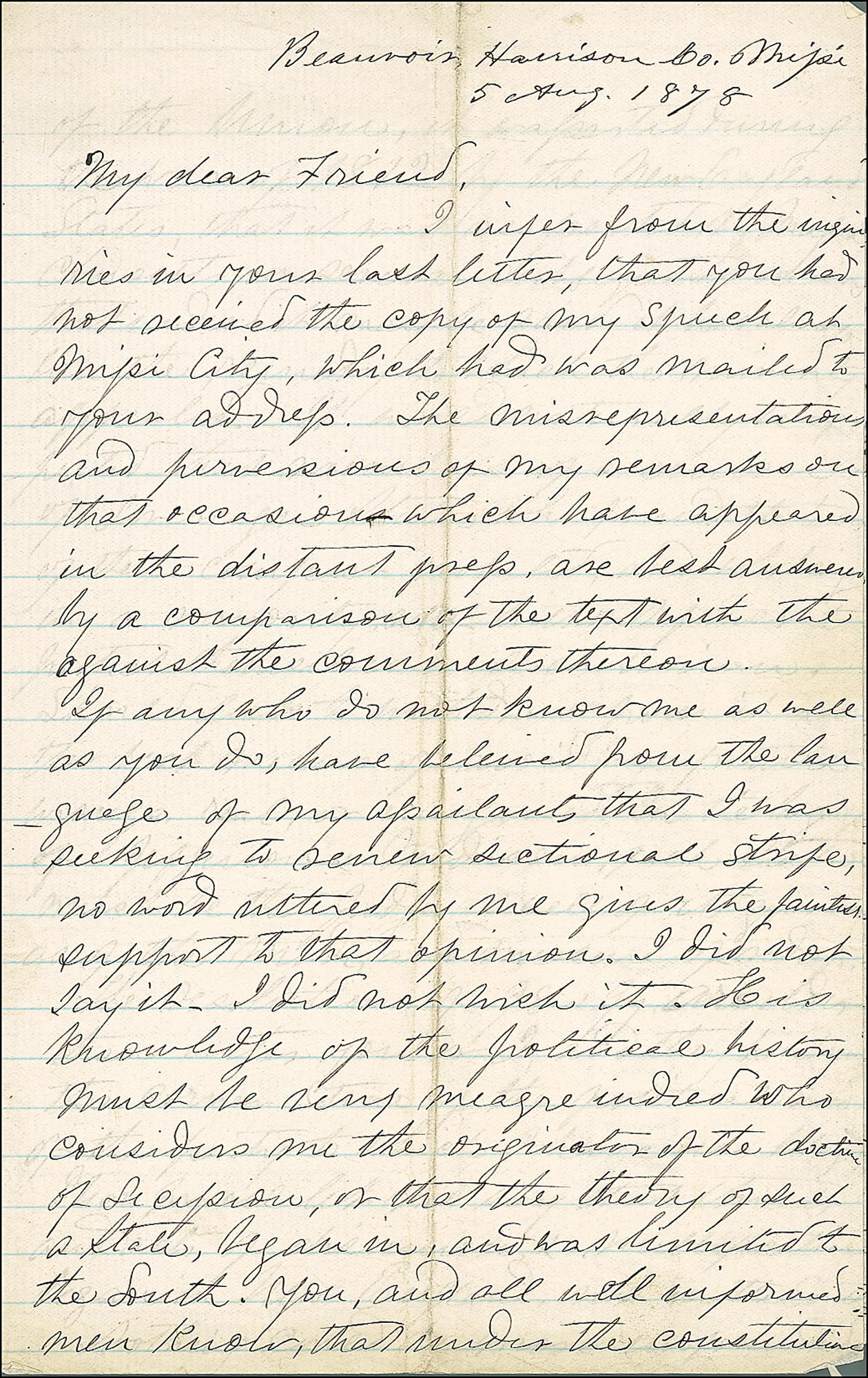
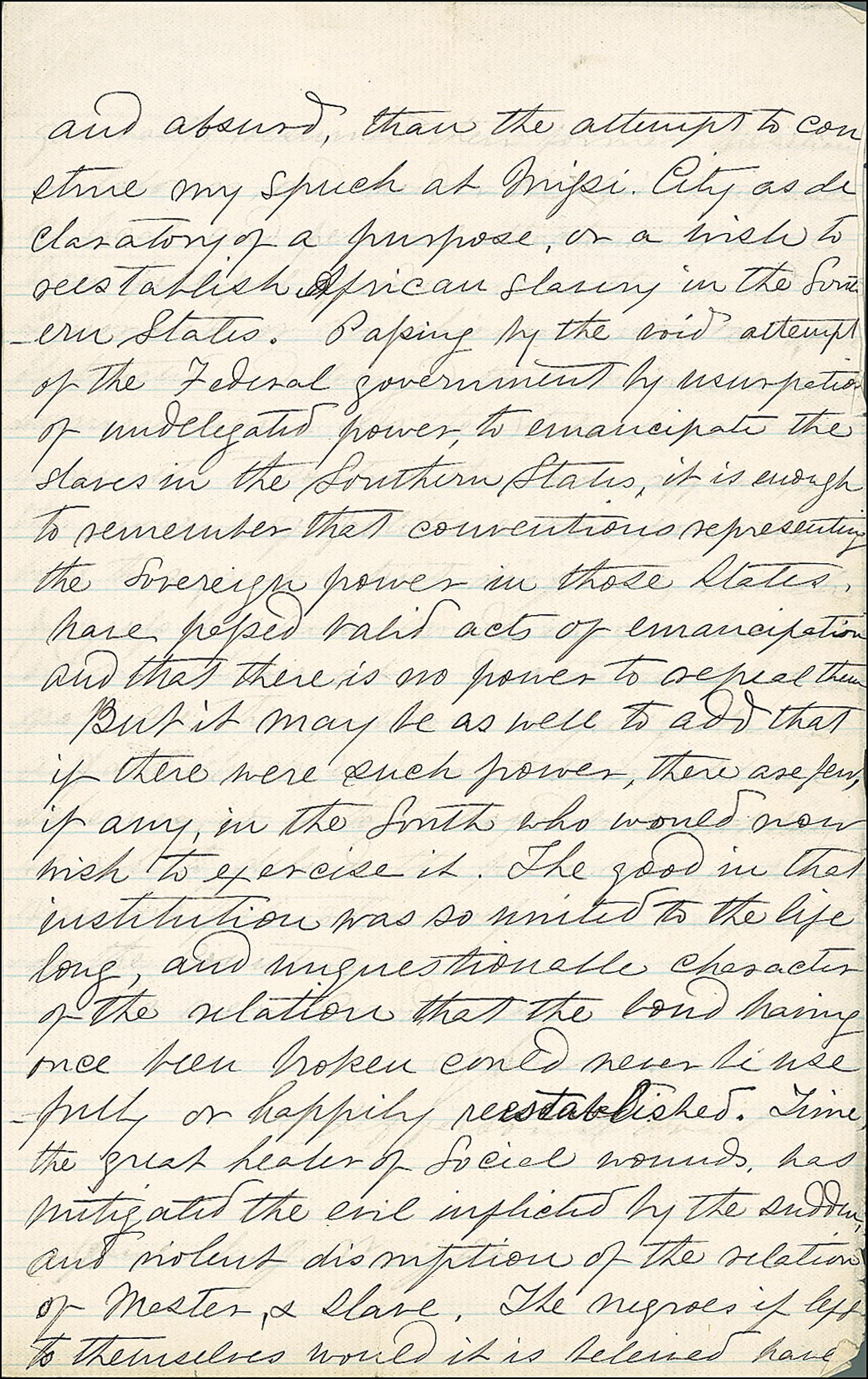
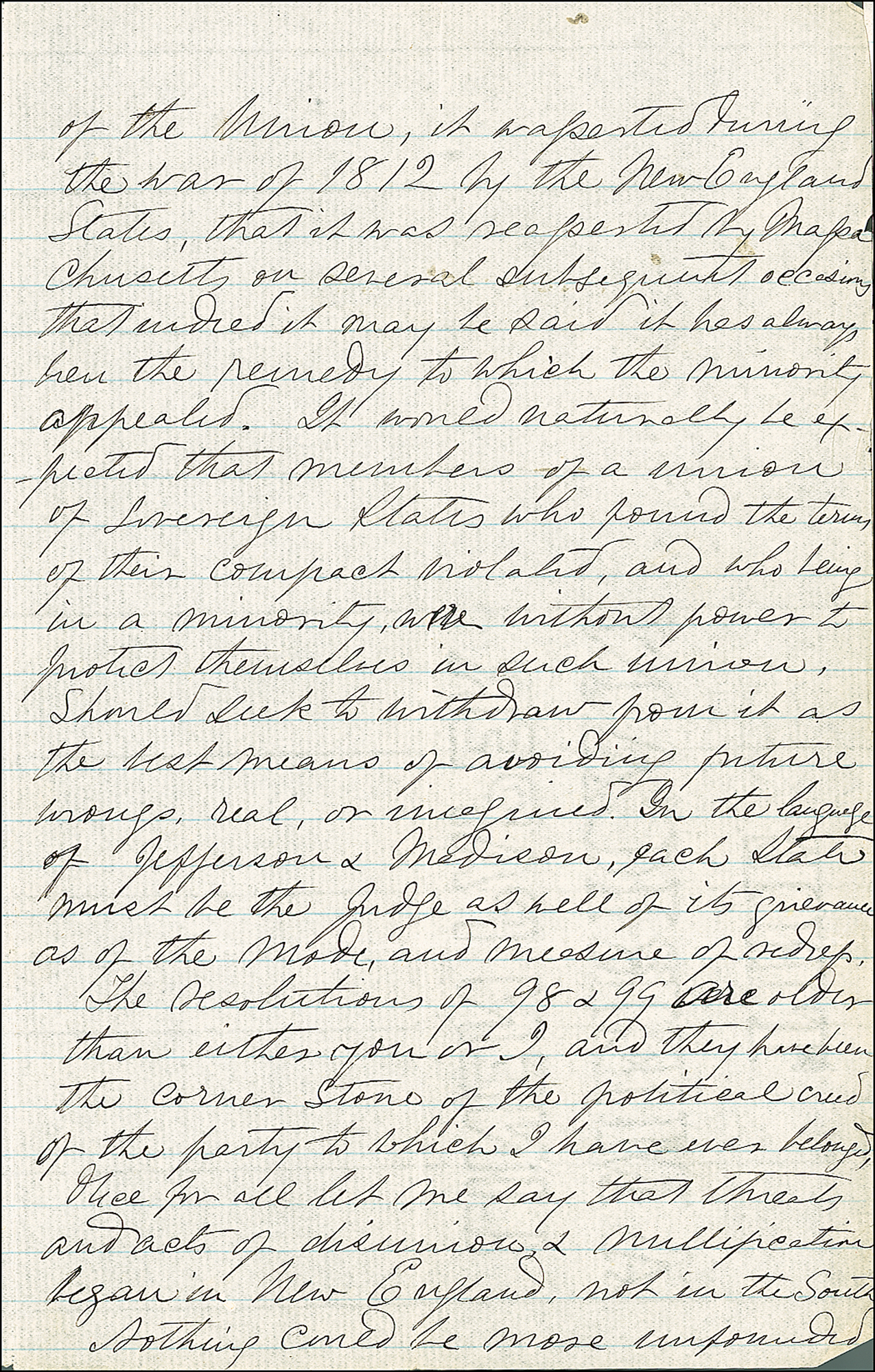
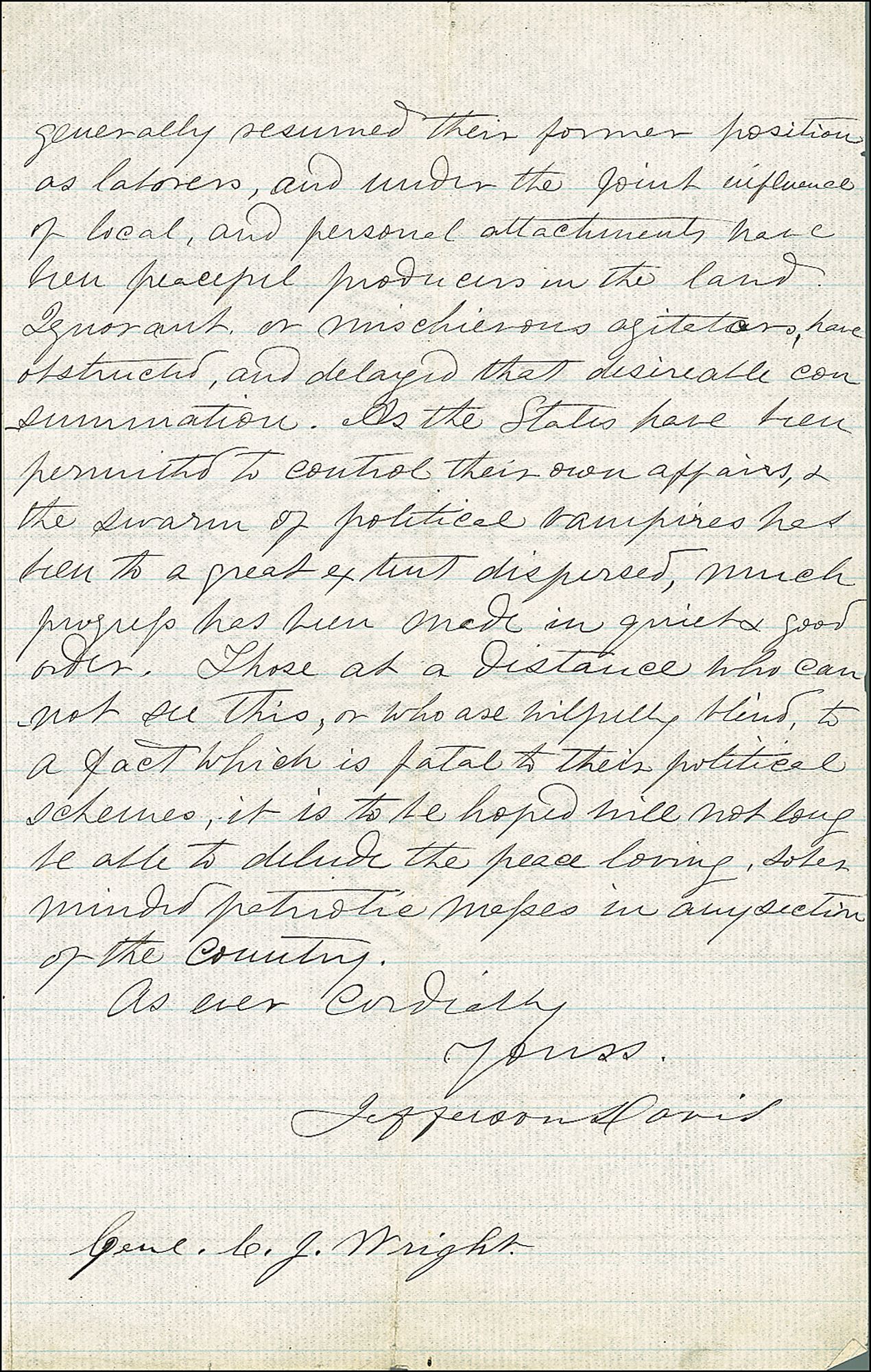
Extraordinary and highly important LS, penned in the hand of Davis’ wife and signed by him, “Jefferson Davis,” four lightly lined pages on two pairs of adjoining sheets, 6 x 9.5, August 5, 1878. A revealing, historically significant letter to Davis’ longtime friend and frequent correspondent, General Crafts J. Wright, who had been his roommate at West Point in the 1820s. In part: “I infer from the inquiries in your last letter, that you had not received the copy of my speech at Missi. City, which was mailed to your address. The misrepresentations and perversions of my remarks on that occasion which have appeared in the distant press are best answered by a comparison of the text with the against [sic] of the comments thereon. If any who do not know me as well as you do, have believed from the language of my assailants that I was seeking to renew sectional strife, no word uttered by me gives the faintest support to that opinion. I did not say it. I did not wish it. His knowledge of the political history must be very meagre indeed who considers me the originator of the doctrine of secession, or that the theory of such a state, began in, and was limited to, the South…. Indeed it may be said it has always been the remedy to which the minority appealed. It would naturally be expected that members of a union of Sovereign States who found the terms of their compact violated, and who being in a minority, were without power to protect themselves in such union, should seek to withdraw from it as the best means of avoiding future wrongs, real, or imagined. In the language of Jefferson & Madison, each State must be the judge as well of its grievance as of the mode, and measure of redress…. Nothing could be more confounded and absurd, than the attempt to construe my speech at Missi. City as declaratory of a purpose, or a wish to reestablish African slavery in the Southern States. Passing by the void attempt of the Federal government by usurpation of undelegated power, to emancipate the slaves in the Southern States, it is enough to remember that conventions representing the sovereign power in those States, have pressed valid acts of emancipation and that there is no power to repeal them…. Time, the great healer of social wounds, has mitigated the evil inflicted by the sudden, and violent disruption of the relation of master & slave. The negroes if left to themselves would it is believed have generally resumed their former position as laborers, and under the joint influence of local, and personal attachment have been peaceful producers in the land…. As the states have been permitted to control their own affairs, & the swarm of political vampires has been to a great extent dispersed, much progress has been made.” This letter was originally part of the fabled Oliver R. Barrett Lincoln Collection (the subject of a notable book by Carl Sandburg) and sold at Parke-Bernet Galleries on February 20, 1952. In fine condition, with usual folds, mild scattered soiling, and a touch of edge wear and wrinkling. COA John Reznikoff/PSA/DNA and R&R COA.

