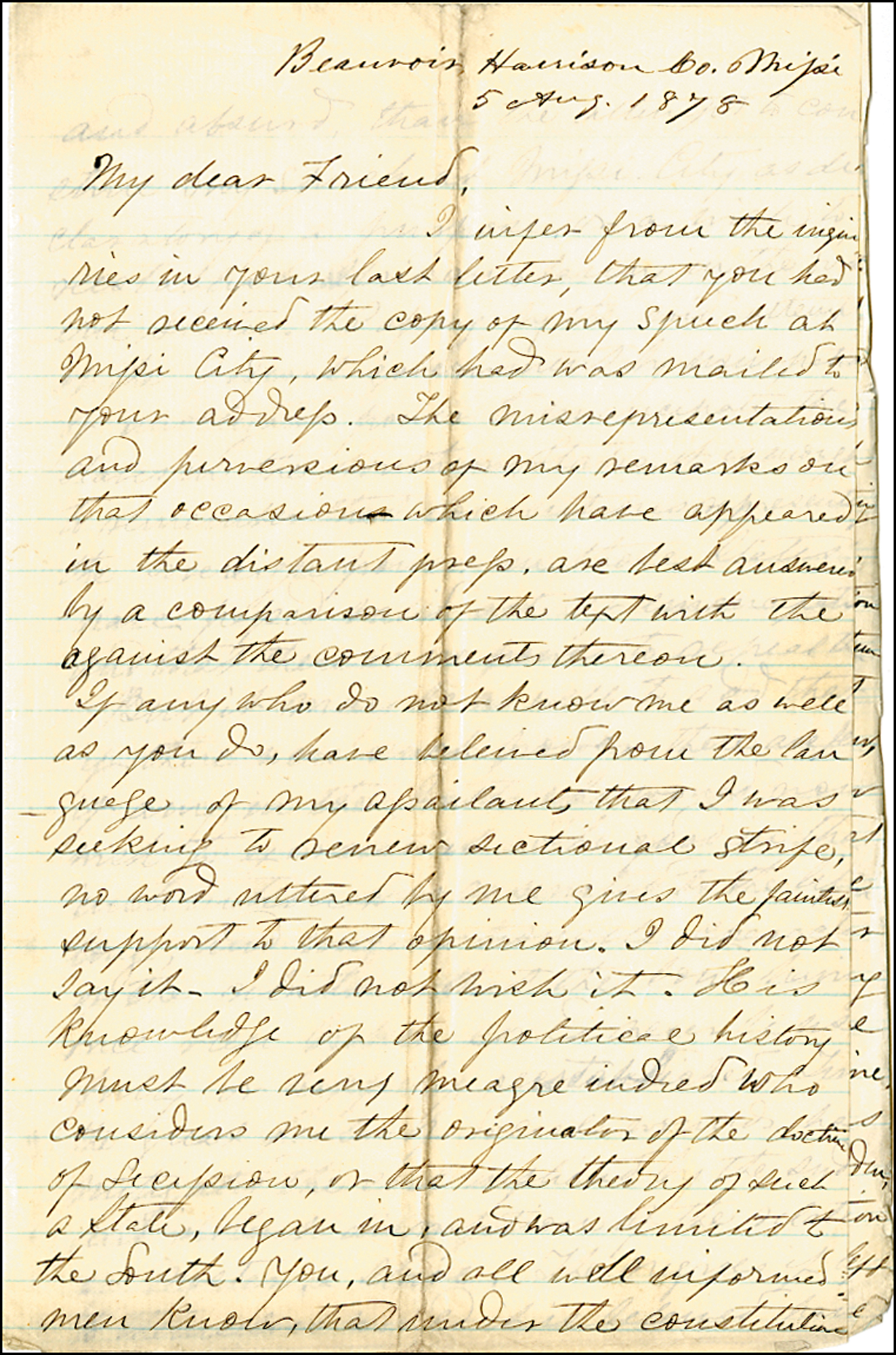
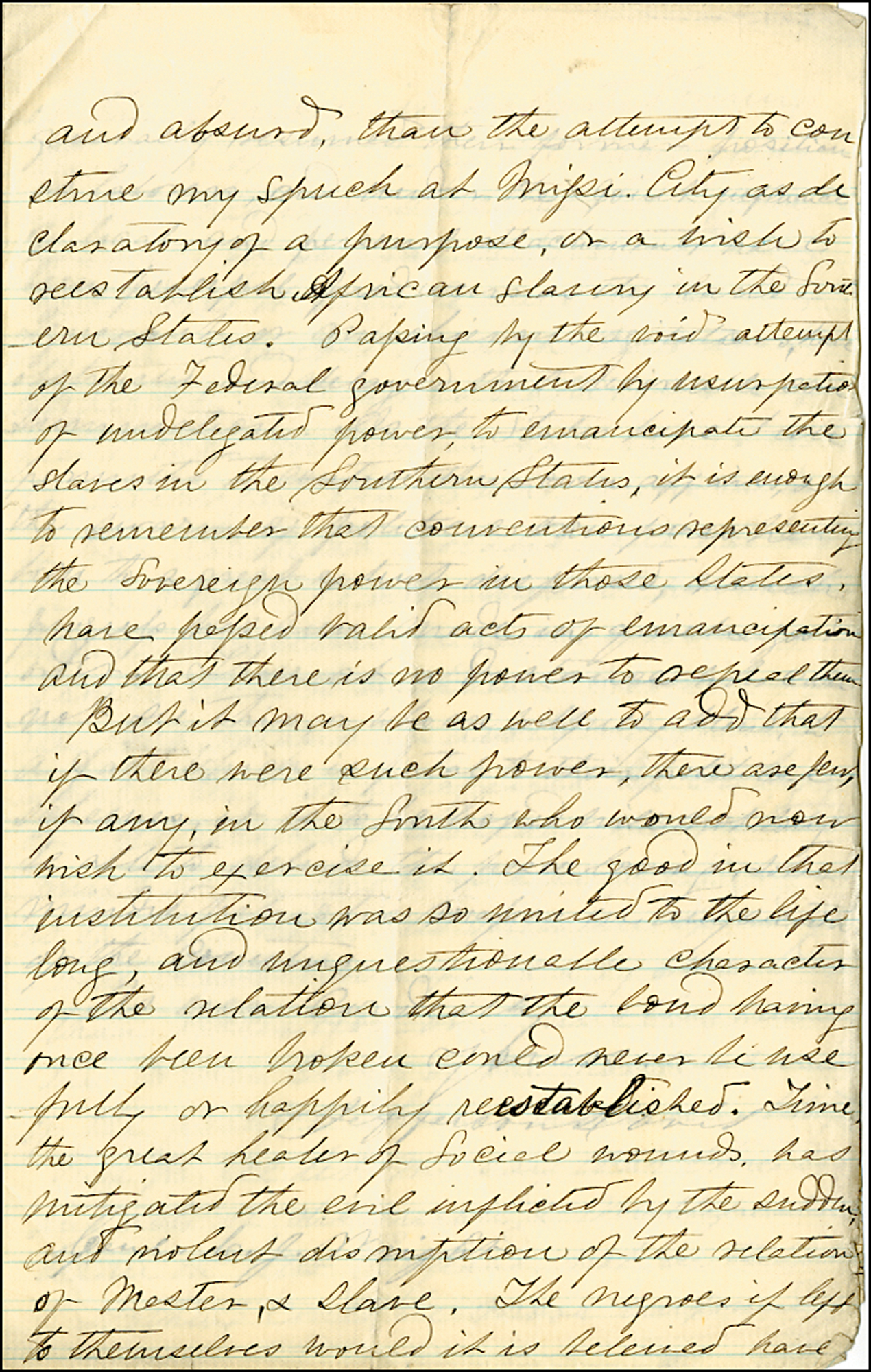
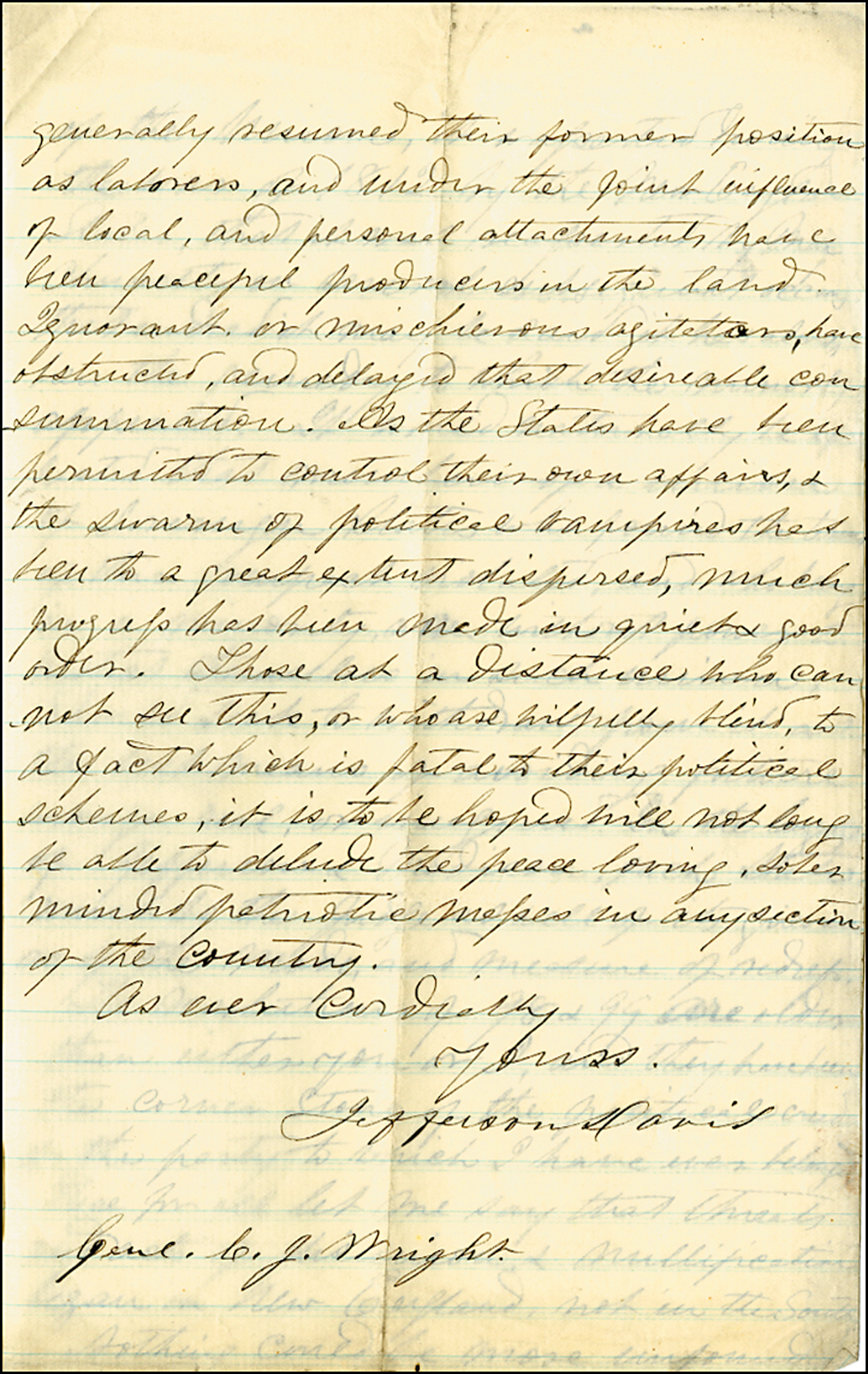
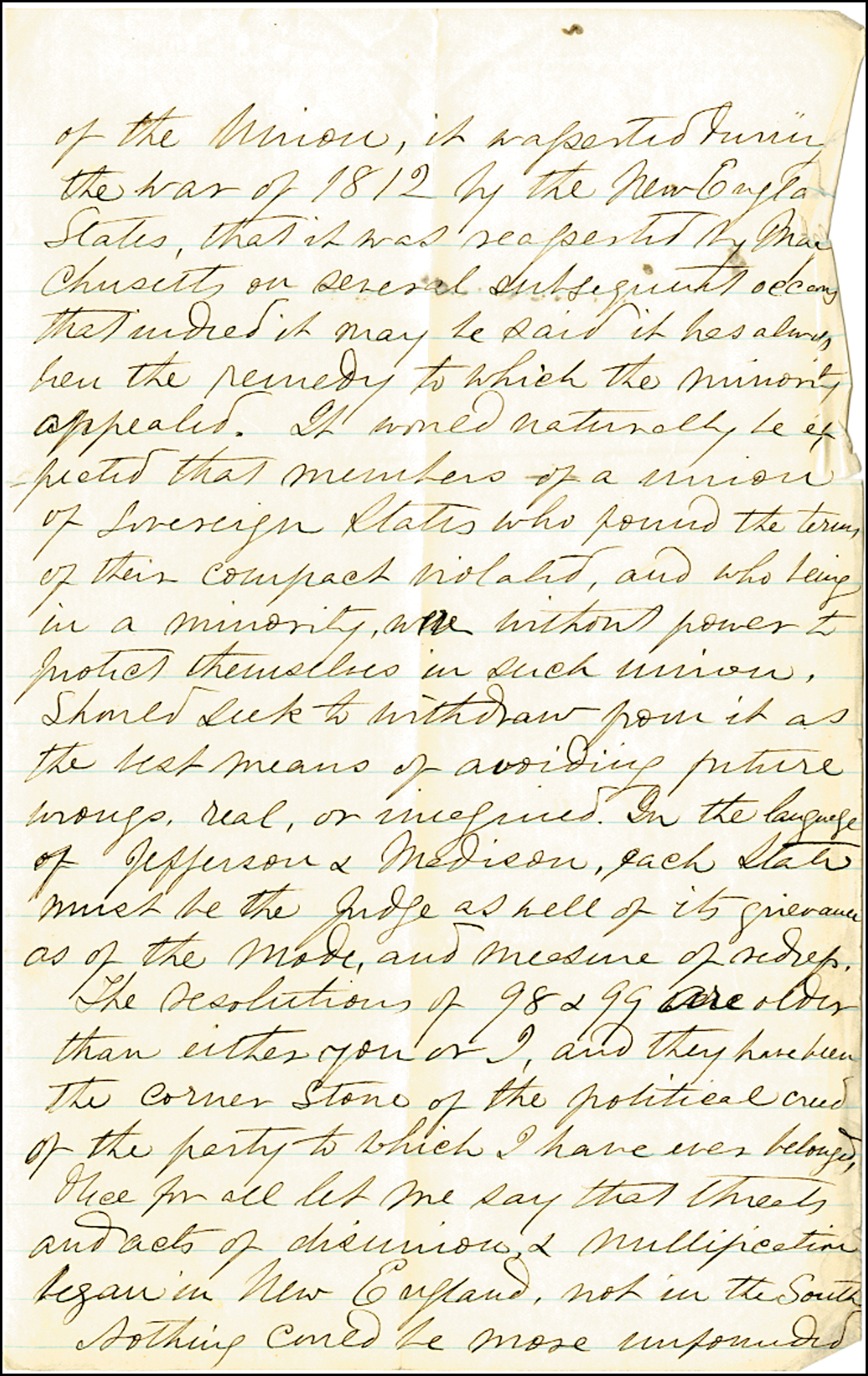
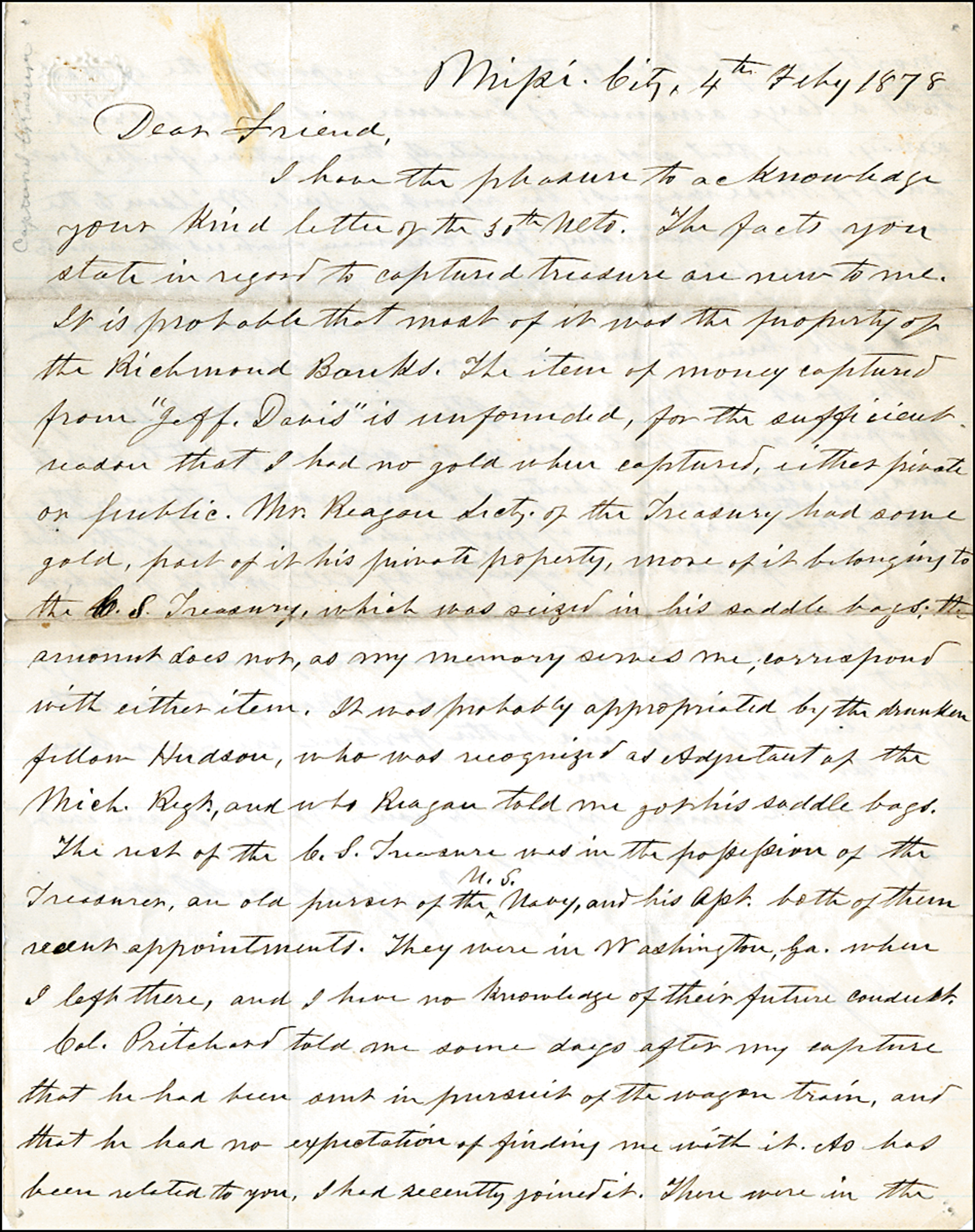
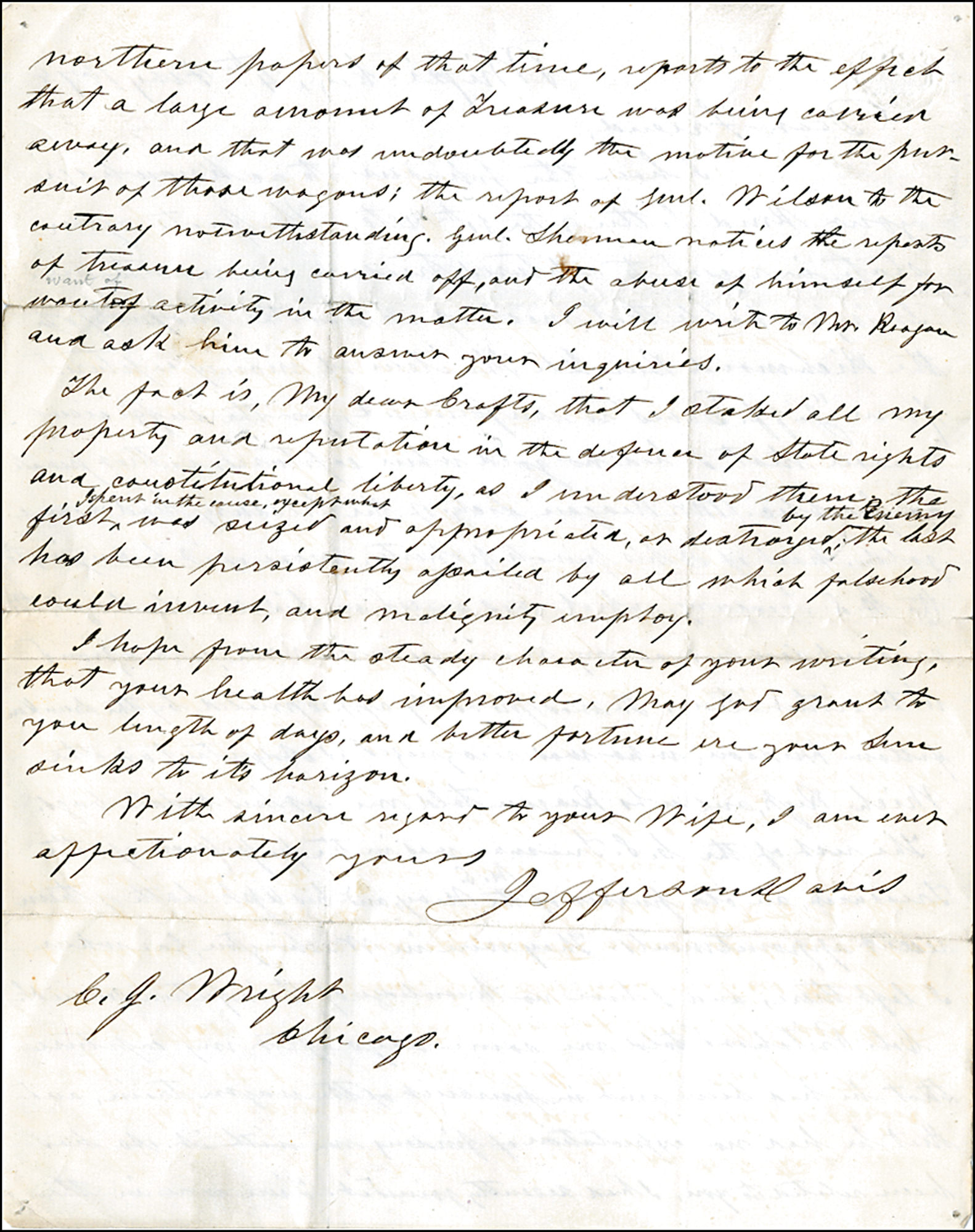
Fascinating and historically significant ALS, one page both sides, 7.75 x 9.75, February 4, 1878. Davis writes from Mississippi City to his frequent correspondent, C. J. Wright, in Chicago. In part: “The facts you state in regard to captured treasure are new to me. It is probable that most of it was the property of the Richmond Banks. The item of money captured from ‘Jeff. Davis’ is unfounded, for the sufficient reason that I had no gold when captured, either private or public. Mr. [John H.] Reagan Secty. of the Treasury had some gold, part of it his private property, most of it belonging to the C. S. Treasury, which was seized in his saddle bags: the amount does not, as my memory serves me, correspond with either item. It was probably appropriated by the drunken fellow [Captain Charles T.] Hudson, who was recognized as Adjutant of the Mich. Regt., and who Reagan told me got his saddle bags. The rest of the C. S. Treasure was in the possession of the Treasurer, an old purser of the U. S. Navy, and his Apt. both of them recent appointments. They were in Washington, Ga. when I left there, and I have no knowledge of their future conduct. Col. [B. D.] Pritchard told me some day after my capture that he had been ... in pursuit of the wagon train, and that he had no expectation of finding me with it. As had been related to you, I had recently joined it. There were in the northern papers of that time, reports to the effect that a large amount of Treasure was being carried away, and that was undoubtedly the motive for the pursuit of those wagons; the report of Genl. [James H.] Wilson to the contrary notwithstanding, Genl. Sherman notices the reports of treasure being carried off, and the abuse of himself for want of activity in the matter. I will write to Mr. Reagan and ask him to answer your inquiries. The fact is ... that I staked all my property and reputation in the defense of State rights and constitutional liberty, as I understood them. The first I spent in the cause, except what was seized and appropriated, or destroyed by the Enemy; the last has been persistently assailed by all which falsehood could invent, and malignity employ.” Though he harbored vain hopes of a future for the Confederacy in the weeks following Lee’s surrender at Appomattox, Davis was eventually forced to abandon the CSA capital in Richmond, setting up a temporary headquarters in Danville and eventually fleeing Virginia altogether. Davis, along with several CSA cabinet members (some of whom he alludes to above), was finally captured in Irwinsville, Georgia by the Fourth Michigan cavalry on May 10, 1865. The northern press crowed over this final fatal blow to the Confederate government, and Davis was mercilessly ridiculed in the press. Though he was merely wearing his wife’s overcoat and shawl as a disguise at the time of his arrest, he was painted as having been discovered in full ladies’ finery, inspiring scores of satirical cartoons, souvenirs, and such novelty songs as “Jeff in Petticoats.” He was imprisoned for two years in Fort Monroe, Virginia, during which time the harsh conditions provoked much sympathy and outrage in the north as well as the south. He was finally released in May 1867 on a $100,000 bond raised by prominent supporters, including Horace Greeley and Cornelius Vanderbilt. Though charges against him were dropped by the U.S. government on the basis of Constitutional concerns, neither his health nor his finances ever fully recovered, and he died in much-reduced circumstances on December 5, 1889. This letter was originally part of the fabled Oliver R. Barrett Lincoln Collection (the subject of a book by Carl Sandburg) and sold at Parke-Bernet Galleries on February 20, 1952. In fine condition, with mild toning, light scattered soiling, and folds (a few clean edge separations touching a few words). COA John Reznikoff/PSA/DNA and R&R COA.

