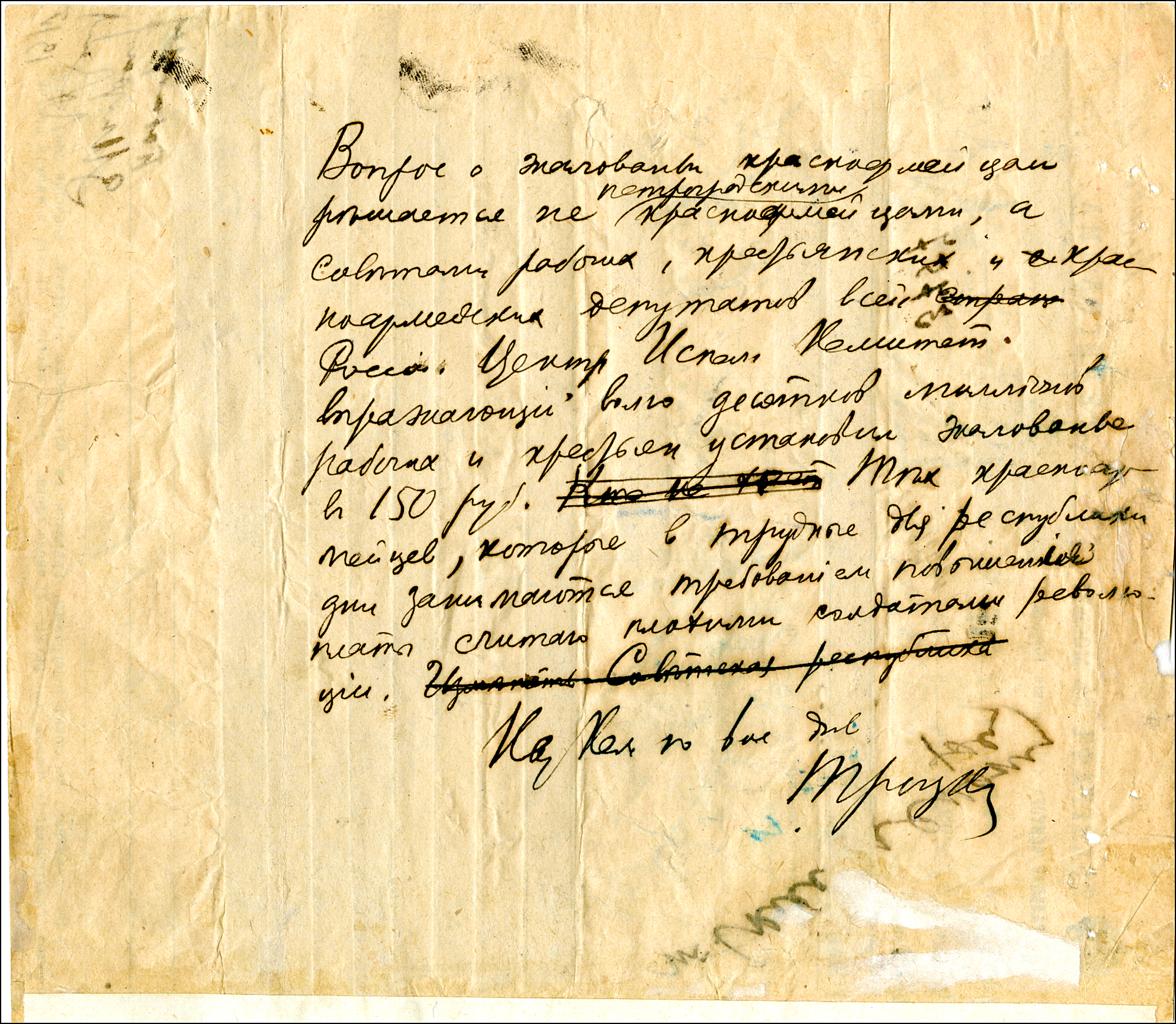
Russian Communist leader who, with Lenin, organized the Bolshevik seizure of power during the October Revolution of 1917. In 1929, after Lenin’s death, Stalin defeated Trotsky for control of the Communist party and banished him from Russia. Trotsky spent most of the remainder of his life in Mexico, where he was assassinated in 1940. Scarce and interesting ALS in Russian, one page, 9.25 x 8.25, on the reverse of a printed telegram, 1918. Trotsky responds to the telegram printed on the reverse side, which reads [translated]: “The second Petrograd conference of the Red Army decided to establish a salary of 350 rubles per month for the Red Army. The commission of all regions were informed that this decision was sent to you in Moscow. Simultaneously it was confirmed as an execution of the decree number 250. Please give us an answer which can be given to all Red Army divisions.” Trotsky’s handwritten reply: “The question about the salary of the Red Army soldiers can not be decided by the Petrograd Red Army, but by the … workers, farmers, and Red Army deputies of all Russia. The Central … Committee expressing the will of the … workers and farmer established the salary at 150 rubles. Those Red Army soldiers who, in the difficult days of the Republic, demand a higher salary, I consider bad soldiers of the Revolution.” In very good condition, with toning and scattered spotting, folds, wrinkling, a few mounting remnants and archivally repaired tears (the latter touching a few words), a few small holes and chips, and ink show-through partly visible behind Trotsky’s signature, the writing nonetheless remaining clear, dark, and mostly unaffected. COA John Reznikoff/PSA/DNA and R&R COA.

