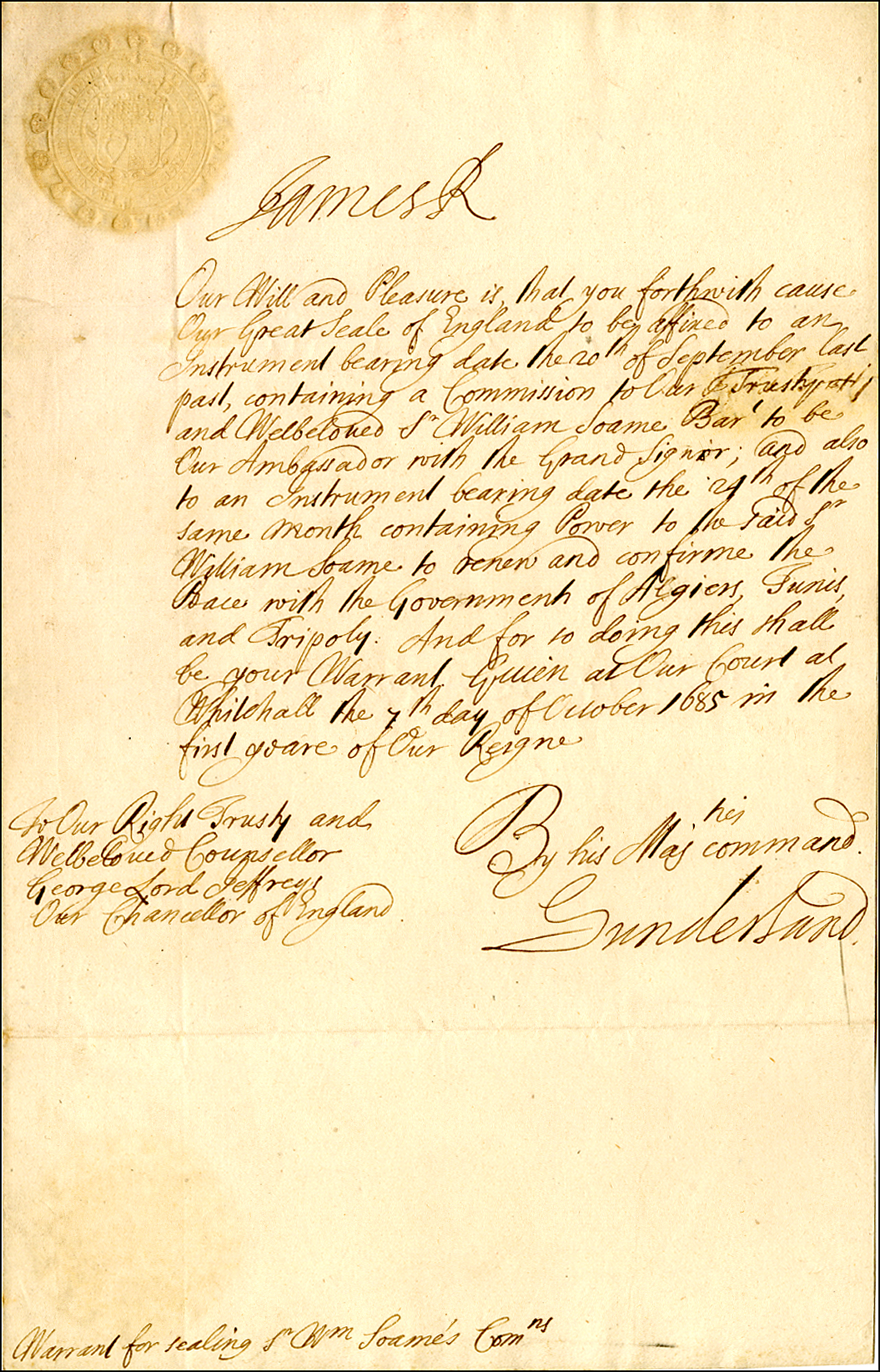
Became King of England, King of Scots, and King of Ireland in 1685. He was the last Catholic monarch to reign over the Kingdom of England, Kingdom of Scotland, or Kingdom of Ireland. Some of his subjects distrusted his religious policies and alleged despotism, leading a group of them to depose him in the Glorious Revolution. DS, signed “James R,” one page, 7.5 x 12, October 7, 1685. Document sent to Judge George Lord Jeffreys, ordering him to affix the “Great Seal of England,” to the appointment of Sir William Soame “our ambassador with the Grand Signor; and also to an instrument bearing date of the 24th same month containing power to said Sir William Soame to renew and confirm the Peace with the Government of Algiers, Tunis and Tripoly.” Signed along the top by James and countersigned by Robert Spencer, the Earl of Sunderland. The Barbary pirates operated out of Tunis, Tripoli, Algiers, Salè and ports in Morocco, preying on shipping in the western Mediterranean Sea from the time of the Crusades as well as on ships on their way to Asia around Africa until the early 19th century. Their stronghold was along the stretch of northern Africa known as the Barbary Coast (a medieval term for the Maghreb after its Berber inhabitants), although their predation was said to extend as far north as Iceland, and south along West Africa's Atlantic seaboard. As well as preying on shipping, raids were often made on European coastal towns. The pirates were responsible for capturing large numbers of Christian slaves from Western Europe, who were sold in slave markets in places such as Morocco. Sultan Moulay Ismail had a very substantial fortified palace built almost entirely by Christian slave labour obtained through the actions of Barbary pirates. In fine condition, with light folds and a small area of discoloration to right side, lightly affecting a couple words of text. COA John Reznikoff/PSA/DNA and R&R COA.

