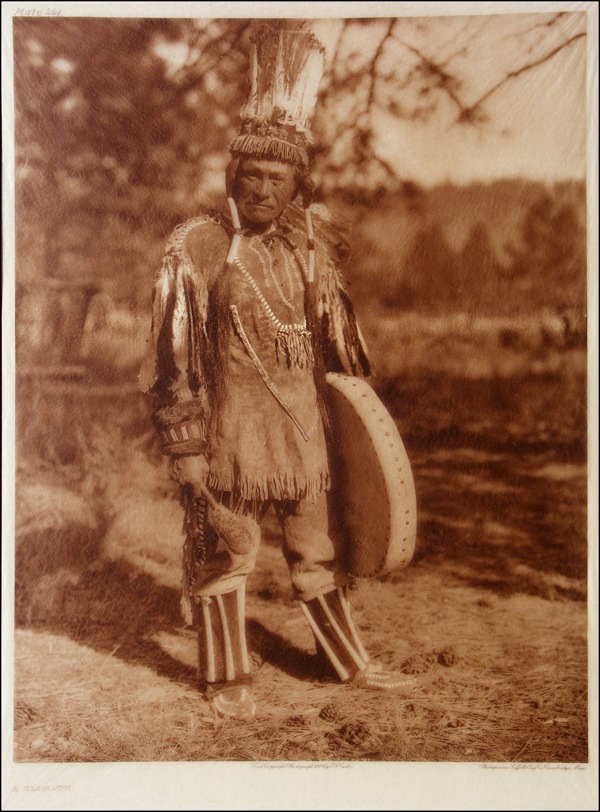
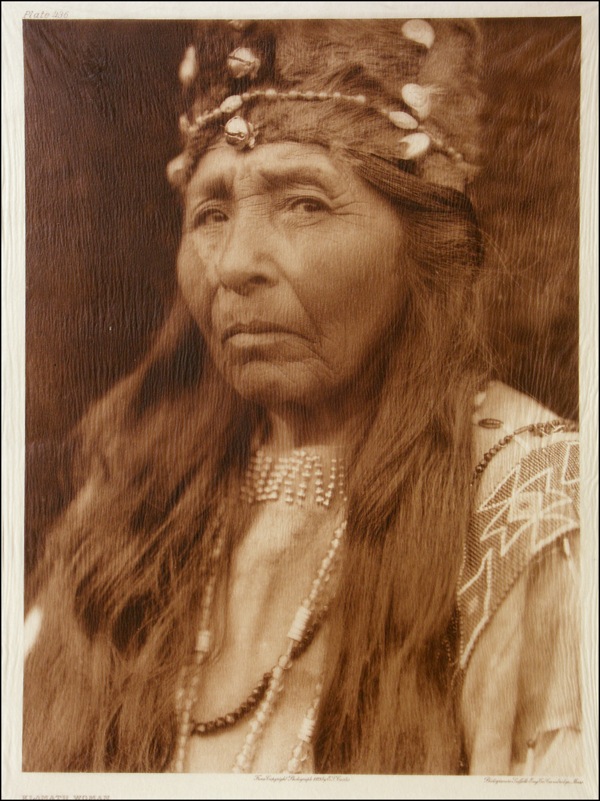
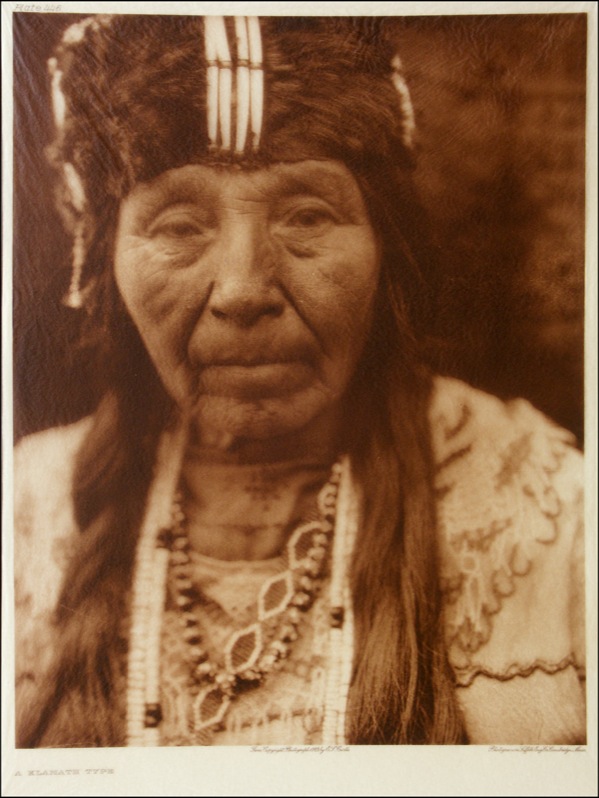
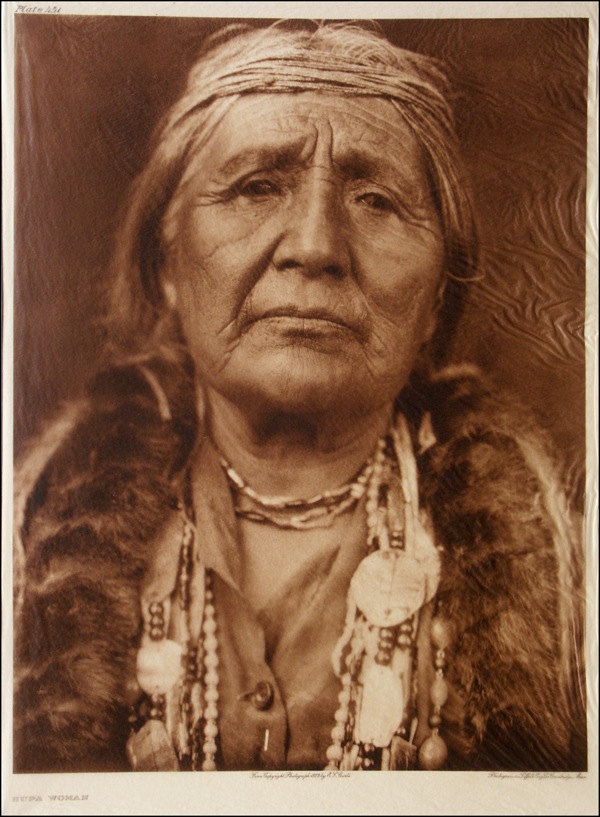
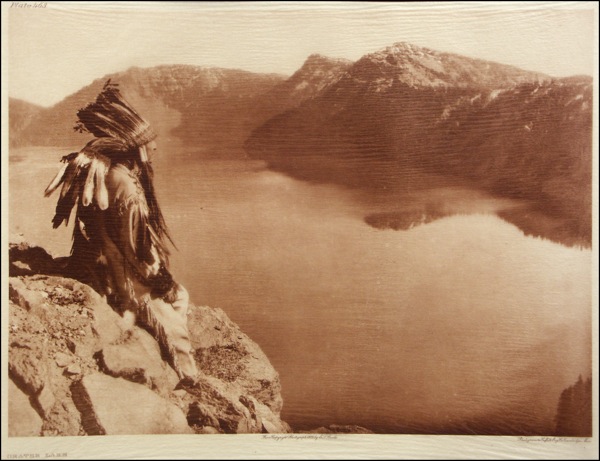
Edward Sheriff Curtis’ The North American Indian: List of Large Plates Supplementing Volume Thirteen. Thirty-six large sepia photogravure plates, 12 x 16 printed on tissue sheets window matted on 18 x 22 paper, enclosed in paper wrappers; unbound as issued in original folding portfolio of brown half-morocco over tan buckram; string ties; letterpress broadsheet list the plates with brief descriptions, also enclosed in wrapper. One of 20 original volumes of large portfolios printed to accompany the 20 bound volumes of Curtis’ The North American Indian, that incorporated the smaller full-page gravures. Approximately 1500 images in number [8 x 10 to 11 x 14] with accompanying text issued from 1907 to 1930. Cambridge, MA: Edward S. Curtis, [1923]. First Edition Howes C965, Witkin & London 116-117, Roth. Book of 101 Books. It is difficult to comprehend the enormity of the 30 year project that is The North American Indian, Being a Series of Volumes Describing the Indians of the United States and Alaska. Curtis’ amazing journey had already found him traveling some 9,000 miles, taking more than 5,000 photographs as official photographer for the 1899 Harriman Alaska exploration expedition in the company of ethnologist George Bird Grinnell, Dr. C. Hart Merriam - chief of the U.S. Biological Survey, ornithologist John Burroughs and Naturalist John Muir. Out of the experiences of the two month trip with the expedition, came the ambition to photograph American Natives in a way that captured as much of their vanishing aboriginal lifestyle as possible. A grand concept began to take shape that envisioned a multi-volume set which Curtis estimated would take 15 years to complete. President Theodore Roosevelt became interested followed by the support of J. Pierpont Morgan who would eventually agree to finance the project for five years at $15,000 per annum. By the time the last volume was issued in 1930, it had taken twice as long at a cost of 1.5 million, half of which was funded by Morgan. For those long years Curtis had visited more than eighty tribes, taking 40,000 pictures. Some of this pictures took years of planning, between scouting locations, cultivating the participation of his subjects, and gathering artifacts used to set the scene. To say the least, Curtis was a perfectionist. The result was one of the largest photo-documentaries ever produced by one artist, an enduring recreation of the real as well as the mythological life of a people. Even so, the acclaim quickly subsided after the publication of the final volume. Native American studies by now were not in fashion and little attention was paid to the work for the next 40 years. It did not help that the publication date of the last volume coincided with the beginning of the Great Depression so that out of a planned 500 sets, best estimates are that 272 were ever assembled, and at a price of $3,000.00, only a handful of individuals and institutions were able to purchase them. Furthermore, when they were rediscovered, they met with criticism of aspects such as what now seemed like an overly romanticized style, and the very fact that they were often staged with props like wigs that Curtis carried with him to the shootings. Understood now as an enduring masterpiece, the result of the painstaking work of an artist with intense and passionate commitment to his subject, are here reflected in 37 beautiful, large examples projecting as precisely as possible the vision of a disappearing culture. Images include portraits and costume, scenes of fishing and hunting, depiction of the making and use of basketry, tools, fish-weirs and canoes. R&R COA. Oversized.

