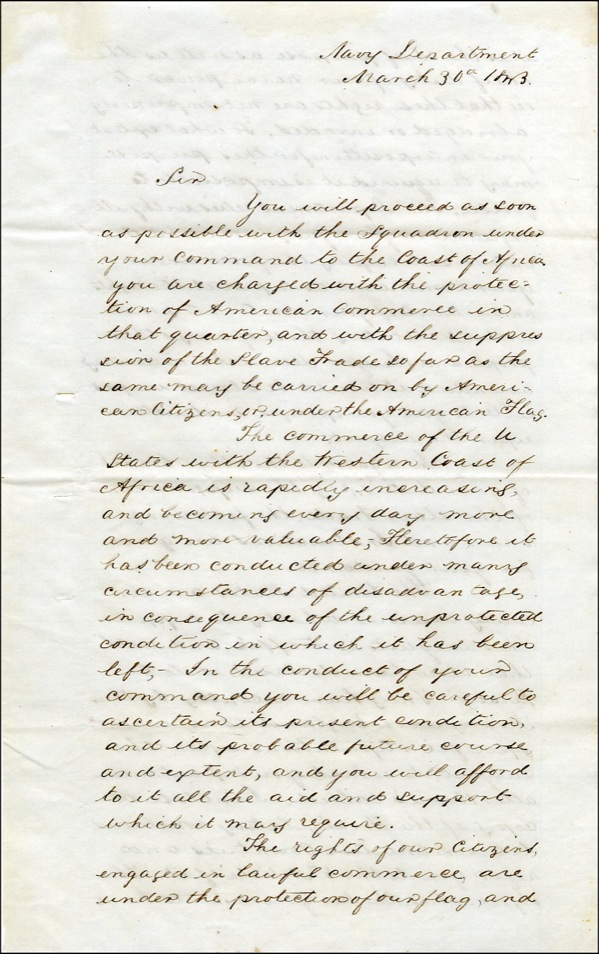
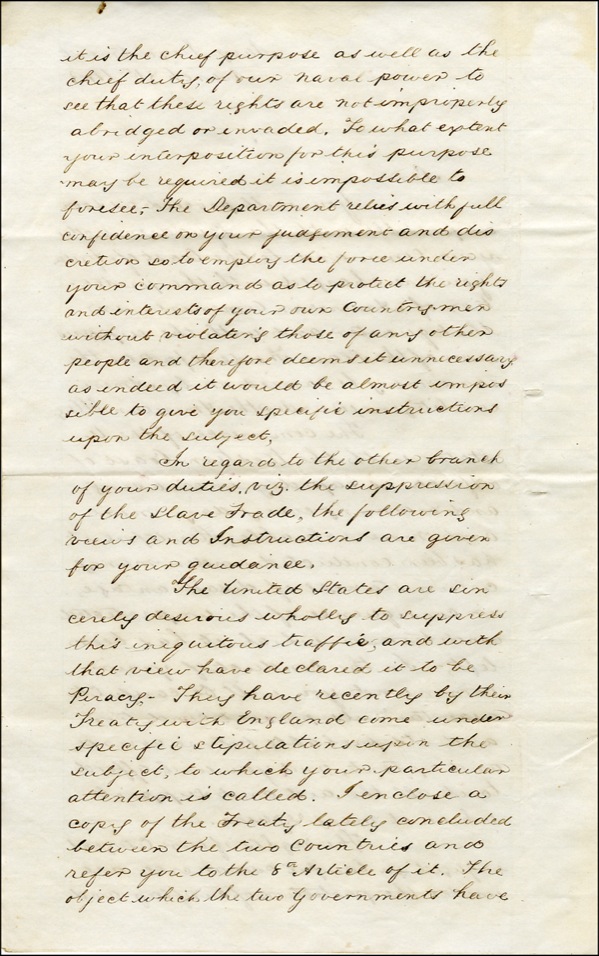
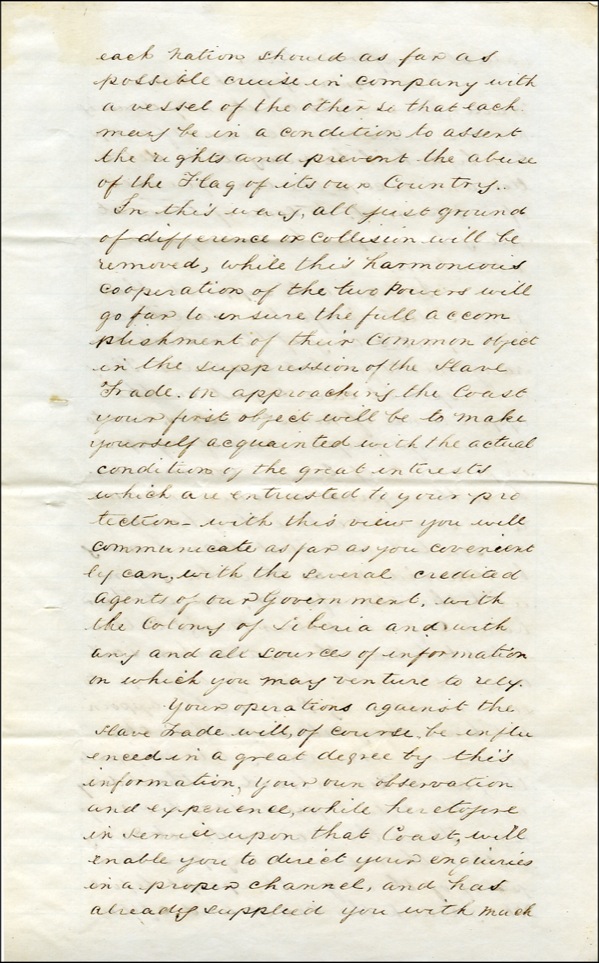
Naval officer and commander of the squadron sent to Japan in the 1850s to negotiate the treaty which opened up that country to commerce with the West. DS, signed “M. C. Perry, Com. African Squadron,” seven pages, 8.25 x 12.5, no date, circa 1843-1844. Extracts from ”Gen. Instructions from Hon. A. P. Upsur addressed to Com. Perry transmitted to Lt. A. Lewis.” In part, “The commerce of the US with the Western Coast of Africa is rapidly increasing…The rights of our citizens engaged in lawful commerce are under the protection of our Flag, and it is in the chief purpose as well as the chief duty, of our naval power to see that these rights are not improperly abridged or invaded…The Dept. relies with full confidence on your judgement…to protect the rights of your own countrymen, without violating those of any other people…In regard to the other branch of your duties viz; the suppression of the slave trade…The US are sincerely desirous wholly to suppress this iniquitous traffic; and with that view have declared it to be piracy…I enclose a copy of the treaty lately concluded with England…plain language…I… impress upon you the importance of strictly observing…and of preserving inviolate the pledged faith of your country upon this point…This government does not acknowledge a right in any other to visit and detain the vessels of American citizens engaged in commerce. By the general consent of all civilized nations vessels suspected of acts which are piracy…may be visited for the purpose of ascertaining their true character…of this latter character is the Slave Trade which is declared to be piracy by Act of Congress…The US in stipulating to keep a squadron of not fewer than 80 guns in the Coast of Africa, meant to give to England and all the world an assurance of her determination and ability to protect her own flag against abuse…you may find it convenient to make for cooperation with British cruizers [sic]…should cruize [sic] in company with a vessel of the other…assert the rights and prevent the abuse of the flag of its own country…harmonious cooperation…will go far to insure…the suppression of the Slave Trade. It is not to be supposed that vessels destined for the Slave Trade will exhibit any of the usual arrangements for that business. They take special care to put on the appearance of traders…It is their practice to run into some river or inlet where they have reason to believe slaves may be obtained, make their bargain with the slave factor, deposit their handcuffs and other things calculated to betray them and then sail on an ostensible trading voyage…at the appointed time they return and as the slaves are then ready to be shipped they are taken on board without delay and the vessel proceeds on her voyage. Thus the slavers do not carry within themselves any positive proof of their guilt…before they reach the coast and after they leave it with slaves on board…positive proof of their guilt…double sets of papers…an unusual number of water casks…The log book should be particularly examined…common practice among slavers to keep two logs…By exhibiting the false log they represent themselves…as not to expose them to the suspicion of slave trading…The shipping list may afford strong presumptive evidence…the great exposure, hardships and hazards of the slave trade he wages the sailors engaged in it are generally much higher. Consular certificates are often forged in lieu of the usual Consular seal, the impression is made with an American half-dollar…the artful character of the adversaries with whom you have to deal…the reckless disregard of all truth and honor as well as of law and humanity…the United States sincerely desire the suppression of the Slave Trade…they are not prepared to sacrifice to it any of their rights as an independent nation…the flag of the US has been often used to cover the traffic in slaves.” Accompanied by a twelve page letter of instruction from William P. Roagen, dated March 30, 1843, sent to the Coast of Africa. In fine condition, with expected folds, a bit of scattered mild toning and a few gentle wrinkles. COA John Reznikoff/PSA/DNA and R&R COA.

