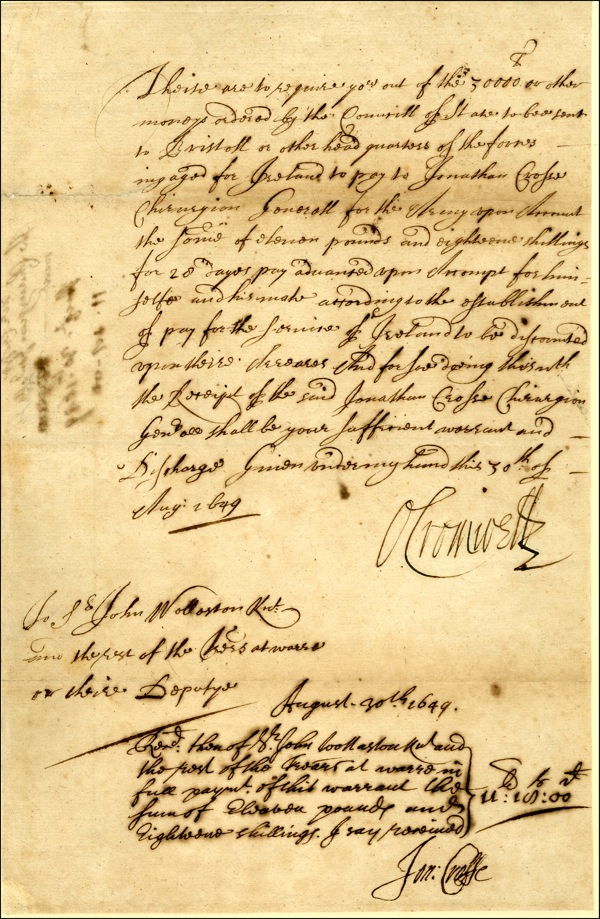
English soldier and statesman who led Parliamentary forces in the English Civil War, waged war against Scotland and Ireland and was installed as Lord Protector of England, Scotland and Ireland in 1653. LS signed “O. Cromwell,” one page, 7.25 x 11, August 30, 1649. Letter requesting funds to pay the Surgeon General of his army. In part, “These are to require you out of the 30000 or other moneys ordered by the Council of State to be sent to Bristol or other headquarters of the forces engaged for Ireland to pay to Jonathan Crosse, Chirugion General for the Army upon account the sum of eleven pounds and eighteen shillings for 20 days pay advanced upon…for himself and his mate according to the establishment of pay for the service of Ireland to be discounted…and for so doing this with the receipt of the said Jonathan Crosse, Chirugion General shall be your sufficient warrant and discharge.” Boldly signed at the conclusion in black ink by Cromwell, and signed at the bottom upon receipt of payment by Crosse. This letter was written two weeks after Cromwell arrived in Dublin, and only one day before he embarked on his march to Drogheda, where a famous battle occurred. The Parliamentarian army swept through the town of Drogheda, slaughtering officers and soldiers. The Royalist governor Sir Arthur Aston was bludgeoned to death with his own wooden leg, which the soldiers believed to be filled with gold coins. Catholic priests and friars were treated as combatants and killed on sight. Many civilians died in the carnage. A group of defenders who had barricaded themselves in St Peter's church in the north of the town were burned alive when the Parliamentarians set fire to the church. One month later he committed a similar act in Wexford. Commenting on the slaughter as Drogheda, Cromwell wrote, “I am persuaded that this is a righteous judgement of God upon these barbarous wretches who have imbrued their hands in so much innocent blood, and that it will tend to prevent the effusion of blood for the future, which are satisfactory grounds of such actions.” In very good condition, with letter having been professionally inlaid to a slightly larger sheet, scattered light toning and soiling, light show through from docketing on reverse, some blurring to the text but not Cromwell’s signature, and a few small pinprick holes from ink erosion. COA John Reznikoff/PSA/DNA and R&R COA.

