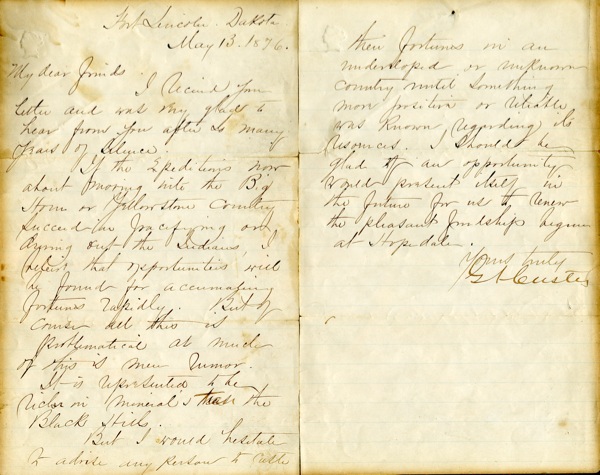
Civil War general and Indian fighter, Custer distinguished himself as a cavalry commander. He became a brigadier general of volunteers at age 23. Following the war he became field commander of the 7th Cavalry. He was killed with all in his immediate command in the battle of Little Bighorn on June 25, 1876. LS signed “G. A. Custer,” two lightly lined pages, 5 x 8, May 13, 1876. Letter addressed to “Dear friends,” written from Fort Lincoln, just two days before Custer would begin his final campaign against the Indians. In full, “I received your letter and was very glad to hear from you after so many years of silence. If the expedition now about moving into the Big Horn or Yellowstone Country succeed in pacifying or driving out the Indians, I believe that opportunities will be found for accumulating fortunes rapidly. But of course all this is problematical as much as of this is mere rumor. It is represented to be richer in minerals than the Black Hills. But I would hesitate to advise any person to caste their fortunes in an undeveloped or unknown country until something more positive or reliable was known regarding its resources. I should be glad if an opportunity would present itself in the future for us to renew the pleasant friendship begun at Hopedale.” Both pages of the letter are affixed to an 11.25 x 8.5 color cardboard image of two Native Americans working on a shield. The 7th Regiment rode out of Fort Lincoln on May 15, 1876, General Custer commanded his regiment in a campaign against the confederated Sioux tribes. The Indians were discovered encamped on the Little Big Horn River, in a region almost unknown. Eleven tribes, numbering nearly 9,000, had their villages on and in the vicinity of the Little Big Horn. The government expedition consisted of 1,100 men. The strength of the enemy not being known, General Custer was ordered to take his regiment and pursue a trail. He arrived at what was supposed to be the only Indian village on June 25, and an attack was made by a portion of the regiment numbering fewer than 200 cavalry, while General Custer, with 277 troopers, charged on the village from another direction. Overwhelming numbers met them, and General Custer, with his entire command, was slain. In very good condition, with partial separations along horizontal mailing folds, scattered light toning to first page, with even toning to edges of both pages, small tack hole to top of second page and some light wrinkles. COA John Reznikoff/PSA/DNA and R&R COA.

