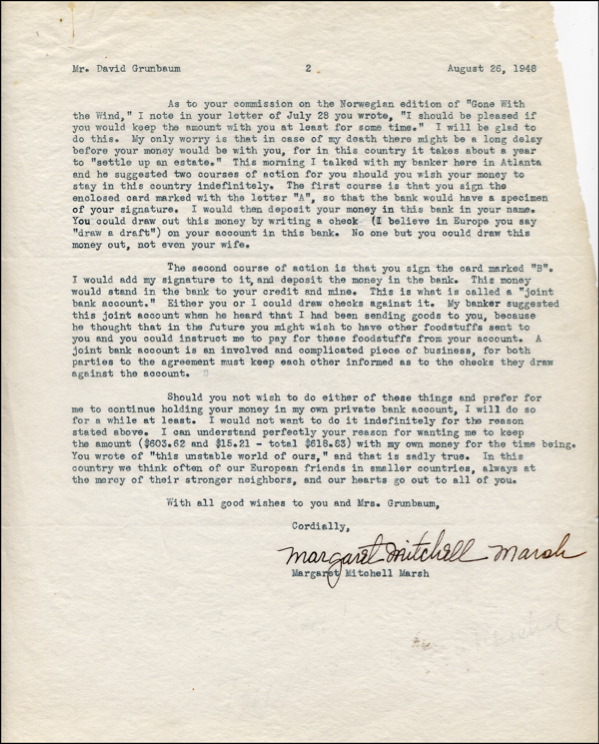
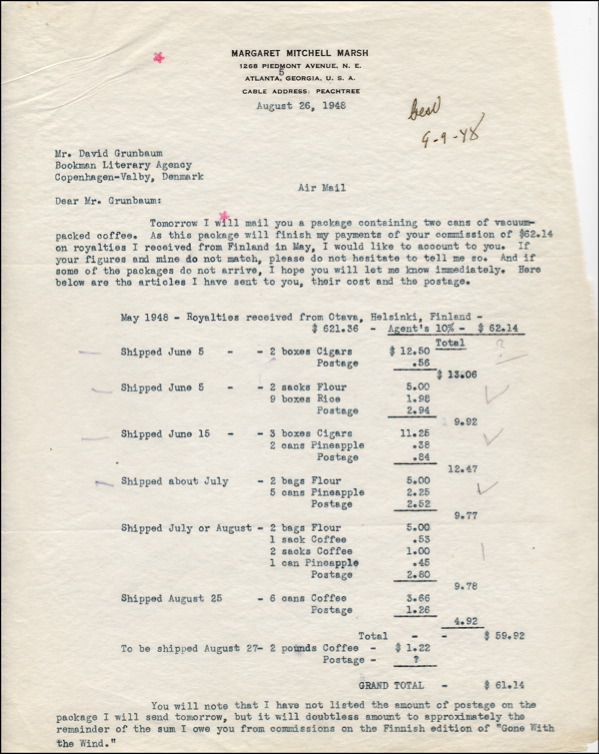
TLS signed “Margaret Mitchell Marsh,” two onionskin pages, 8.5 x 11, personal letterhead, August 26, 1948. Letter to a Finnish literary agent. “Tomorrow I will mail you a package containing two cans of vacuum-packed coffee. As this package will finish my payments of your commission of $62.14 on royalties I received from Finland in May, I would like to account to you. If your figures and mine do not match, please do not hesitate to tell me so. And if some of the packages do not arrive, I hope you will let me know immediately. Here below are the articles I have sent you, their cost and postage." Mitchell goes on to list items she has sent, their cost and postage. The items include sacks of flour, boxes of rice, cans of pineapple, cigars and coffee. She continues, "You will note that I have not listed the amount of postage on the package I will send tomorrow, but it will doubtless amount to approximately the remainder of the sum I owe you from commissions on the Finnish edition of ‘Gone With the Wind.’ The next page is a letter from Mitchell that was undoubtedly attached to this list which suggests that she and Mr. Grunbaum have a joint bank account so she can deposit money in it rather than sending "foodstuff." Mitchell writes, "Mr. David Grunbaum, As to your commission on the Norwegian edition of "Gone With the Wind," I note in your letter of July 28 you wrote, 'I should be pleased if you would keep the amount with you at least for some time.' I will be glad to do this. My only worry is that in case of my death there might be a long delay before your money would be with you, for in this country it takes about a year to "settle up an estate." This morning I talked with my banker here in Atlanta and he suggested two courses of action for you should you wish your money to stay in the country indefinitely. This first course is that you sign the enclosed card marked with the letter "A", so that the bank would have a specimen of your signature. I would then deposit your money in this bank in your name. You could draw out this money by writing a check (I believe in Europe you say "draw a draft") on your account in this bank. No one but you could draw this money out, not even your wife. The second course of action is that you sign a card marked "B". I would add my signature to it, and deposit the money in the bank. This money would stand in the bank to your credit and mine. This is what is called a "joint bank account." Either you or I could draw checks against it. My banker suggested this joint account when he heard that I had been sending goods to you, because he thought that in the future you might wish to have other foodstuffs sent to you and you could instruct me to pay for these foodstuffs from your account. A joint bank account is an involved and complicated piece of business, for both parties to the agreement must keep each other informed as to the checks they draw against the account. Should you not wish to do either of these things and prefer me to continue holding your money in my own private bank account, I will do so for a while at least. I would not want to do it indefinitely for the reason stated above. I can understand perfectly your reason for wanting me to keep the amount $603.62 and $15.21 - total $618.83 with my own money for the time being. You wrote of "this unstable world of ours," and that is sadly true. In this country we think often of our European friends in smaller countries, always at the mercy of their stronger neighbors, and our heart go out to all of you.” In very good condition, with paper loss to right edge of second page, several ink and pencil notations and some light toning. COA John Reznikoff/PSA/DNA and R&R COA.

