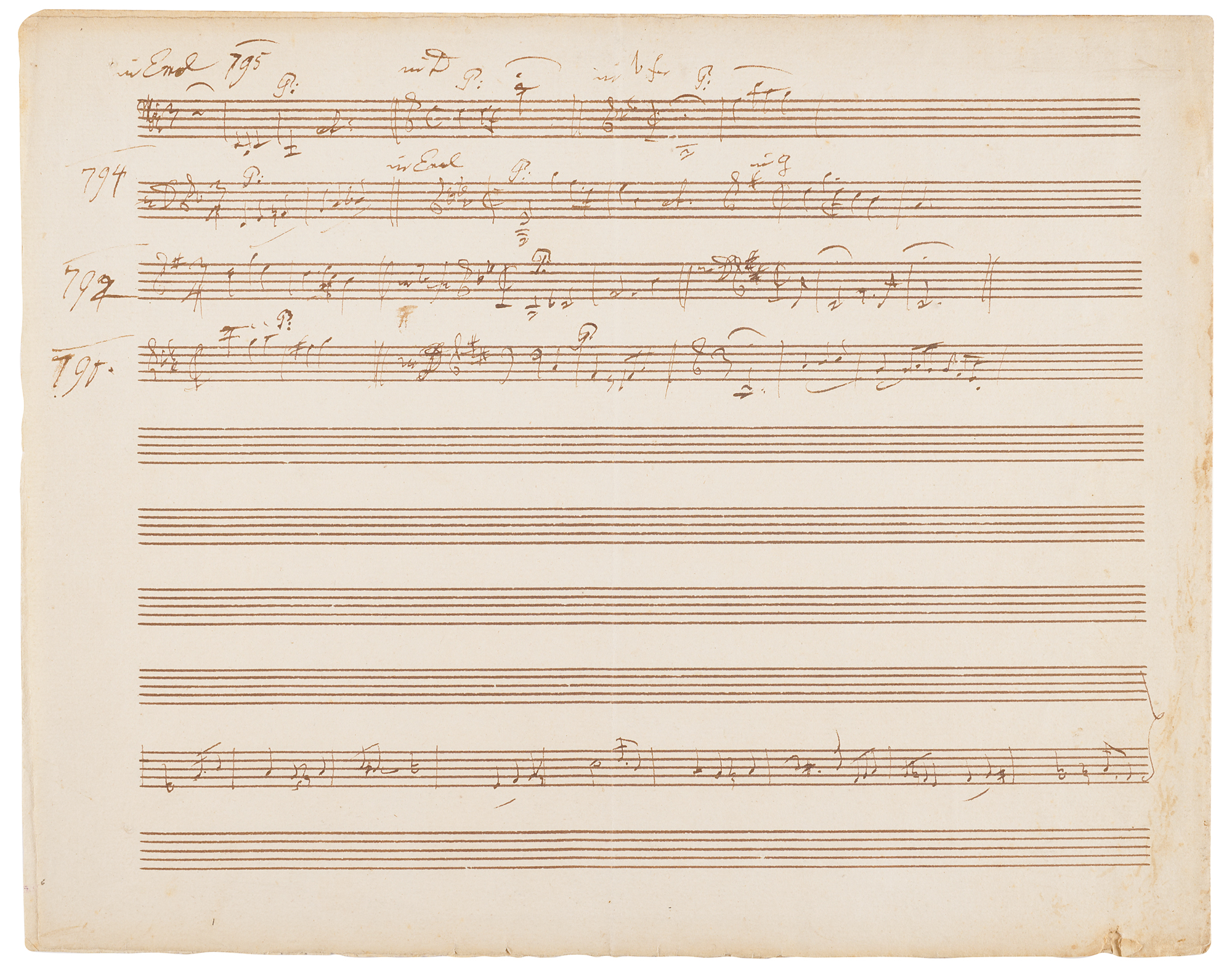
Remarkable handwritten musical manuscript by Joseph Haydn, unsigned, 12 x 9.5, no date but circa 1796, consisting of musical incipits for the composer’s 12 “London” Symphonies and an autograph musical sketch for the celebrated 'Gypsy Rondo' finale from his Piano Trio No. 39 in G major. The manuscript is notated in dark brown ink on the fourth page of a large oblong quarto bifolium of 10-stave rastrum-ruled British paper, with a 1794 watermark. In addition to the musical incipits—25 measures spread across four staves—Haydn identifies the key, time signature, and year of first performance for each of the 12 symphonies, Hob. I:93–104, though he mistakenly gives 1791 rather than 1792 for Symphony No. 97. Five staves below the symphonic incipits, Haydn adds a nine-measure melodic sketch for the famous “Gypsy Rondo” third movement of the Piano Trio No. 39. A penciled note in another hand to the first page reads: “Haydn autograph notes of the 12 English Symphonies. Haydn misquotes the 2nd.” In fine condition, with some light edge staining.
Provenance: Leo Liepmannssohn auction catalogue, Berlin, 1907, lot 91; The Westley Manning Collection, Sotheby’s London, October 12, 1954, lot 207.
Haydn’s London Symphonies, composed between 1791 and 1795 for the impresario and violinist Johann Peter Salomon, stand as the crowning achievement of his symphonic career. Written during the composer’s triumphant visits to England, they were created for enthusiastic London audiences and display Haydn at the height of his invention—brilliant, witty, expansive, and increasingly bold in form, orchestration, and dramatic surprise. The manuscript’s compact survey of all 12 works amounts to a miniature self-catalogue of the masterpieces that secured Haydn’s late international fame.
The added sketch for the 'Gypsy Rondo' is equally evocative. The finale of the G major Piano Trio became one of Haydn’s most popular instrumental movements, admired for its infectious energy and 'Hungarian' or 'Gypsy' character. Its presence here links the manuscript not only to Haydn’s greatest symphonic cycle, but also to one of the most beloved chamber works of his London period.
A unique and exceptionally significant Haydn manuscript, uniting incipits for all 12 London Symphonies with a working sketch for the famous 'Gypsy Rondo.' As both a personal index of his late symphonic triumphs and a glimpse into one of his most popular piano trio movements, the leaf offers an extraordinary document of Haydn’s final great creative period in London.

