The 30 Minute Rule begins October 14 at 7:00 PM EDT. An Initial Bid Must Be Placed By October 14 at 6:00 PM EDT To Participate After 6:00 PM EDT
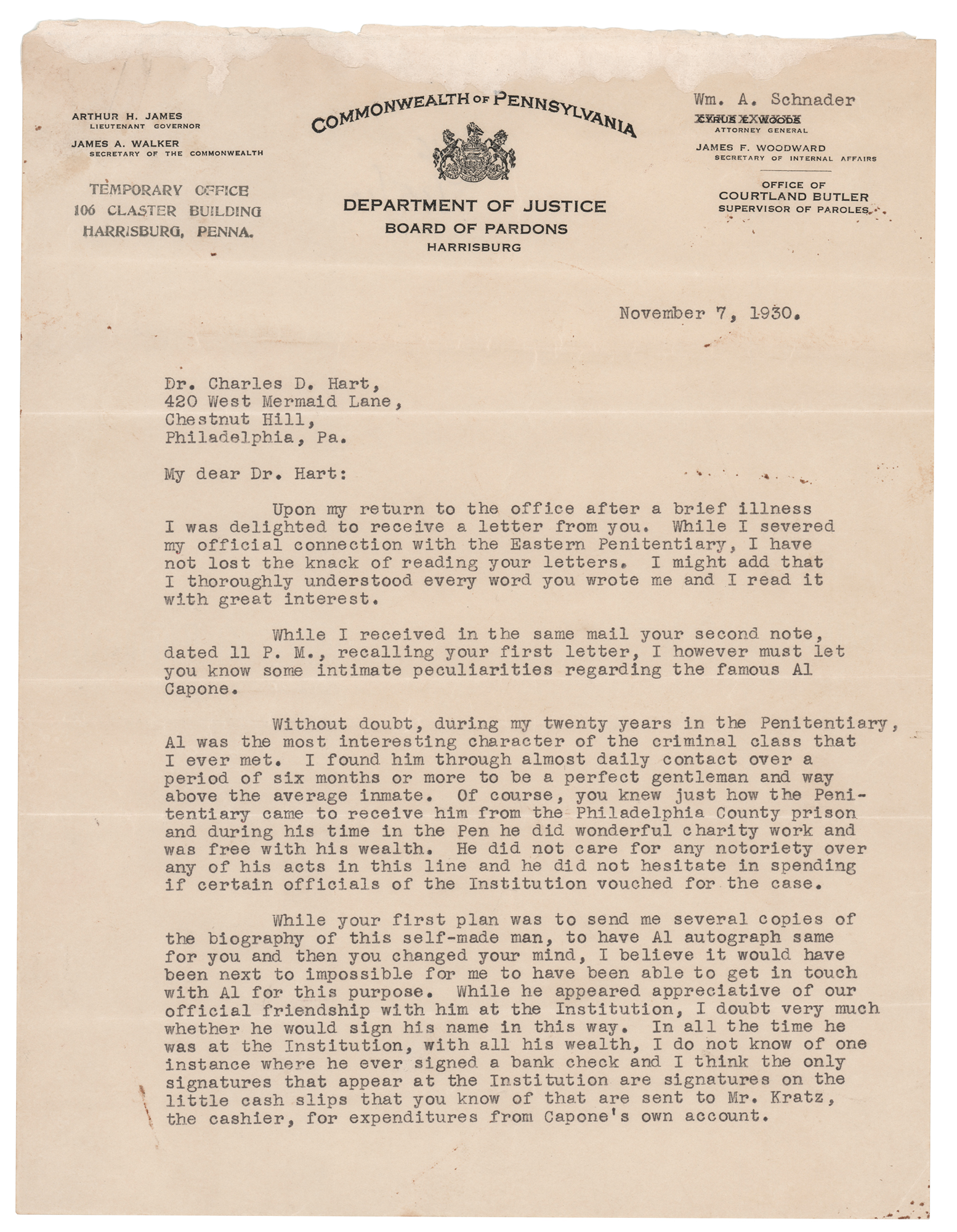
TLS, two pages, 8.5 x 11, Commonwealth of Pennsylvania, Department of Justice, Board of Pardons (Harrisburg) letterhead, November 7, 1930. Letter to Dr. Charles D. Hart, in full: “Upon my return to the office after a brief illness I was delighted to receive a letter from you. While I severed my official connection with the Eastern Penitentiary, I have not lost the knack of reading your letters. I might add that I thoroughly understood every word you wrote me and I read it with great interest.
While I received in the same mail your second note, dated 11 P. M., recalling your first letter, I however must let you know some intimate peculiarities regarding the famous Al Capone.
Without doubt, during my twenty years in the Penitentiary, Al was the most interesting character of the criminal class that I ever met. I found him through almost daily contact over a period of six months or more to be a perfect gentleman and way above the average inmate. Of course, you knew just how the Penitentiary came to receive him from the Philadelphia County prison and during his time in the Pen he did wonderful charity work and was free with his wealth. He did not care for any notoriety over any of his acts in this line and he did not hesitate in spending if certain officials of the Institution vouched for the case.
While your first plan was to send me several copies of the biography of this self-made man, to have Al autograph same for you and then you changed your mind, I believe it would have been next to impossible for me to have been able to get in touch with Al for this purpose. While he appeared appreciative of our official friendship with him at the Institution, I doubt very much whether he would sign his name in this way. In all the time he was at the Institution, with all his wealth, I do not know of one instance where he ever signed a bank check and I think the only signatures that appear at the Institution are signatures on the little cash slips that you know of that are sent to Mr. Kratz, the cashier, for expenditures from Capone's own account.
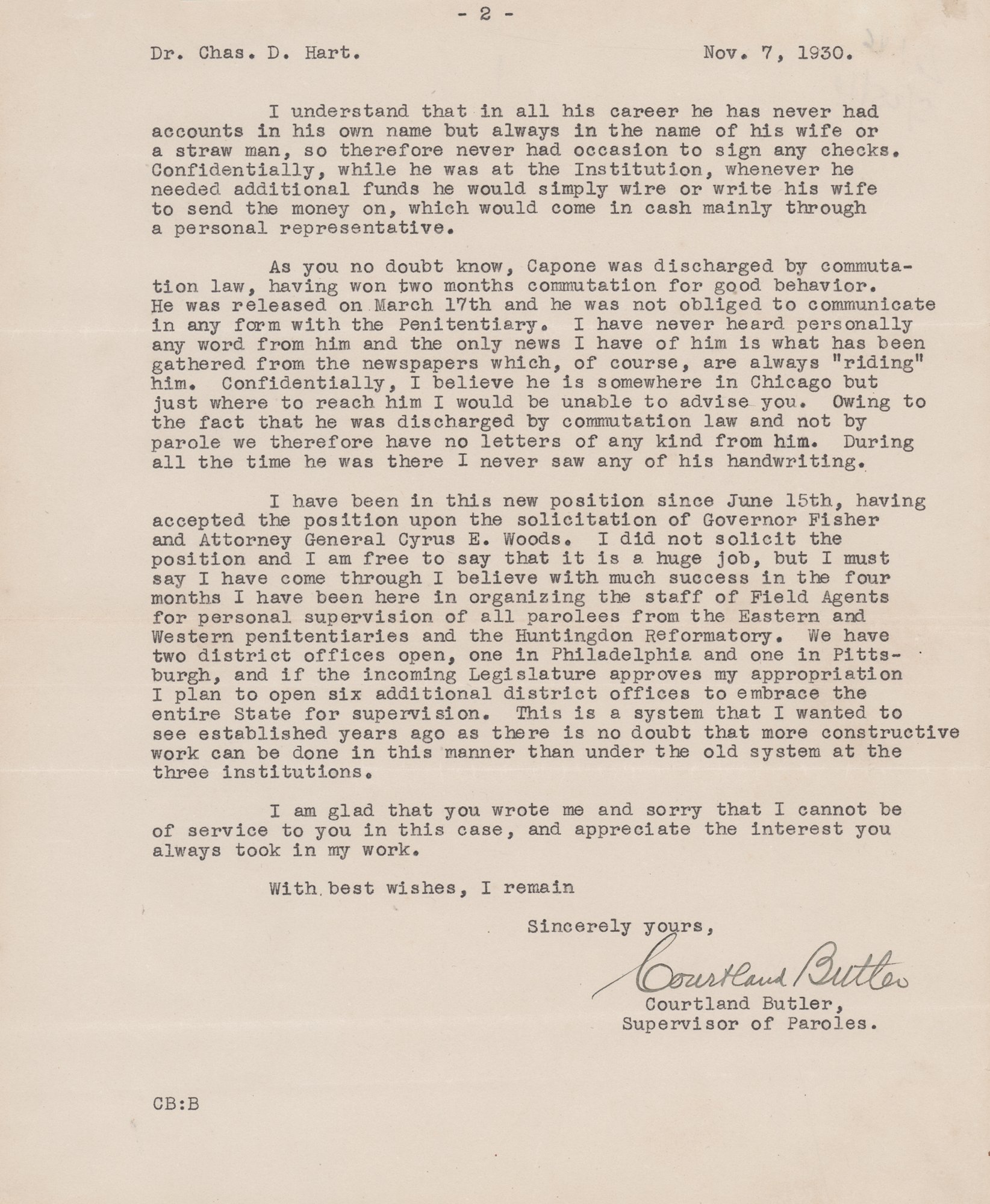
I understand that in all his career he has never had accounts in his own name but always in the name of his wife or a straw man, so therefore never had occasion to sign any checks. Confidentially, while he was at the Institution, whenever he needed additional funds he would simply wire or write his wife to send the money on, which would come in cash mainly through a personal representative.
As you no doubt know, Capone was discharged by commutation law, having won the two months commutation for good behavior. He was released on March 17th and he was not obliged to communicate in any form with the Penitentiary. I have never heard personally any word from him and the only news I have of him is what has been gathered from the newspapers which, of course, are always ‘riding’ him. Confidentially, I believe he is somewhere in Chicago but just where to reach him I would be unable to advise you. Owing to the fact that he was discharged by commutation law and not by parole we therefore have no letters of any kind from him. During all the time he was there I never saw any of his handwriting.
I have been in this new position since June 15th, having accepted the position upon the solicitation of Governor Fisher and Attorney General Cyrus E. Woods. I did not solicit the position and I am free to say that it is a huge job, but I must say I have come through I believe with much success in the four months I have been here in organizing the staff of Field Agents for personal supervision of all parolees from the Eastern and Western penitentiaries and the Huntingdon Reformatory. We have two district offices open, one in Philadelphia and one in Pittsburgh, and if the incoming Legislature approves my appropriation I plan to open six additional district offices to embrace the entire State for supervision. This is a system that I wanted to see established years ago as there is no doubt that more constructive work can be done in this manner than under the old system at the three institutions.
I am glad that you wrote me and sorry that I cannot be of service to you in this case, and appreciate the interest you always took in my work.” In very good to fine condition, with edge trimming to the second page.
Courtland Butler served for two decades at Philadelphia's Eastern State Penitentiary before being appointed Pennsylvania's Supervisor of Paroles in 1930. During his tenure at Eastern State, he came into frequent contact with many of the era's most notorious criminals, including Al Capone, whose 1929–1930 imprisonment gave Butler firsthand insight into the Chicago gangster's conduct while incarcerated.

