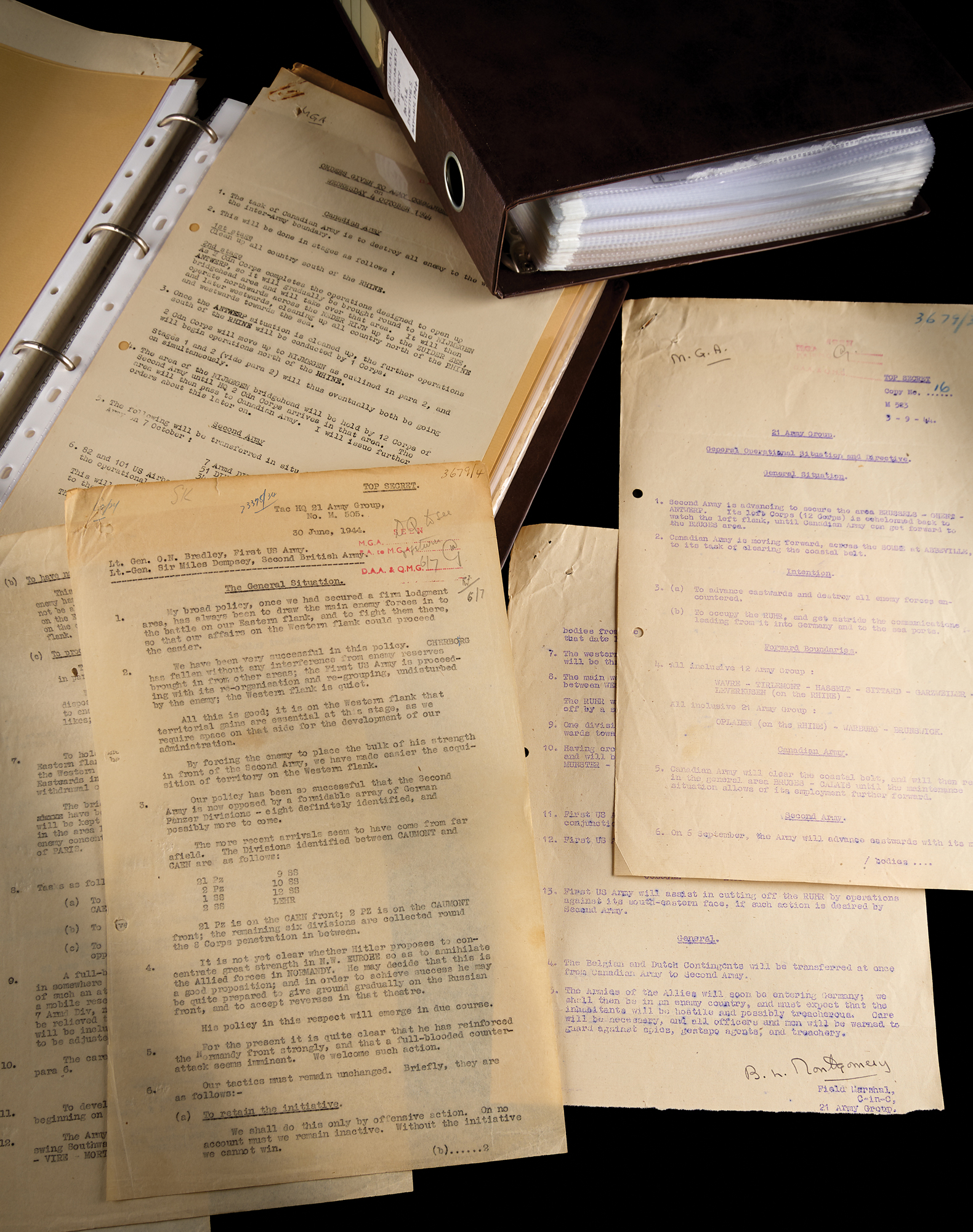
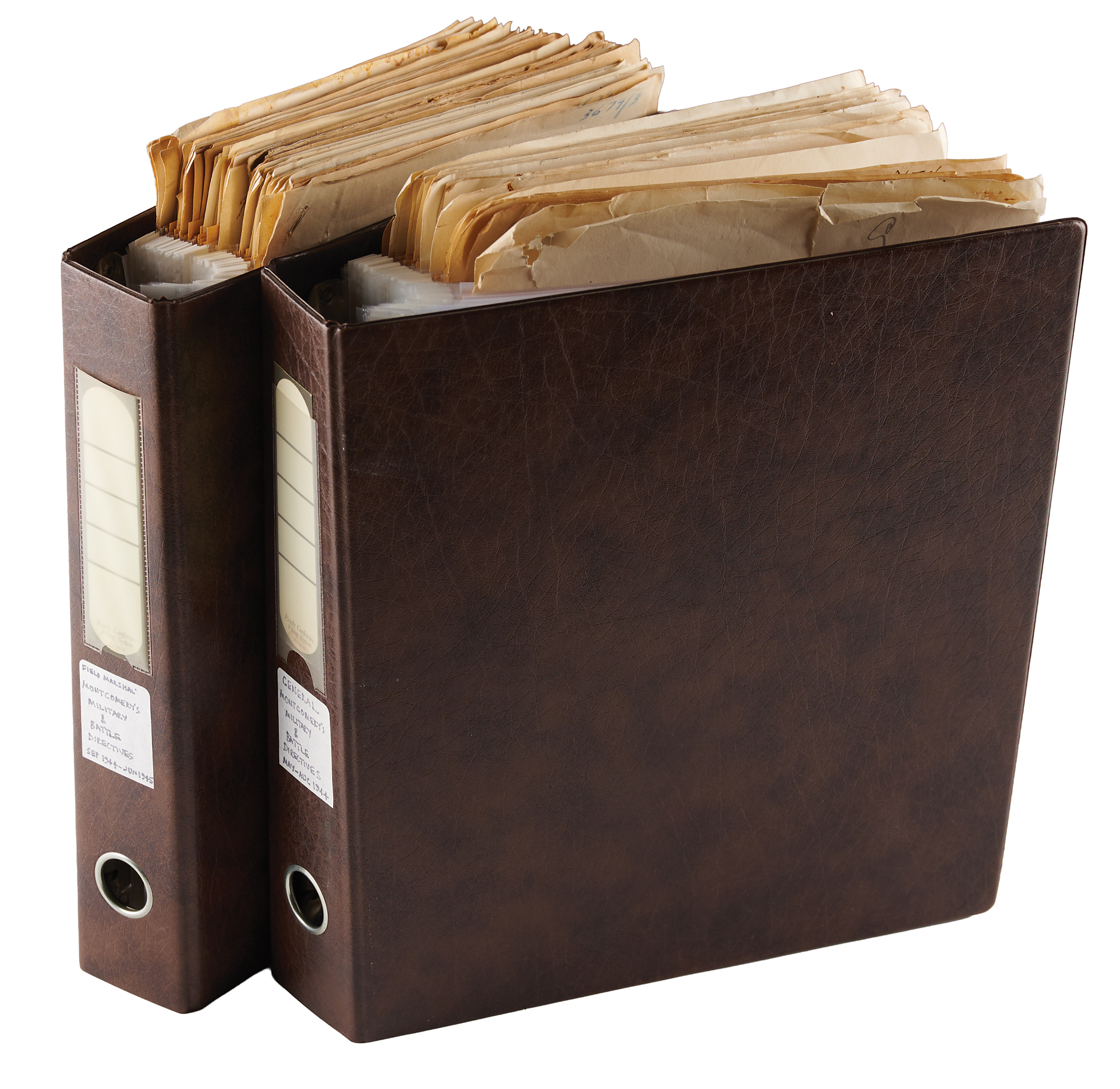
One of the most important surviving private archives of Allied high command operational papers from the Second World War: a near-sequential sequence of top-secret battle directives issued by Field Marshal Bernard Law Montgomery during the campaign from Normandy to the fall of Nazi Germany, preserved from the personal files of Major-General Miles Graham, Montgomery’s senior administrative officer at 21st Army Group. Covering every major phase of the Northwest Europe campaign—from D-Day and Operation Cobra to Market Garden, the Ardennes, the Rhine crossing, and the final advance into Germany—the archive provides an offensive-by-offensive documentary record of how victory in Western Europe was planned, directed, and executed at the highest level.
The comprehensive collection consists of 28 original World War II–dated "Top Secret" battle orders and briefs, totaling approximately 116 pages, including 21 signed in ink by Bernard Law Montgomery. These orders were circulated in limited numbers to no more than twenty members of the senior Anglo-American leadership of the war in Western Europe—the named recipients are a small and immediately recognizable circle including Churchill, Eisenhower, Bradley, Patton, Dempsey, Crerar, Bedell-Smith, Alan Brooke, de Guingand, Leigh-Mallory, Cunningham, Simpson, with the staff officers Graham, Poole, and Belchem. Most retain Graham’s contemporary ‘seen’ initials, acknowledging receipt.
Most significantly, these are operational documents, issued in their day by Field Marshal Montgomery and his staff, carrying throughout Montgomery's unmistakable command voice: his personality runs through them with directness, certainty, the occasional flash of impatience, and an unmistakable sense of a single mind in command. As Supreme Commander of the Allied Expeditionary Force, General Eisenhower delegated to Montgomery the conduct of all Allied ground forces in the field from D-Day until 1 September 1944, the date on which the United States 12th Army Group under Bradley and the 6th Army Group under Devers were fully deployed in France and Eisenhower assumed direct ground command himself.
For those eighty-eight days, a British general directed American armies in the field—a circumstance which had not occurred since the eighteenth century, and which speaks to the trust that existed between the two commanders. The directives of this period are accordingly of unusual significance, and the archive contains the fullest sequence of them known to remain in private hands.
The documents, chronologically:
May 8, 1944 (Operation Bigot, codename for the planning of the Normandy landings on D-Day, unsigned) - Brief outlining the planning and decisions relating to bulk petrol for the ground forces, administrative control on the continent, the British use of US Mulberry and Cherbourg, and the establishment of posts for US invasion forces in Brittany.
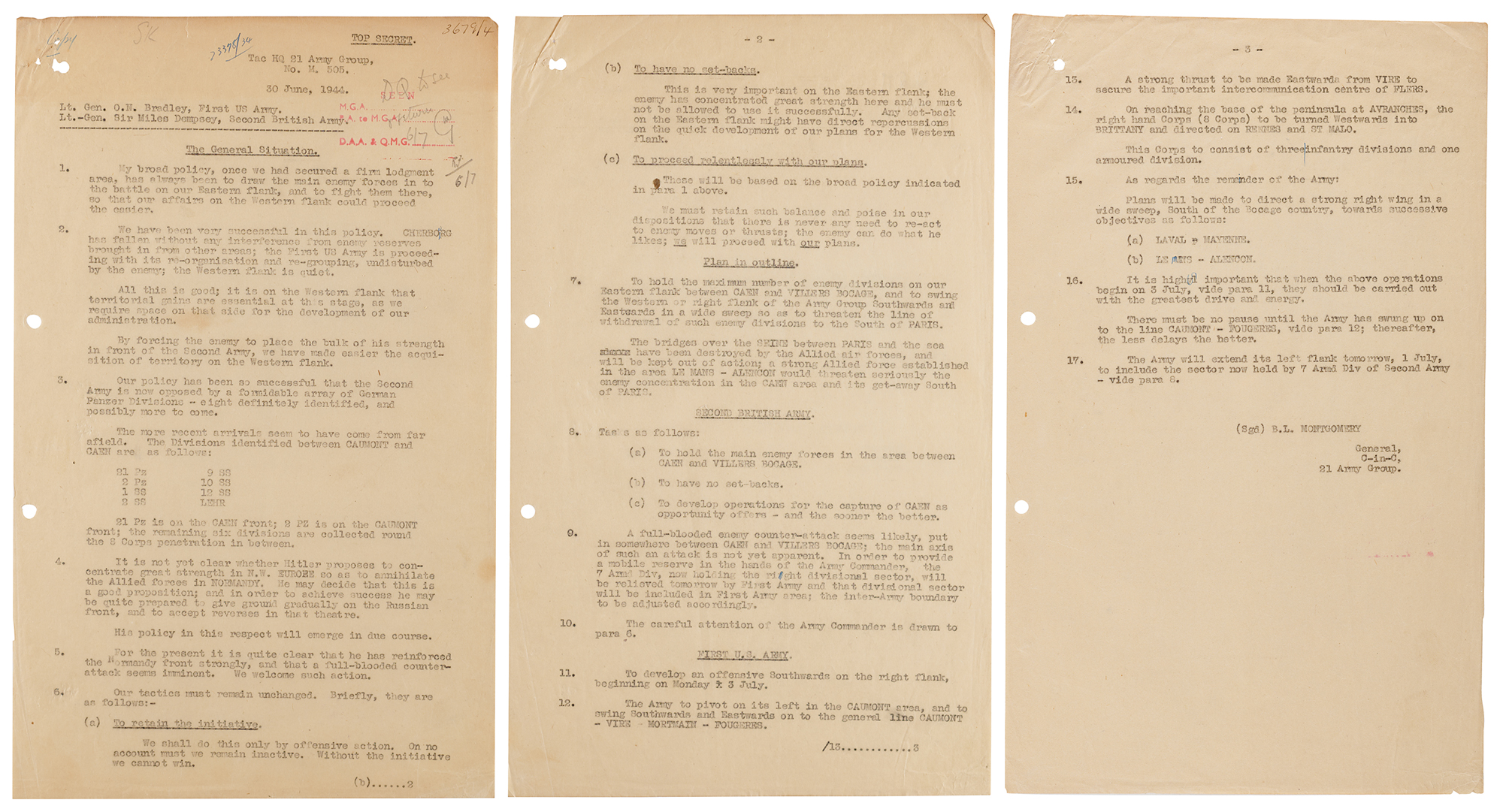
June 30, 1944 (unsigned) - Montgomery's battle directive for developing the break-out from Normandy: "My broad policy, once we had secured a firm lodgment area, has always been to draw the main enemy forces in to the battle on our Eastern flank, and to fight them there, so that our affairs on the Western flank could proceed the easier. We have been very successful in this policy. Cherborg has fallen without any interference from enemy reserves…the First US Army is proceeding with its re-organisation and re-grouping, undisturbed by the enemy; the Western flank is quiet…It is not yet clear whether Hitler proposes to concentrate great strength in N.W. Europe so as to annihilate the Allied forces in Normandy. He may decide that this is a good proposition; and in order to achieve success he may be quite prepared to give ground gradually on the Russian front, and to accept reverses in that theatre." He goes on to give orders to the Second British Army and First U.S. Army to develop operations for the capture of Caen and for a southward offensive.
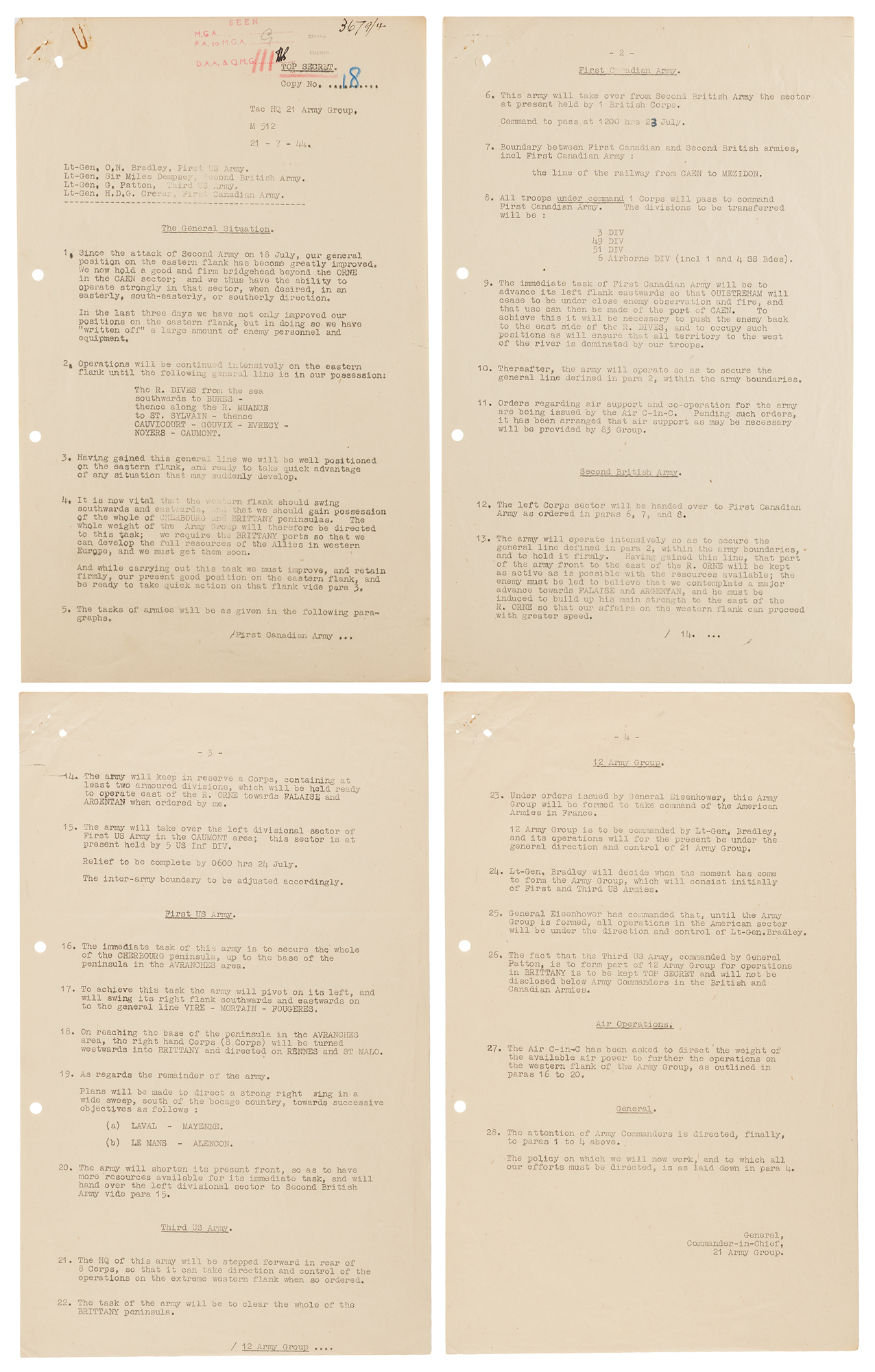
July 21, 1944 (M512, unsigned) - Montgomery's plan for the break-out from the Normandy beachhead, Operation Cobra: "Since the attack of Second Army on 18 July, our general position on the eastern flank has become greatly improved. We now hold a good and firm bridgehead beyond the Orne in the Caen sector; and we thus have the ability to operate strongly in that sector, when desired, in an easterly, south-easterly, or southerly direction. In the last three days we have not only improved our positions on the eastern flank, but in doing so we have 'written off' a large amount of enemy personnel and equipment…It is now vital that the western flank should swing southwards and eastwards, and that we should gain possession of the whole of Cherbourg and Brittany peninsulas. The whole weight of our Army Group will therefore be directed to this task; we require the Brittany ports so that we can develop the full resources of the Allies in western Europe, and we must get them soon." He gives orders to the First Canadian Army, Second British Army, First US Army, Third US Army, and 12 Army Group.
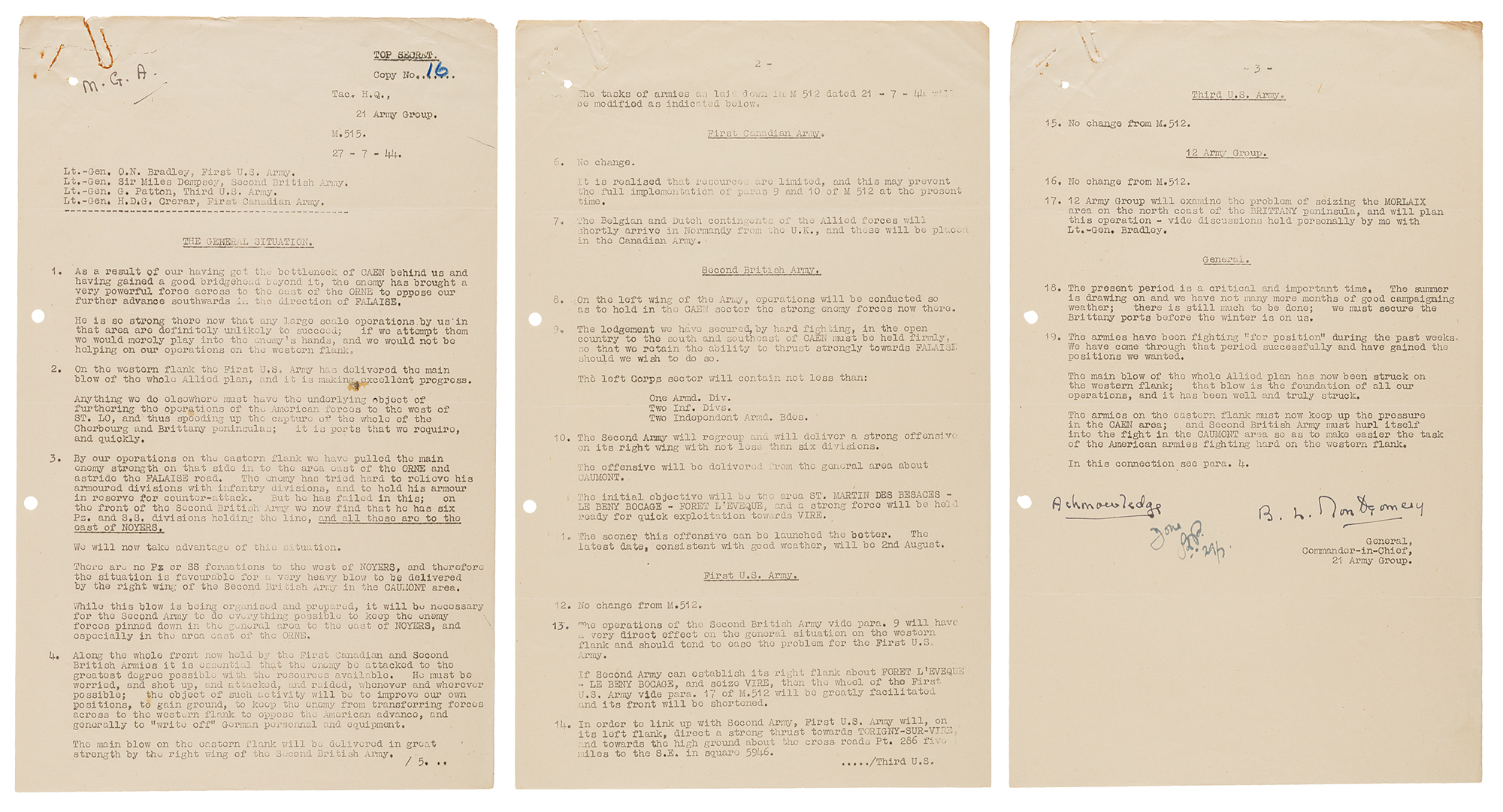
July 27, 1944 (M515, signed "Acknowledge, B. L. Montgomery") - Further battle orders for the Operation Cobra offensive: "As a result of our having got the bottleneck of Caen behind us and having gained a good bridgehead beyond it, the enemy has brought a very powerful force across to the east of the Orne to oppose our further advance southwards in the direction of Falaise. He is so strong there now that any large scale operations by use in that area are definitely unlikely to succeed; if we attempt them we would merely play into the enemy's hands, and we would not be helping our operations on the western flank. On the western flank the First U.S. Army has delivered the main blow of the whole Allied plan, and it is making excellent progress. Anything we do elsewhere must have the underlying object of furthering the operations of the American forces to the west of St. Lo, and thus speeding up the capture of the whole of the Cherbourg and Brittany peninsulas; it is ports that we require, and quickly…The present period is a critical and important time. The summer is drawing on and we have not many more months of good campaigning weather; there is still much to be done; we must secure the Brittany ports before the winter is on us."
August 4, 1944 (M516, signed "Acknowledge, B. L. Montgomery") - Montgomery opens the Battle of the Falaise Gap, in which the German Seventh Army was largely encircled and destroyed by converging Allied forces—Patton's Third Army driving north, the First Canadian Army driving south, the British Second Army from the east: "The general situation is very good. We have unloosed the shackles that were holding us down, and have knocked away the 'key rivets.' The enemy front is now in such a state that it could be made to disintegrate completely. But to achieve this great result, very determined and energetic action is necessary on the part of us all. Once a gap appears in the enemy front we must press into it, and through it, and beyond it into enemy rear areas. Enemy personnel and equipment must be written off in large quantities. Everyone must got all out, all day and every day…The broad strategy of the Allied Armies is to swing the right flank round towards Paris, and to force the enemy back against the Seine—over which river all the bridges have been destroyed between Paris and the sea."
August 6, 1944 (M517, signed "B. L. Montgomery") - Montgomery provides updates on the battle's progress and plainly sets out his design for the enemy's encirclement: "The battle continues to go well…From the general trend of enemy movement it appears he is falling back, unwillingly, to some new line; but there is no evidence yet to show exactly where that line is…But whatever the enemy may want to do will make no difference to us. We will proceed relentlessly, and rapidly, with our plans for his destruction. We must be prepared to attack the enemy quickly, whenever and wherever he may stand to fight; he must not be give time to 'settle in' on any positions. We must follow him up with speed whenever he withdraws, and allow him no respite…Plan in Outline: To pivot on our left, or northern flank. To swing hard with our right along the southern flank and in towards Paris, the gap between Paris and Orleans being closed ahead of our advance. To drive the enemy up against the R. Seine, all bridges over which between Paris and the sea will be kept out of action."
August 11, 1944 (M518, signed "B. L. Montgomery") - Montgomery closes the Falaise Pocket: "Obviously, if we can close the gap completely we shall have put the enemy in the most awkward predicament. As the gap narrows the enemy is certain to re-act…We will now concentrate our energies on closing the gap behind the main enemy forces, so that we can possibly destroy them where they are now."
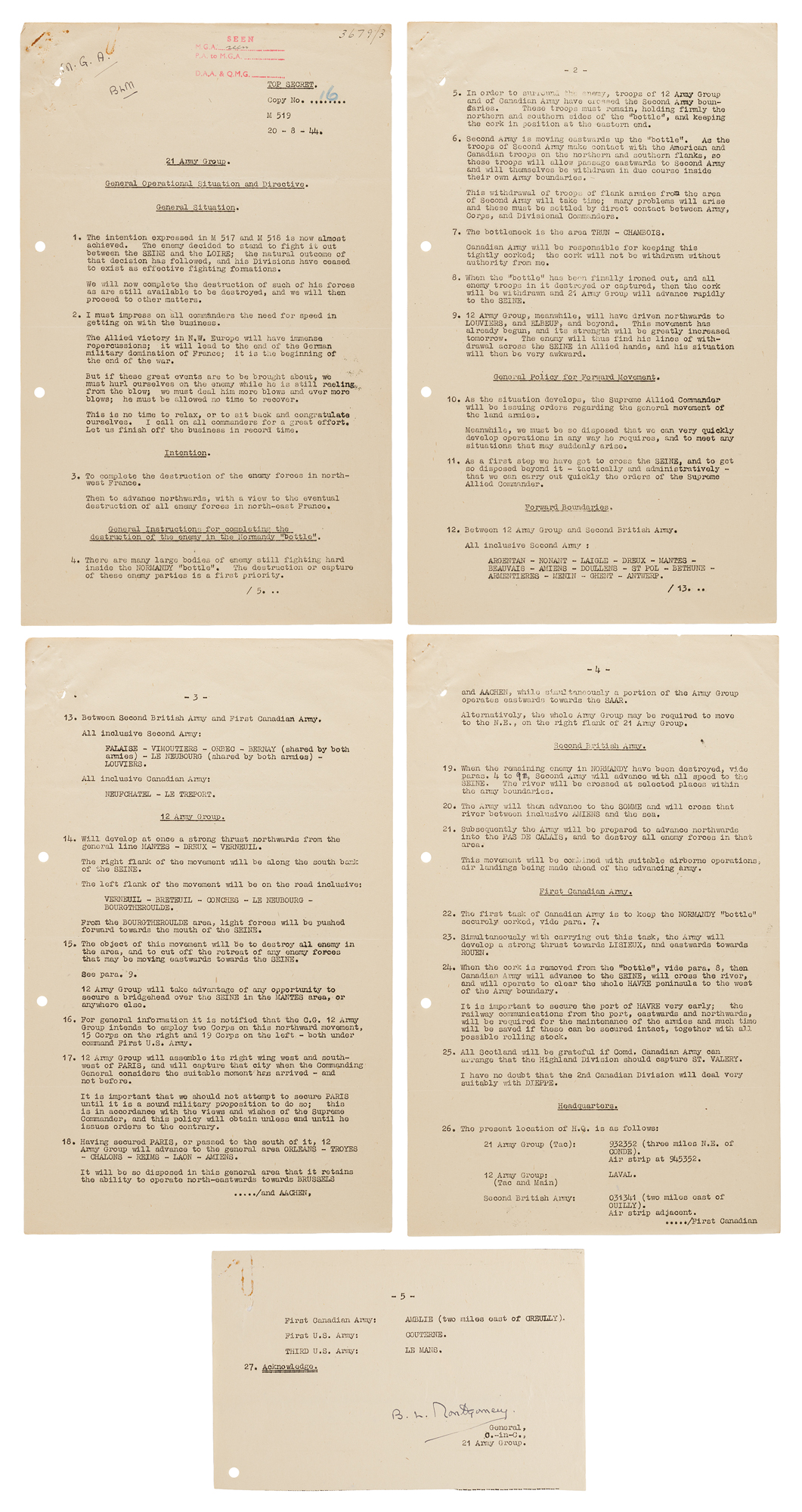
August 20, 1944 (M519, signed "B. L. Montgomery") - Montgomery pushes for Allied victory in Europe and drives to the Seine: "The enemy has decided to stand to fight it out between the Seine and the Loire; the natural outcome of that decision has followed, and his Divisions have ceased to exist as effective fighting formations. We will now complete the destruction of such of his forces as are still available to be destroyed, and we will then proceed to other matters. I must impress on all commanders the need for speed in getting on with the business. The Allied victory in N.W. Europe will have immense repercussions; it will lead to the end of the German military domination of France; it is the beginning of the end of the war. But if these great events are to be brought about, we must hurl ourselves on the enemy while his is still reeling from the blow; we must deal him more blows and ever more blows; he must be allowed no time to recover. There is no time to relax, or to sit back and congratulate ourselves. I call on all commanders for a great effort. Let us finish off the business in record time."
August 26, 1944 (M520, signed "B. L. Montgomery") - Montgomery carries the line forward to the Somme: "The enemy has now been driven north of the Seine except in a few places, and our troops have entered Paris. The enemy forces are very stretched and disorganised; they are in no fit condition to stand and fight us. This, then, is our opportunity to achieve our further objects quickly, and to deal the enemy further heavy blows which will cripple his power to continue the war…Speed of action and of movement is now vital. I cannot emphasise this too strongly; what we have to do must be done quickly."
August 29, 1944 (M522, signed "B. L. Montgomery") - Montgomery's last directive as Commander-in-Chief of the Allied Ground Forces, instructing the 21st Army Group to assist Bradley's American forces in their advance towards Aachen: "It has been decided to drop the airborne forces in the Tournai area…The role of these forces will be to operate offensively from the area secured…and to attack and destroy all enemy bodies attempting to escape eastwards from the coastal belt…I will decide late whether command of the Airborne Corps should pass to Second Army when that Army approaches the Tournai area, or whether the Airborne forces should remain directly under 21 Army Group."
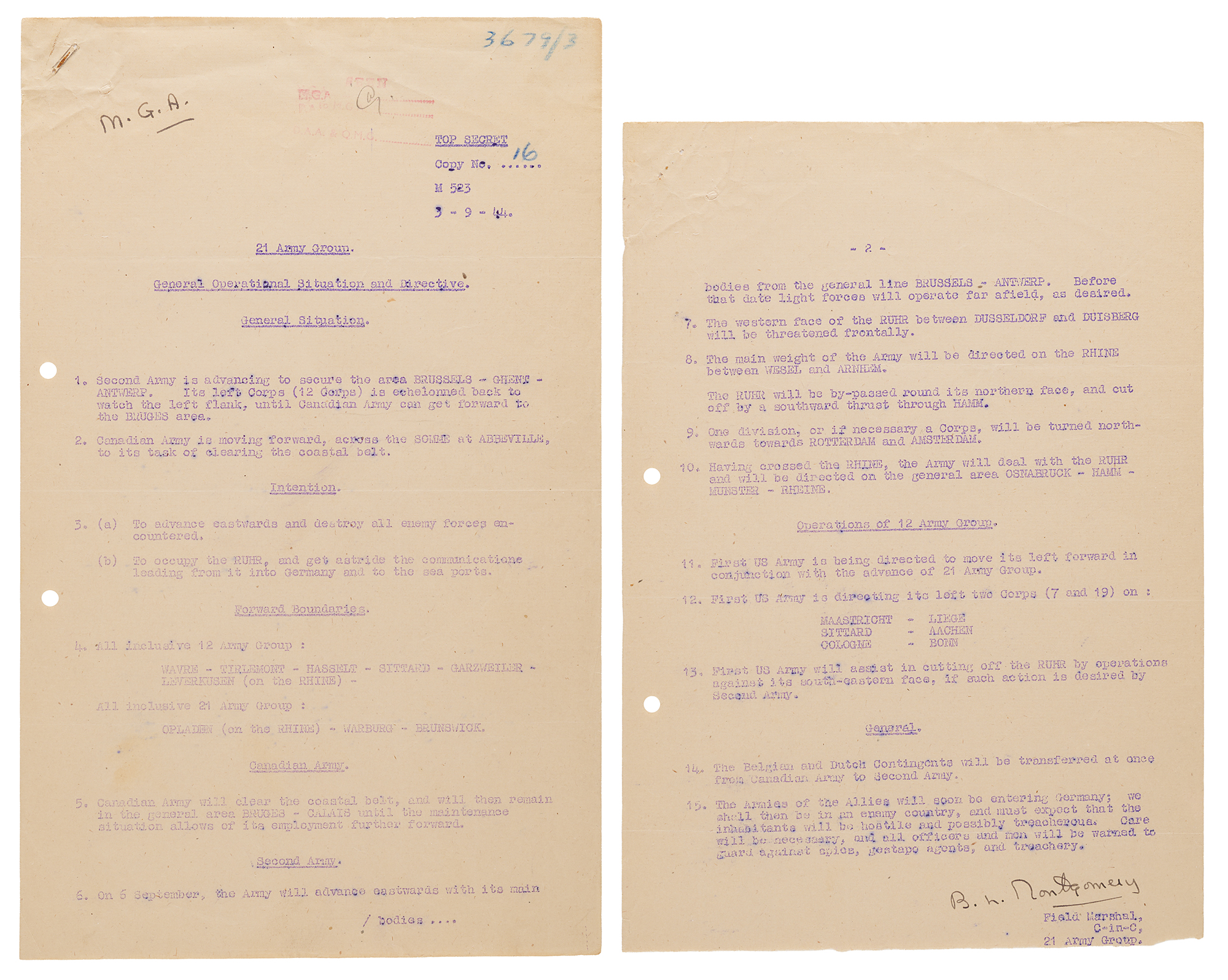
September 3, 1944 (M523, signed "B. L. Montgomery") - Montgomery's first directive as Field Marshal and first directive as C-in-C of British troops only, issued on the same day he met with Browning to discuss Operation Market Garden: "Second Army is advancing to secure the area Brussels - Ghent - Antwerp. Its left Corps (12 Corps) is echelonned back to watch the left flank, until Canadian Army can get forward to the Bruges area. Canadian Army is moving forward, across the Somme at Abbeville, to its task of clearing the coastal belt. Intention: To advance eastwards and destroy all enemy forces encountered. To occupy the Ruhr, and get astride the communications leading from it into Germany and to the sea ports…The Armies of the Allies will soon be entering Germany' we shall then be in enemy country, and must expect that the inhabitants will be hostile and possibly treacherous. Care will be necessary, and all offices and men will be warned to guard against spies, gestapo agents, and treachery." Includes "Top Secret Copy No. 1" of "Notes on Commander-in-Chief's Intentions," prepared by David Belchem, which includes details of preparations for Market Garden; also includes an ANS by Belchem and a carbon copy of Belchem's "resume of the latest directive issued by the Commander-in-Chief."
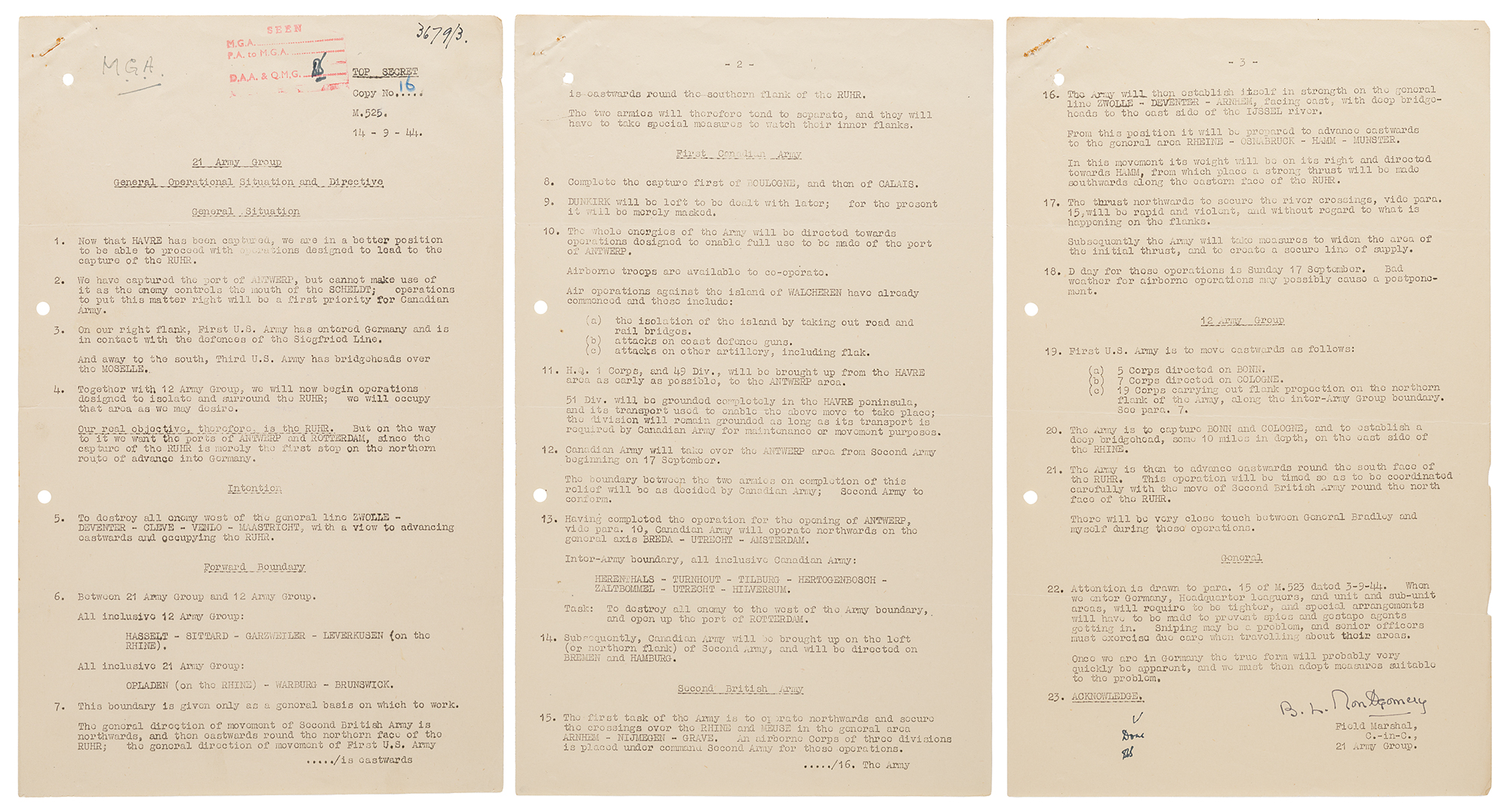
September 14, 1944 (M525, signed "B. L. Montgomery") - The operational order for Operation Market Garden, the airborne and ground offensive intended to seize a Rhine bridgehead and turn the war's northern flank: "Now that Havre has been captured, we are in a better position to be able to proceed with the operations designed to lead to the capture of the Ruhr. We have captured the port of Antwerp, but cannot make use of it as the enemy controls the mouth of the Scheldt; operations to put this matter right will be a first priority for Canadian Army. On our right flank, First U.S. Army has entered Germany and is in contact with the defences of the Siegfried Line. And away to the south, Third U.S. Army has bridgeheads over the Moselle. Together with 12 Army Group, we will now begin operations designed to isolate and surround the Ruhr; we will occupy that area as we may desire. Our real objective, therefore, is the Ruhr. But on the way to it we want the ports of Antwerp and Rotterdam, since the capture of the Ruhr is merely the first stop on the northern route of the advance into Germany."
September 27, 1944 (M527, signed "B. L. Montgomery") - Market Garden did not achieve its furthest objective: the bridge at Arnhem was held by the British 1st Airborne Division and the Polish 1st Independent Parachute Brigade for nine days against overwhelming German armor, but the ground advance—led by the American 82nd and 101st Airborne Divisions and XXX Corps—could not reach them in time. Montgomery's directive, written as the bridgehead was being given up, contains a single line of unmistakable understatement: "The enemy has achieved some success in cutting the Second Army corridor northwards to Nijmegen; but this situation has now been got in hand—I hope finally." He goes on to predict a bloody battle: "The battle is now likely to take a new complexion. We fought a hard dog-fight battle in Normandy; as a result of the victory there gained, we 'tumbled' the enemy back hundreds of miles, so far in fact that we got somewhat stretched ourselves administratively; we then had a 'battle for position,' from the Albert Canal up to the Rhine at Nijmegen. We have won all these different types of battles; and we stand at the door of Germany, and are likely now to have another dogfight battle of killing match…The objective, and the prize, is the Ruhr; its capture will mean the beginning of the end for Germany."
September 29, 1944 (M529, signed "B. L. Montgomery") - Montgomery orders the regrouping of 21st Army Group, consisting of the British Second Army and the First Canadian Army: "The task of Canadian Army is to destroy all enemy to the west of the inter-Army boundary…As Canadian Army completes the operations south of the Rhine so formations of 1 Corps will become available for employment in the Second Army battle against the NW corner of the Ruhr. 1 Corps, having completed its task south of the Rhine, will be temporarily in reserve."
October 9, 1944 (M530, signed "B. L. Montgomery") - Montgomery orders the securing of the Nijmegen bridgehead and discusses the need to open up Antwerp: "Enemy re-actions to our operations have been so great that we must first eliminate certain commitments before we proceed to launch the Second Army towards Krefeld and the Ruhr…Firstly, the Nijmegen bridgehead. This is vital to us; and so long as we have it we can shape the future operations as we desire; the enemy knows this and will undoubtedly try to eliminate it. Therefore this bridgehead must be securely held and maintained; and this means that, for the present, infantry formations will be necessary in the bridgehead in addition to airborne forces…The use of Antwerp is vital to the Allies in order that we can develop our full potential. Therefore the operations to open the port must have priority as regards troops, ammunition, and so on…Before we can launch the Second Army towards Krefeld and the Ruhr we must: (a) be absolutely certain that the Nijmegen bridgehead is firm and secure; (b) drive the enemy back to the east side of the Meuse between Gennep and Roermond."
October 16, 1944 (M532, signed "B. L. Montgomery") - Montgomery's directive for the capture of Antwerp: "The free use of the port of Antwerp is vital to the Allied cause, and we must be able to use the port soon. Operations designed to open the port will therefore be given complete priority over all other offensive operations in 21 Army Group, without any qualification whatsoever. The immediate task of opening up the approaches to the port of Antwerp is already being undertaken by the Canadian Army and good progress has been made. The whole of the available offensive power of Second Army will now be brought to bear also…I must impress on Army Commanders that the early use of Antwerp is absolutely vital. The operations now ordered by me must be begun at the earliest possible moment; they must be pressed with the greatest energy and determination; and we must accept heavy casualties to get quick success."
November 2, 1944 (M534, signed "B. L. Montgomery") - Montgomery plans for the Battle of the Rhineland and the clearance of the West Bank of the River Meuse: "The operations designed to give us the free use of the port of Antwerp, vide M532, are now nearly finished. The final and definite completion of these operations remains our first task…It is now clear that the next operation to be undertaken by Second Army must be the liquidation of the Meuse pocket west of Venlo, and the driving of the enemy back to the east side of the Meuse in that area. It is also clear that the attack by the left wing of 12 Army Group towards Cologne, so as to secure a bridgehead over the Rhine, will not be so strong as is desired…It has been decided that the best was we can help 12 Army Group to get up the Rhine is: Firstly to release the American divisions now serving with us. Secondly to extend our flank southwards and take over some of the 12 Army Group front. Thirdly to develop offensive operations on our right flank, in close co-operation with the left flank of 12 Army Group…We have recently been shooting daily far more ammunition than we import from England, and in consequence our reserve stocks are becoming depleted. I must impress on all commanders the need to ensure that all artillery ammunition is used wisely."
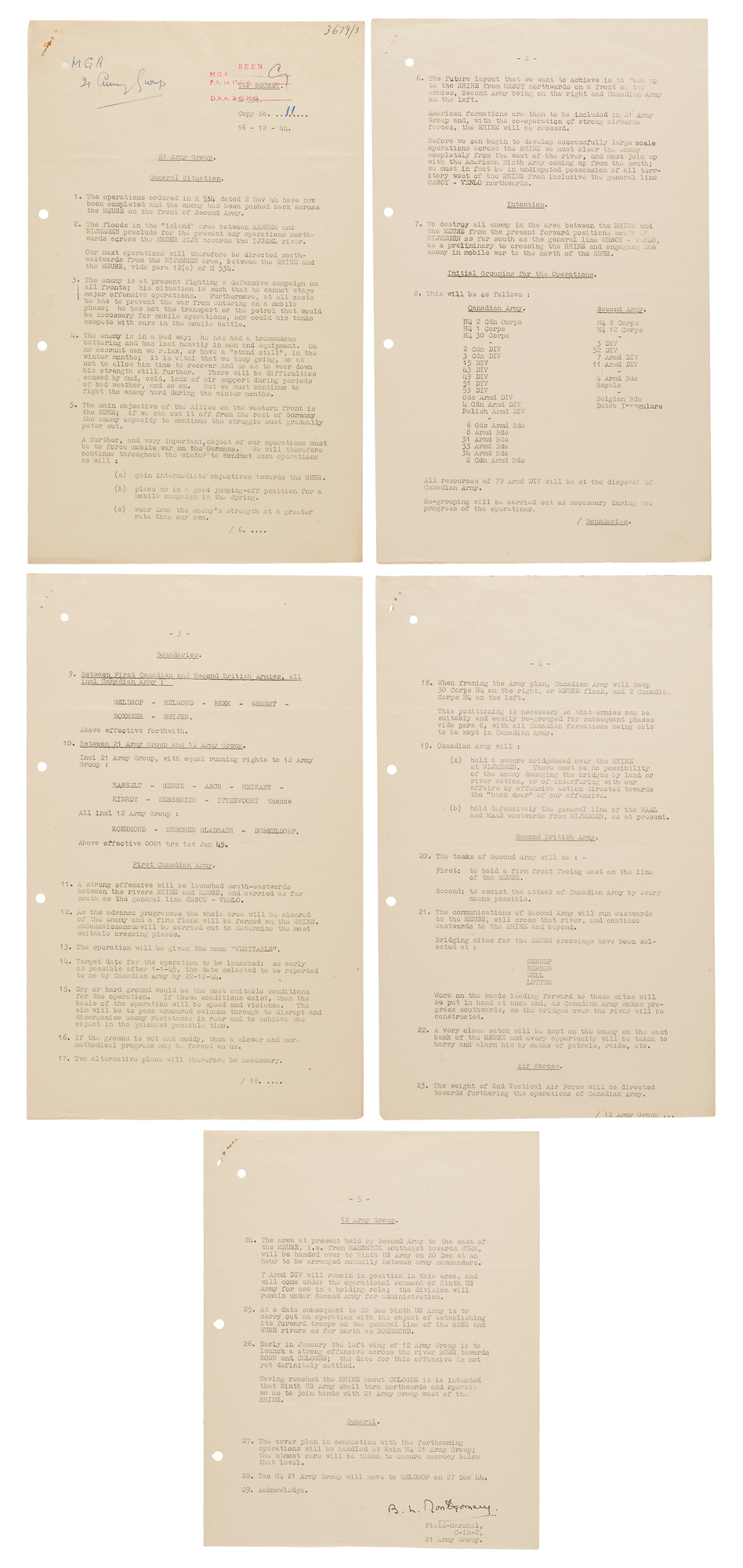
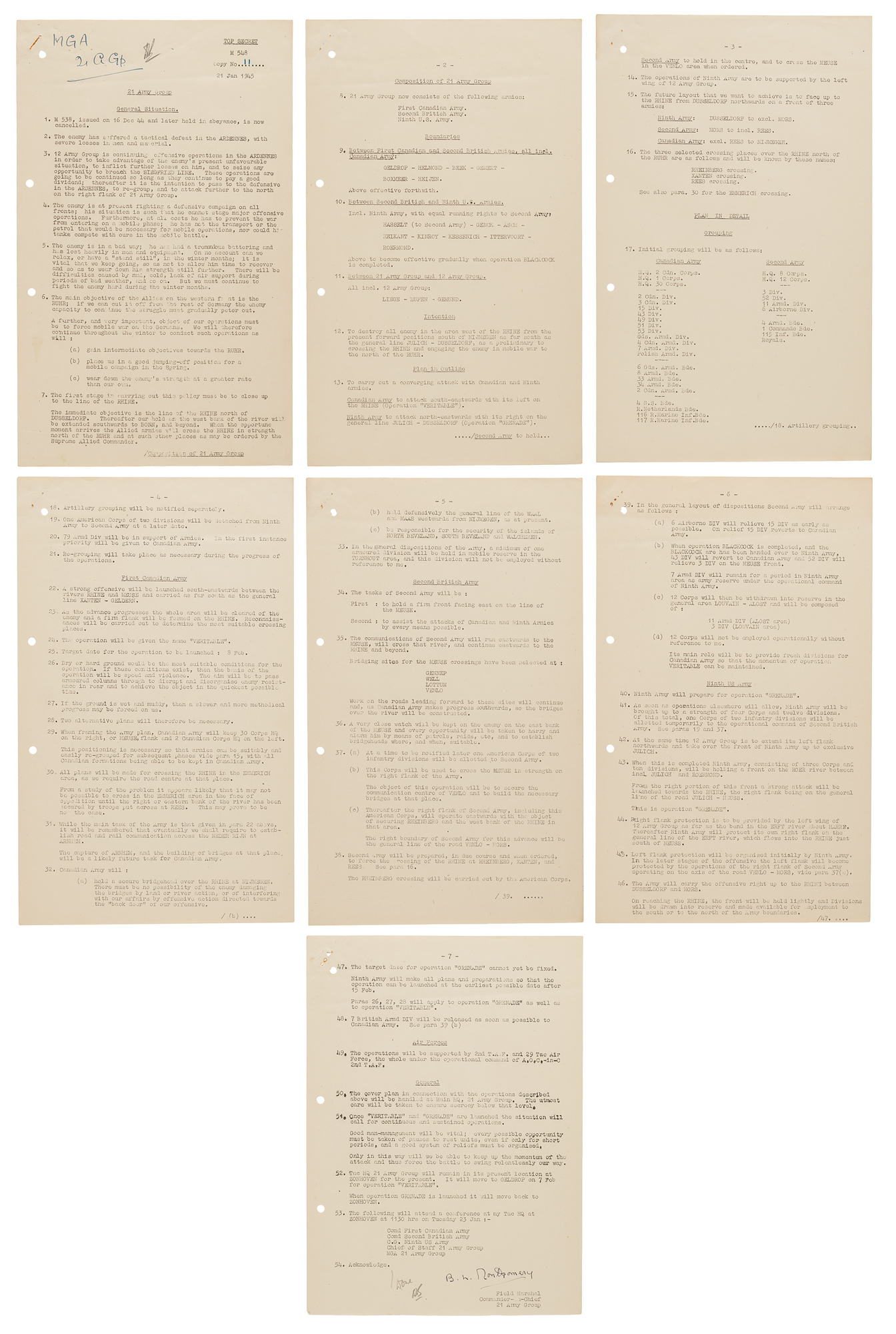
December 16, 1944 (M538, signed "B. L. Montgomery") - Montgomery's new battle directive prepared on the eve of and in ignorance of the Battle of the Ardennes—one of the greatest intelligence blunders of World War II, as Allied forces mistakenly believed that the Germans were unable to mount a serious offensive: "The enemy is at present fighting a defensive campaign on all fronts; his situation is such that he cannot stage major offensive operations. Furthermore, at all costs he has to prevent the war from entering on a mobile phase; he has not the transport or the petrol that would be necessary for mobile operations, nor could his tanks compete with ours in the mobile battle. The enemy is in a bad way; he has had a tremendous battering and has lost heavily in men and equipment. On no account can we relax, or have a 'stand still,' in the winter months; it is vital that we keep going, so as not to allow him time to recover and so as to wear down his strength still further. There will be difficulties caused by mud, cold, lack of air support during periods of bad weather, and so on. But we must continue to fight the enemy hard during the winter months." His closing lines concern secrecy: "The cover plan in connection with the forthcoming operations will be handled at Main HQ 21 Army Group; the utmost care will be taken to ensure secrecy below that level." Accompanied by Eisenhower's G-2's (Sir Kenneth Strong) original and personal copy of the SHAEF Weekly Intelligence Summary (No. 39) which he prepared and submitted on 17th December 1944, Classified "Secret."
January 14, 1945 (signed "R. F. K. Belchem BGS") - The "Commander-in-Chief's Expose of the Situation," outlining the organization and sequence of Operations Blackcock and Veritable: "We must wrest the initiative from the enemy quickly. At the present time the Germans have the strategic initiative, and are using it to keep the theatre reserve divisions on the move. In order to get the initiative quickly, a definite decision should now be made as to our future course of action. It is not sound to make a plan with the proviso that if it fails, a regrouping, followed by a different plan, will be brought into action…Having selected the course of action to take, it is essential to allot really adequate resources for carrying it out. On the rest of the front there must be absolute balance and poise to meet any German threat. For this, available reserve divisions must be suitably located."
January 21, 1945 (M548, signed "B. L. Montgomery") - Montgomery looks past the Ardennes to the Rhineland: "M538, issued on 16 Dec 44 and later held in abeyance, is now cancelled. The enemy has suffered a tactical defeat in the Ardennes, with severe losses in men and material. 12 Army Group is continuing offensive operations in the Ardennes in order to take advantage of the enemy's present unfavourable situation, to inflict further losses on him, and to seize any opportunity to breach the Siegfried Line…The enemy is at present fighting a defensive campaign on all fronts; his situation is such that he cannot stage major offensive operations. Furthermore, at all costs he has to prevent the war from entering on a mobile phase…The enemy is in a bad way; he has had a tremendous battering and has lost heavily in men and equipment…The main objective of the Allies on the western front is the Ruhr; if we can cut it off from the rest of Germany the enemy capacity to continue the struggle must gradually peter out."
January 31, 1945 (unsigned) - Intelligence evaluation issued by Belchem, headed "Considerations concerning Operations 'Veritable' and 'Grenade,'" offensives designed to clear German forces from the west bank of the Rhine in the northern Rhineland. The report discusses factors concerning the operations, ranging from Army groupings to weather on the Western Front.
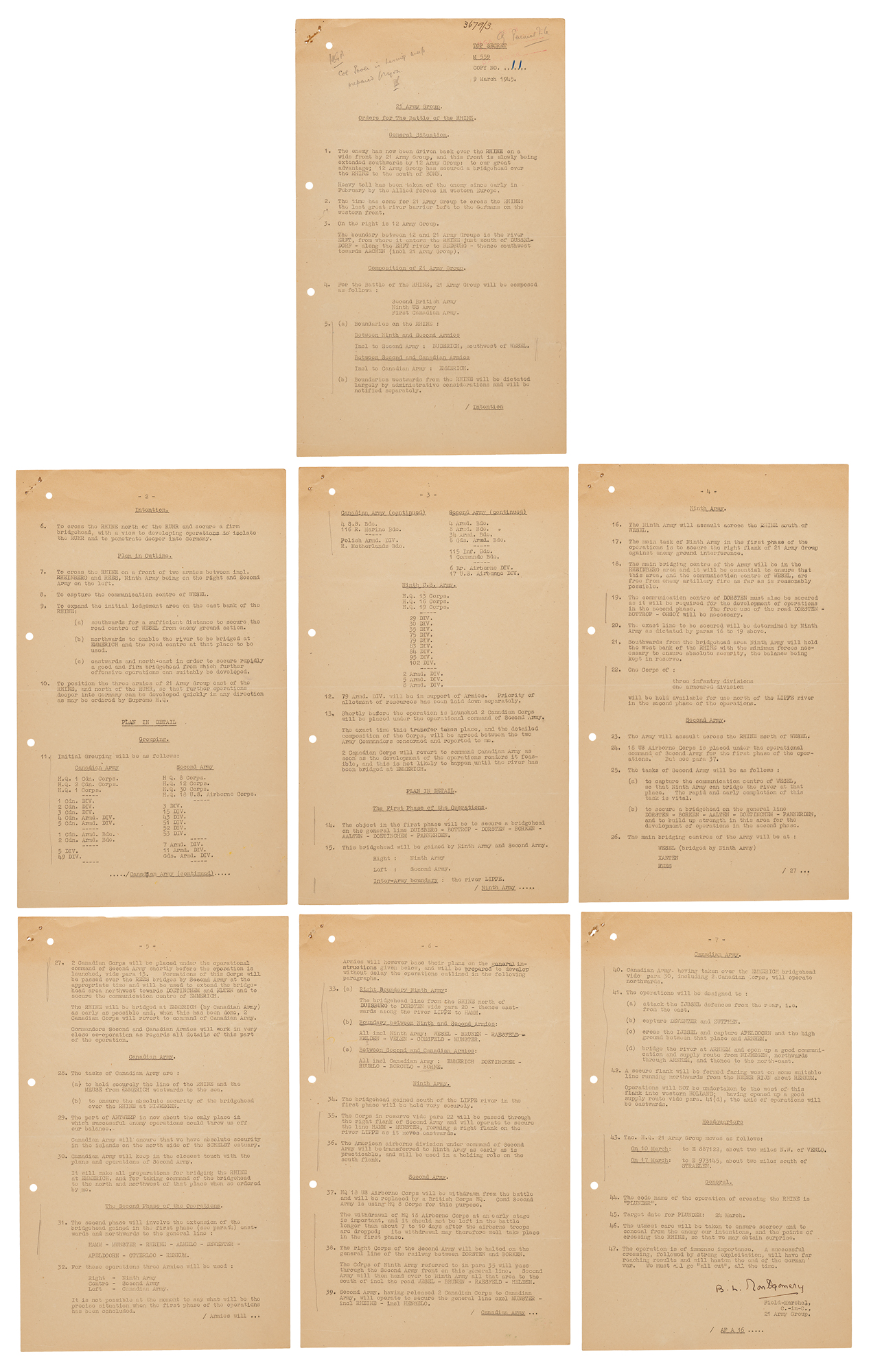
March 9, 1945 (M559, signed "B. L. Montgomery") - Montgomery's orders for the Battle of the Rhine: "The enemy has now been driven back over the Rhine on a wide front by 21 Army Group, and this front is slowly being extended southwards by 12 Army group: to our great advantage; 12 Army Group has secured a bridgehead over the Rhine to the south of Bonn. Heavy toll has been taken of the enemy since early in February by the Allied forces in western Europe. The time has come for 21 Army Group to cross the Rhine: the last great river barrier left to the Germans on the western front…The code name of the operation of crossing the Rhine is 'Plunder'…The operation is of immense importance. A successful crossing, followed by strong exploitation, will have far reaching results and will hasten the end of the German war. We must all go 'all out,' all the time."
March 28, 1945 (M563, signed "B. L. Montgomery") - Montgomery announces victory at the Rhine and plans the advance to the Elbe and the drive to the Baltic: "We have won the Battle of the Rhine. During March the average number of prisoners taken every day by the Allies on the Western front is 10,000: making a total of over a quarter of a million. The enemy divisions were all very weak when the battles for the Rhineland began; they are getting no replacements and are now mere skeletons; there are no fresh and complete divisions in the rear and all the enemy will be able to do is to block roads and approaches with personnel from schools, bath units, pigeon lofts, and so on. The time has now arrived for quick and determined exploitation by armoured and mobile units of 21 Army Group…Intention: To exploit the present situation rapidly, and to drive hard for the line of the R. Elbe so as to gain quick possession of the plains of northern Germany…The operations will be conducted with speed and violence by the armoured columns…This is the time to take risks and to go 'flat out' for the Elbe."
April 5, 1945 (M567, signed "B. L. Montgomery") - "We have now joined up with 12 Army group in the Paderborn area, and about 150,000 Germans are surrounded in the Ruhr. 12 Army group is to clean up the Ruhr area and is then to operate to the southeast towards Leipzig and Dresden. Ninth Army has been withdrawn from 21 Army Group and has reverted to command of 12 Army Group…Second Army: The Army will operate to secure the line of the Weser within the Army boundaries, and will capture Bremen…Canadian Army: Canadian Army will complete the operations ordered in paras 40 and 41 of M559…One Corps, of at least two Divisions, will then operate westwards to clear up western Holland. This may take some time…Canadian Army will have priority for all amphibious resources of 79 Armd Div."
April 12, 1945 (unsigned) - Top secret "Notes on Commander-in-Chief's Conference with Commander First Canadian Army," discussing the advance to the Elbe, the Battle of Bremen, the role of the First Canadian Army, and the Battle for Hamburg.
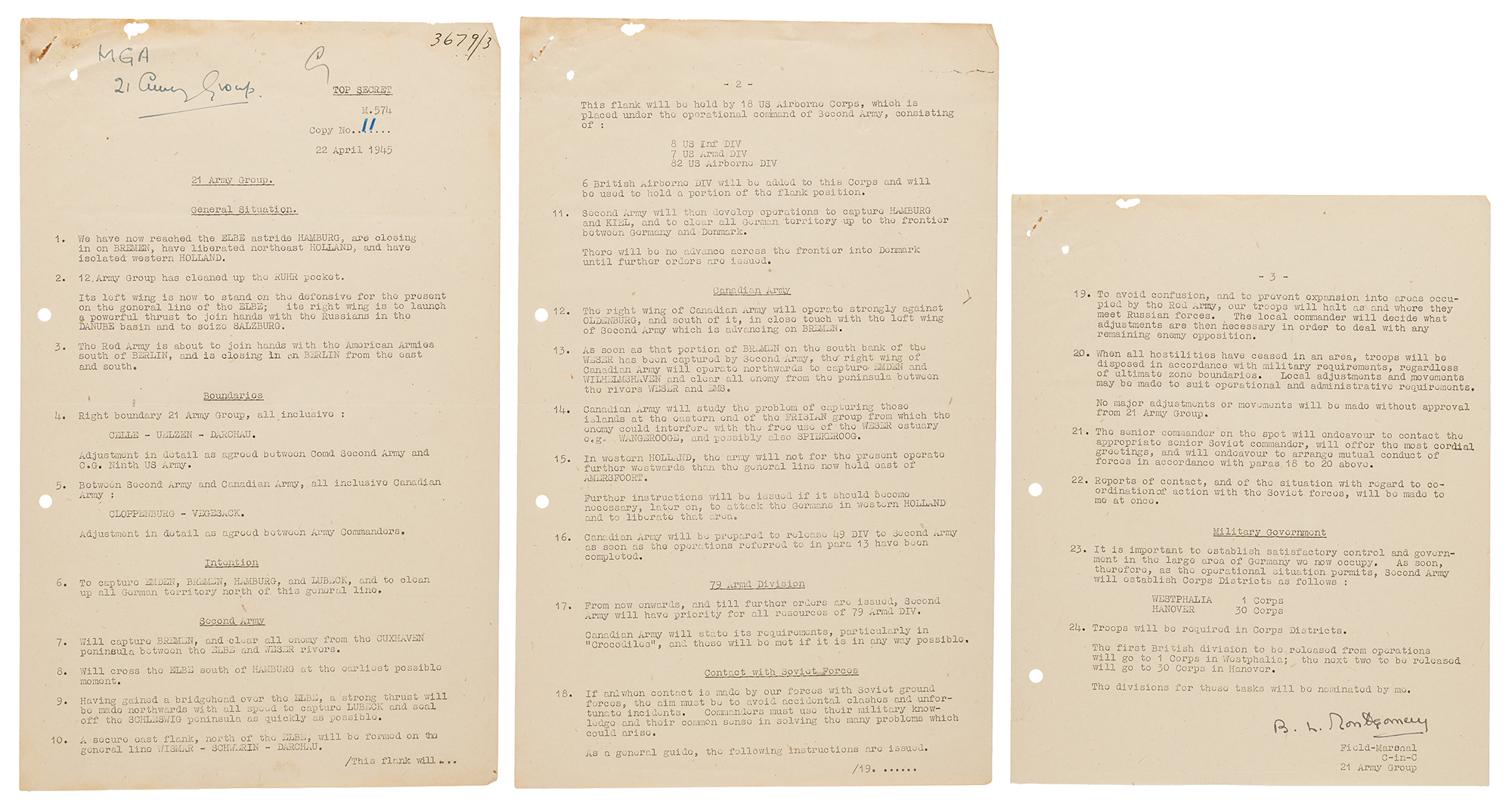
April 22, 1945 (M574, signed "B. L. Montgomery) - The last battle order of the war in Europe, planning the drive to the Baltic: "We have now reached the Elbe astride Hamburg, are closing in on Bremen, have liberated northeast Holland, and have isolated western Holland. 12 Army Group has cleaned up the Ruhr pocket. Its left wing is now to stand on the defensive for the present on the general line of the Elbe; its right wing is to launch a powerful thrust to join hands with the Russians in the Danube basin and to seize Salzburg. The Red Army is about to join hands with the American Armies south of Berlin, and is closing in on Berlin from the east and south…Intention: To capture Emden, Bremen, Hamburg, and Lubeck, and to clean up all German territory north of this general line…If and when contact is made by our forces with the Soviet ground forces, the aim must be to avoid accidental clashes and unfortunate incidents. Commanders must use their military knowledge and their common sense in solving the many problems which could arise…Military Government: It is important to establish satisfactory control and government in the large area of Germany we now occupy. As soon, therefore, as the operation situation permits, Second Army will establish Corps Districts as follows: Westphalia - 1 Corps, Hamburg - 30 Corps."
May 30, 1945 (unsigned) - Montgomery's message to "the population of the British Area in Germany," explaining: "I have been appointed by the British Government to command and control the area now occupied by the British Army. This area will be governed for the present by Military Government under my orders. My immediate object is to establish a simple and orderly life for the whole community. The first step is to see that the population has:—(a) food, (b) housing, (c) freedom from disease…Those who have committed war crimes according to international law will be dealt with in proper fashion…The German Wehrmacht, and other armed forces, will be disarmed and disbanded. All German soldiers, sailors, and airmen, are being sorted out by trades and occupations. In a few days they will start to be discharged from the armed forces so that they can get on with the work."
June 11, 1945 (signed "B. L. Montgomery") - Notes of the C-in-C's "Conference for Corps District Commanders," discussing the governance of occupied Germany, touching upon issues with Russian Communist propaganda, agriculture, German prisoners, German re-education, displaced persons, and other problems and policies.
In overall very good to fine condition, with expected wartime handling wear including folds, filing holes, staple rust, occasional edge wear, and toning.
Comparable command-level operational archives of the Second World War are today overwhelmingly preserved in institutions such as the Imperial War Museum, the U.S. National Archives, and the Liddell Hart Centre for Military Archives. Complete private holdings of this scale and continuity—especially retaining original Montgomery signatures across the campaign chronology—are virtually unknown to the market.
Taken together, the archive constitutes a remarkable chronicle of the Allied liberation of Western Europe, preserving Montgomery’s operational thinking in real time across the decisive final year of the war. Few surviving private archives capture the conduct of modern coalition warfare at such proximity to supreme command, and fewer still do so across the entire campaign from Normandy to occupied Germany.

