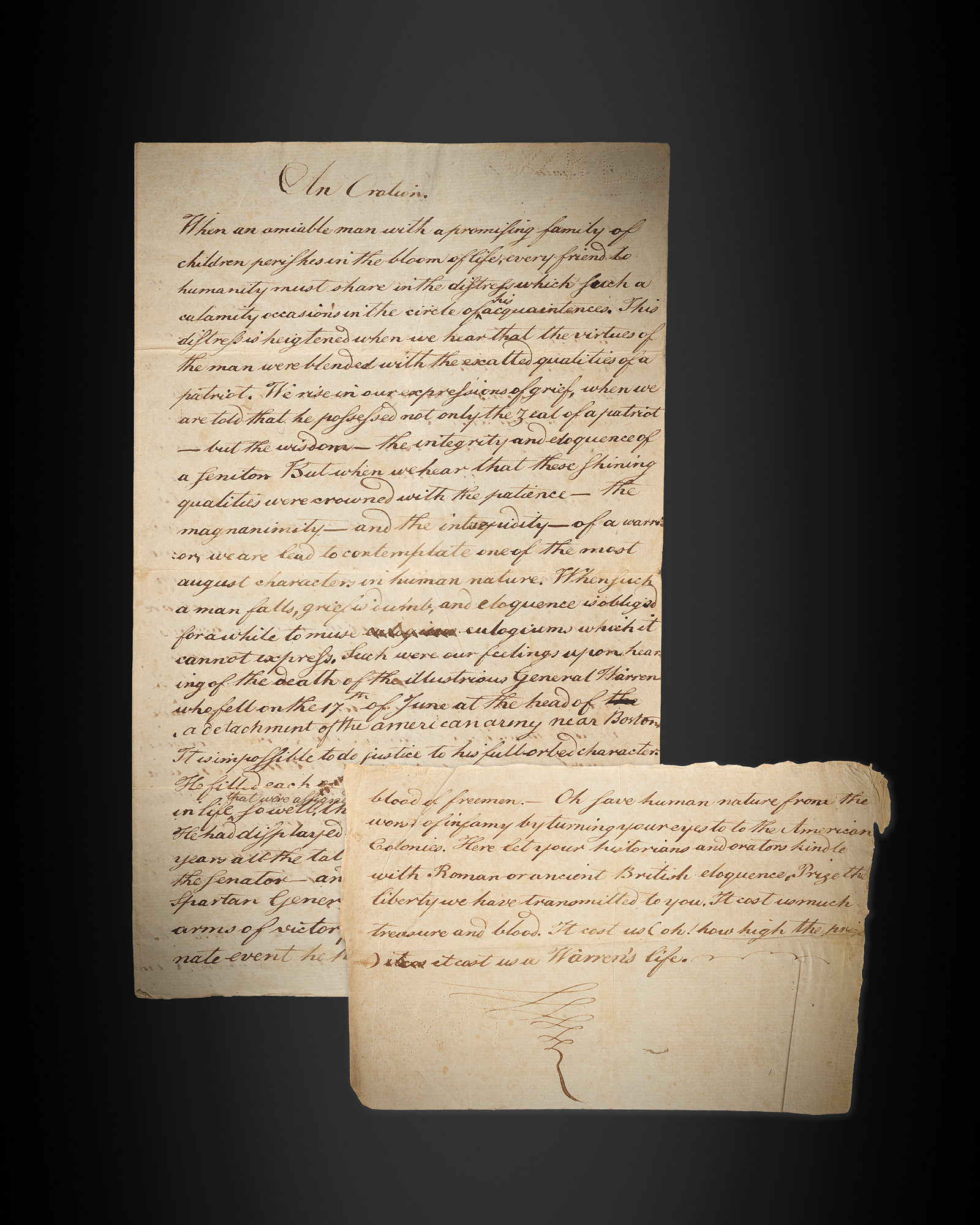
Sold For $1,565
*Includes Buyers Premium
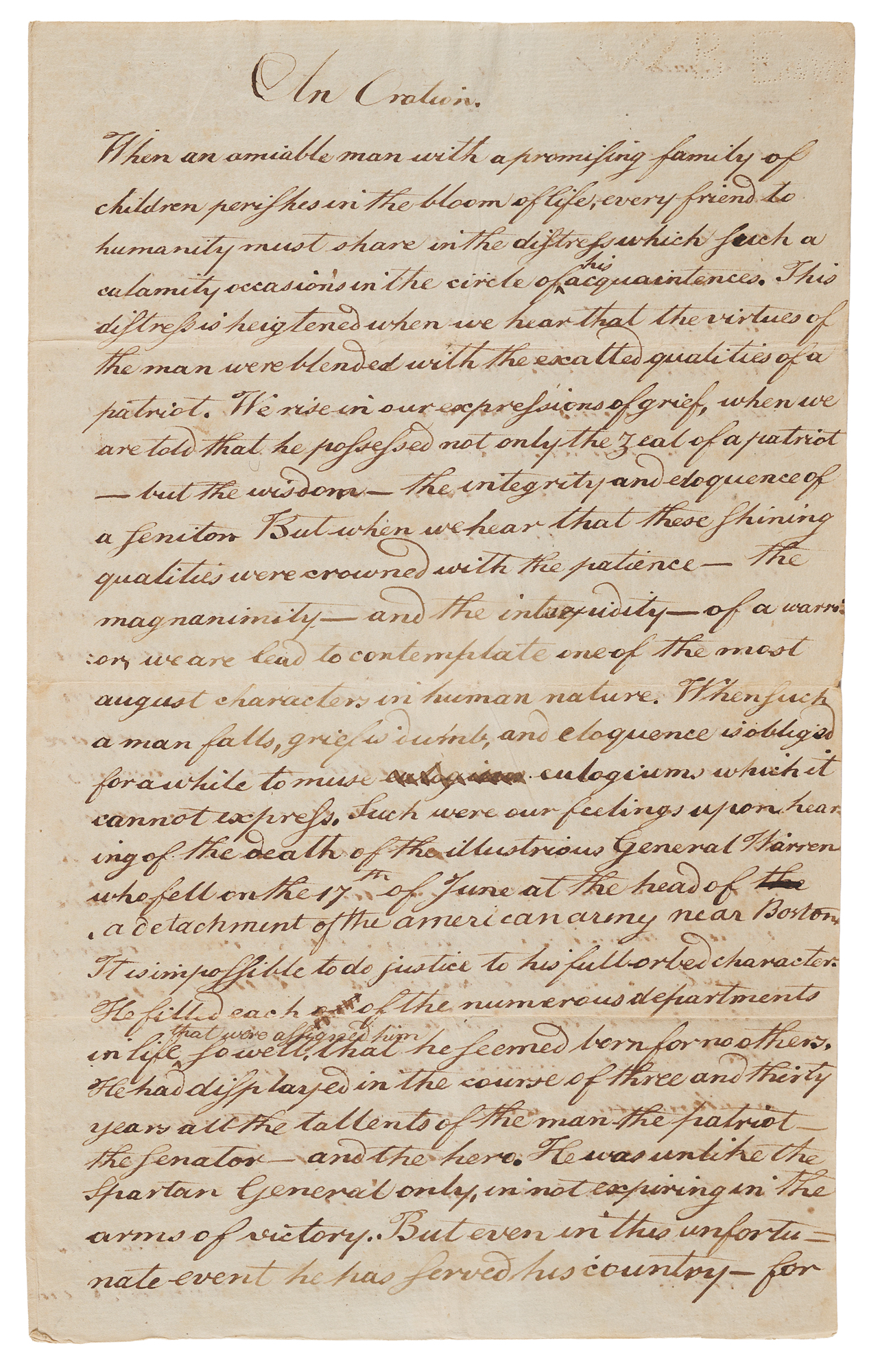
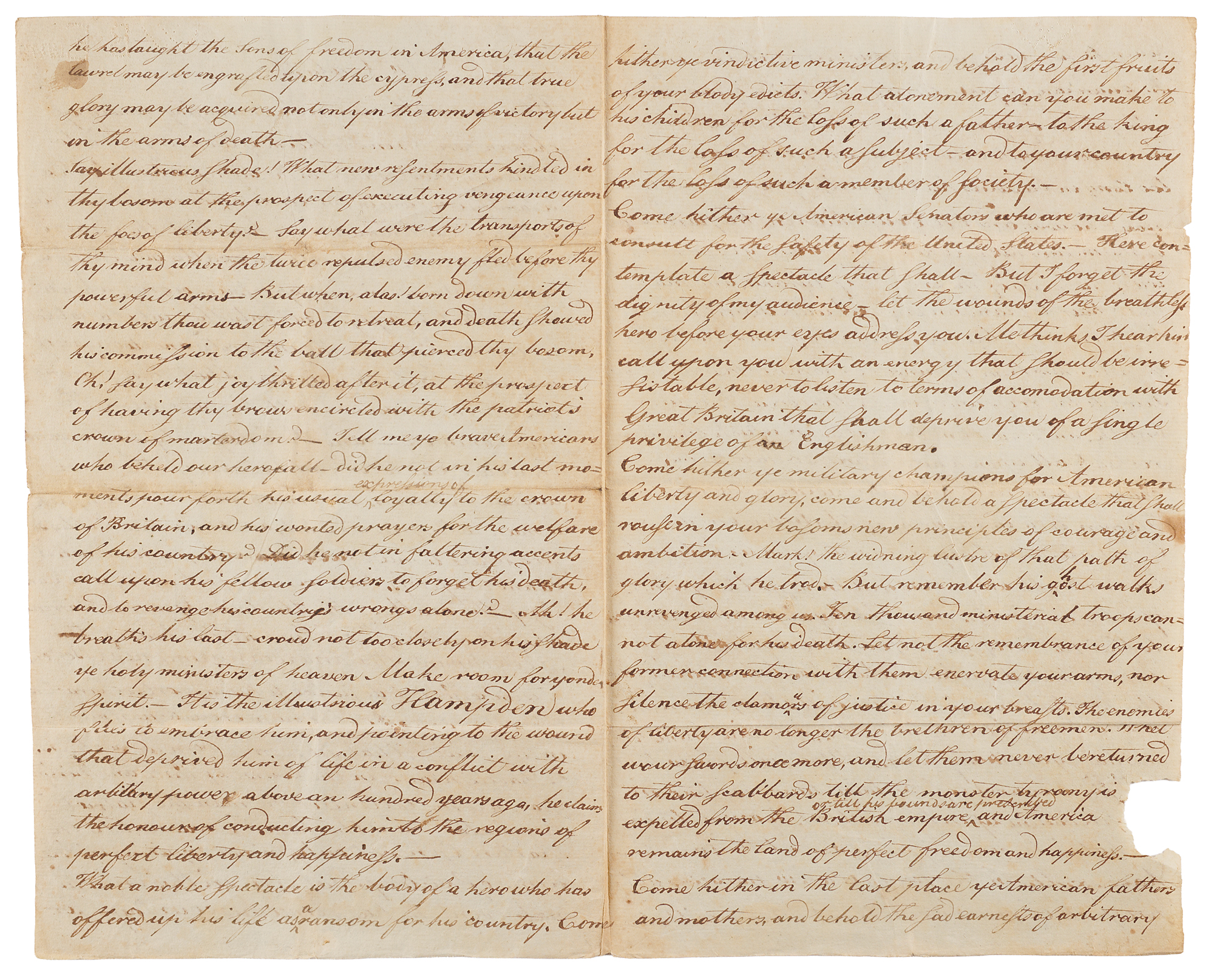
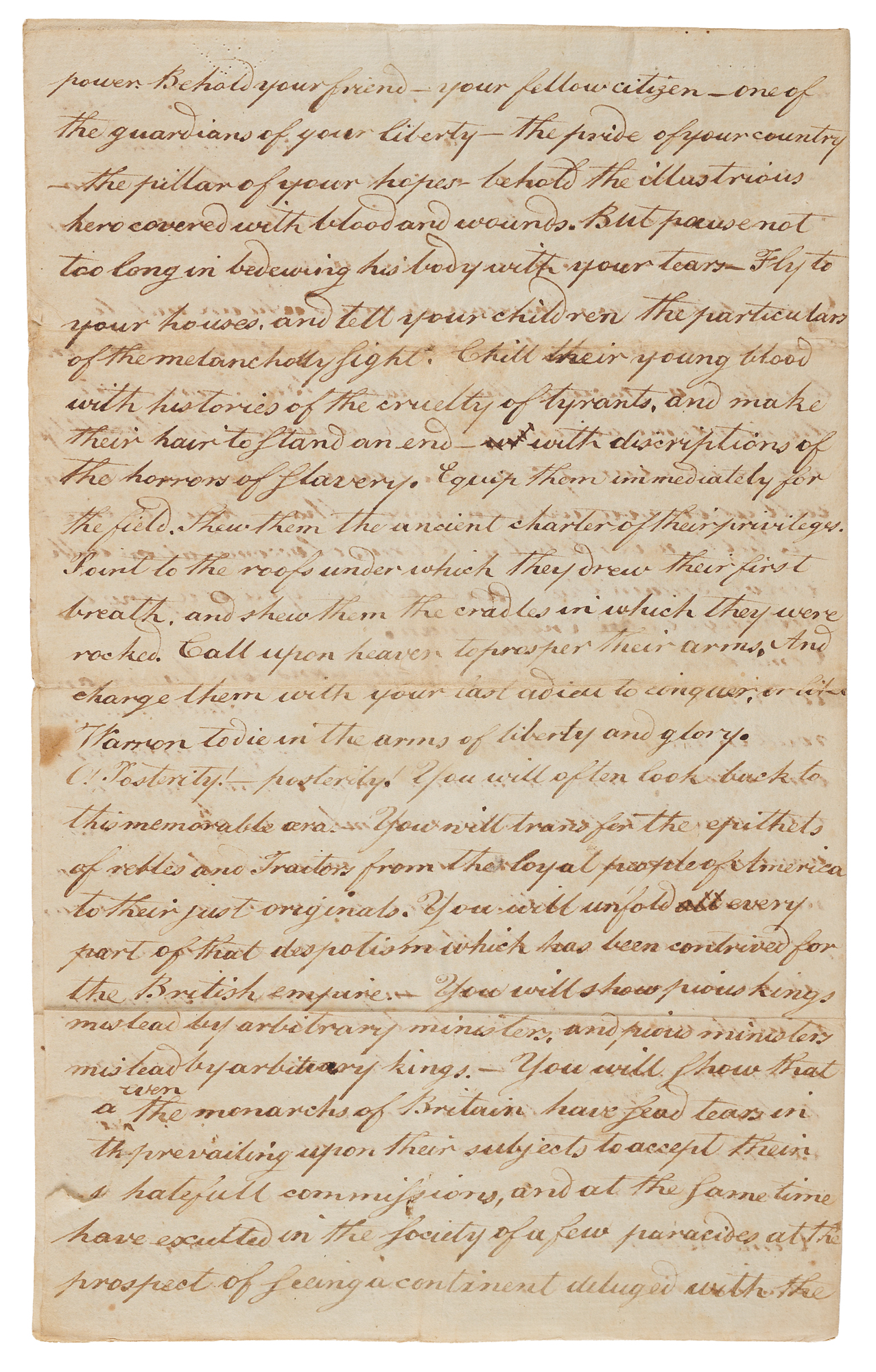
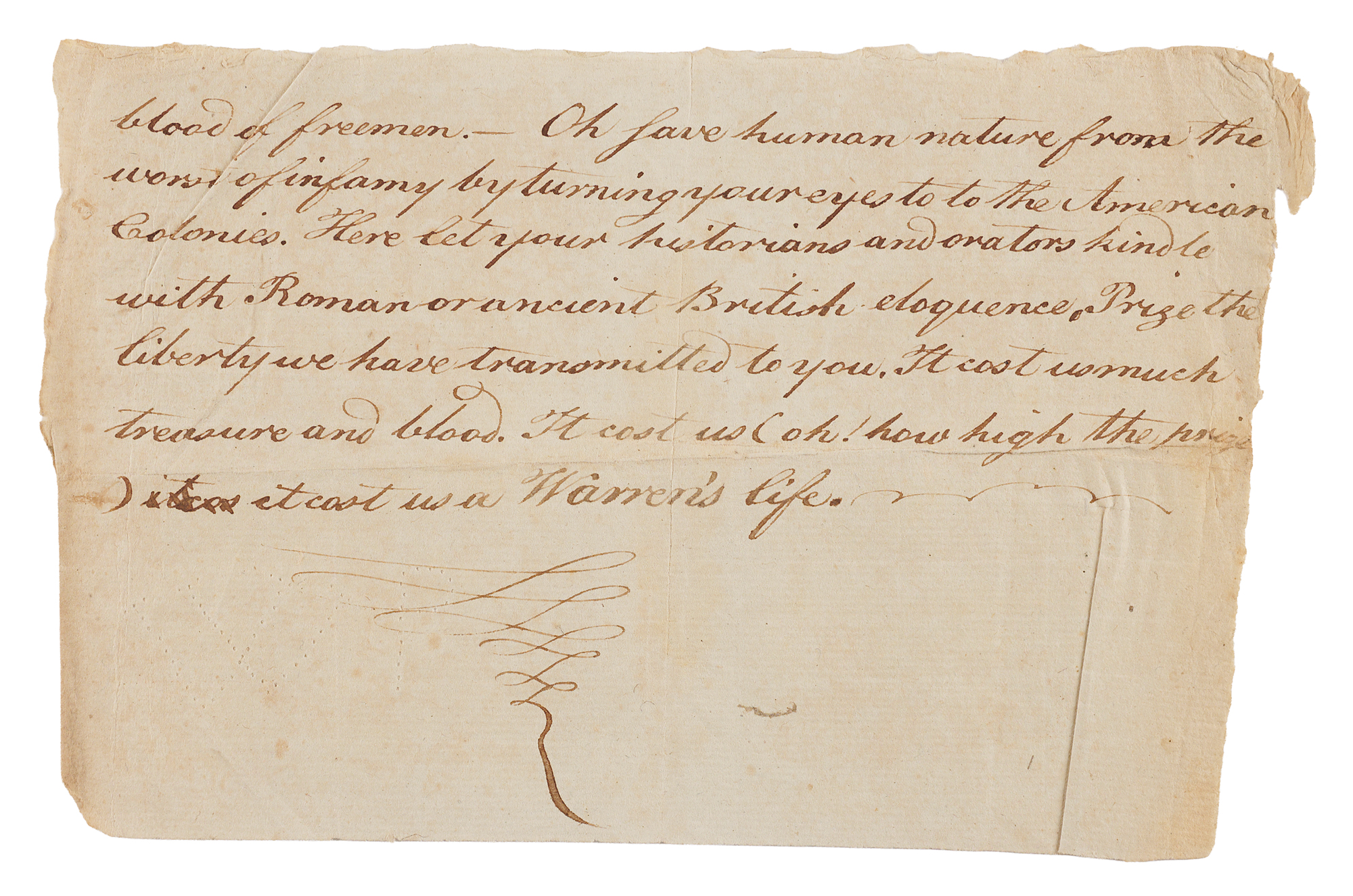
Revolutionary War-era manuscript eulogy memorializing Major General Joseph Warren following his death at the Battle of Bunker Hill on June 17, 1775, apparently an original author’s draft whose text was later published in the “Monthly Intelligence” section of the Pennsylvania Magazine shortly after Warren’s death. The manuscript, four pages on two adjoining sheets, 7.5 x 12.25, with the final paragraph on a separate 8 x 5.25 sheet, is handwritten in ink on period laid paper bearing an “FL” watermark. The manuscript displays numerous small corrections and revisions throughout the text, suggesting either a working draft or an early contemporary transcription prepared for publication or circulation. Also present are pinpoint-dot initials of “WBE” and “WP,” both of uncertain significance.
The eulogy begins, in part: “When an amiable man with a promising family of children perishes in the bloom of life, every friend to humanity must share in the distress which such a calamity occasions in the circle of his acquaintances. This distress is heightened when we hear that the virtues of the man were blended with the exalted qualities of a patriot. We rise in our expressions of grief, when we are told that he possessed not only the zeal of a patriot – but the wisdom – the integrity and the eloquence of a senator. But when we hear that these shining qualities were crowned with the patience – the magnanimity – and the intrepidity – of a warrior, we are led to contemplate one of the most august characters in human nature. When such a man falls, grief is dumb, and eloquence is obliged for a while to muse eulogiums which it cannot express.”
It concludes: “O! Posterity! – posterity! You will often look back to this memorable æra. – You will treasure the exploits of rebels and traitors from the loyal people of America to their just originals. You will unfold every part of that despotism which has been contrived for the British empire – you will show pious kings misled by arbitrary ministers, and pious ministers misled by arbitrary kings. – You will show that even the monarchs of Britain have shed tears in the…prevailing upon their subjects to accept their hateful commissions, and at the same time have exulted in the society of a few paracides at the prospect of seeing a continent deluged with the blood of freemen. – Oh! save human nature from the worst of infamy by turning your eyes to the American Colonies. Here let your historians and orators kindle with Roman or ancient British eloquence. Prize the liberty we have transmitted to you. It cost us much treasure and blood. It cost us (oh! how high the prize) it cost us a Warren’s life.” In fine condition, with a small area of paper loss, affecting a few words of text.
Joseph Warren, physician, politician, and major general of the Massachusetts militia, emerged as one of the most important Patriot leaders of the early American Revolution. A central organizer of resistance in Boston alongside Samuel Adams and Paul Revere, Warren played a leading role in Revolutionary communications, intelligence, and militia organization in the months preceding Lexington and Concord. Although appointed a major general shortly before the Battle of Bunker Hill, Warren chose to fight as a volunteer on June 17, 1775, where he was killed during the British assault on Breed's Hill. His death transformed him into one of the first great martyrs of the American cause, inspiring an outpouring of commemorative sermons, poems, broadsides, and patriotic eulogies throughout the colonies.
The manuscript corresponds closely to the text of a eulogy published in the "Monthly Intelligence" section of the Pennsylvania Magazine in 1775, during the period in which Thomas Paine served as editor of the publication. Structured as a sweeping patriotic oration addressed in turn to senators, soldiers, parents, and posterity, the eulogy reflects the influence of classical republican rhetoric that shaped Revolutionary political literature in the opening months of the American Revolution. The emotionally charged language portrays Warren as the embodiment of republican virtue while denouncing British military authority as ‘arbitrary power’ and ‘ministerial tyranny,’ exhorting Americans across every station of life to continue the struggle for independence in the wake of his death.

