Sold For $10,208
*Includes Buyers Premium
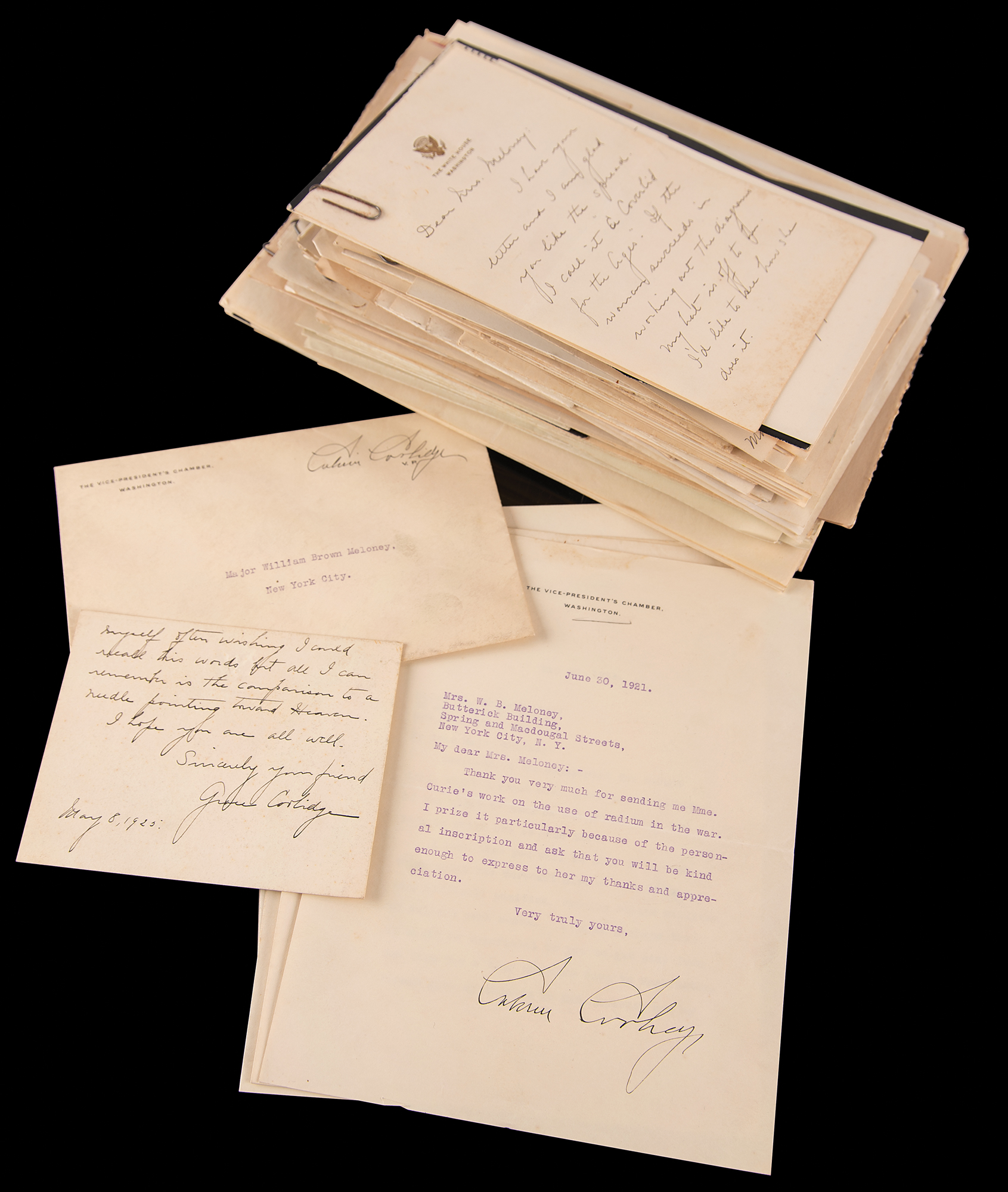
Archive of over 100 letters signed by Calvin and Grace Coolidge, dated between 1921 and 1933, deriving from the personal collection of Marie Mattingly Meloney (1878–1943), a distinguished magazine editor and influential social figure widely regarded as ‘one of the leading women journalists of the United States.’ The wife of noted journalist, writer, and shipping historian William Brown Meloney (1878–1925), she played a significant role in American public life during the 1920s. Among her many accomplishments, she organized a successful international campaign to raise funds for the purchase of radium for Marie Curie and founded the Better Homes in America movement, promoting improved housing and living standards. Meloney was also a close friend and confidante of both Grace Coolidge and Eleanor Roosevelt.
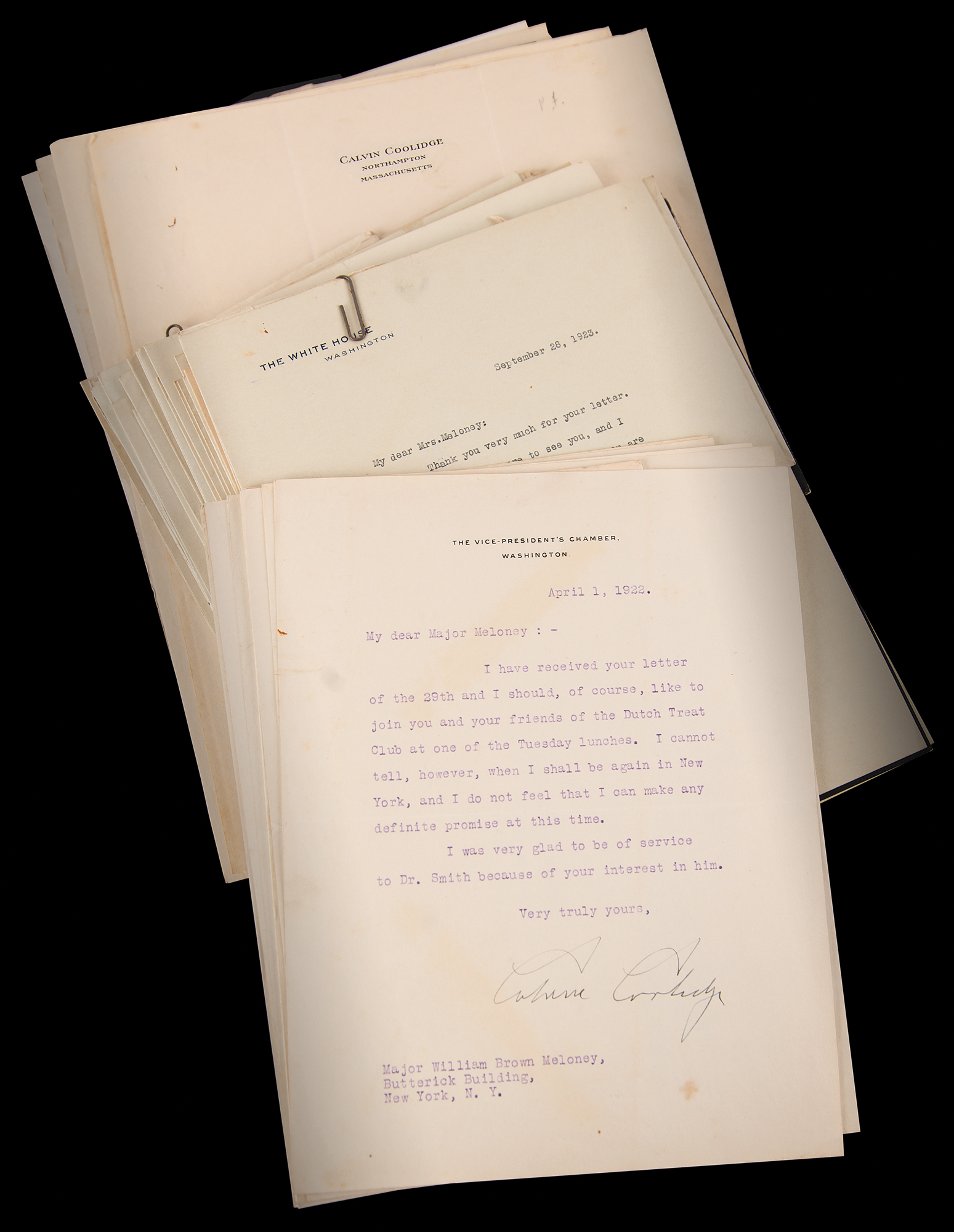
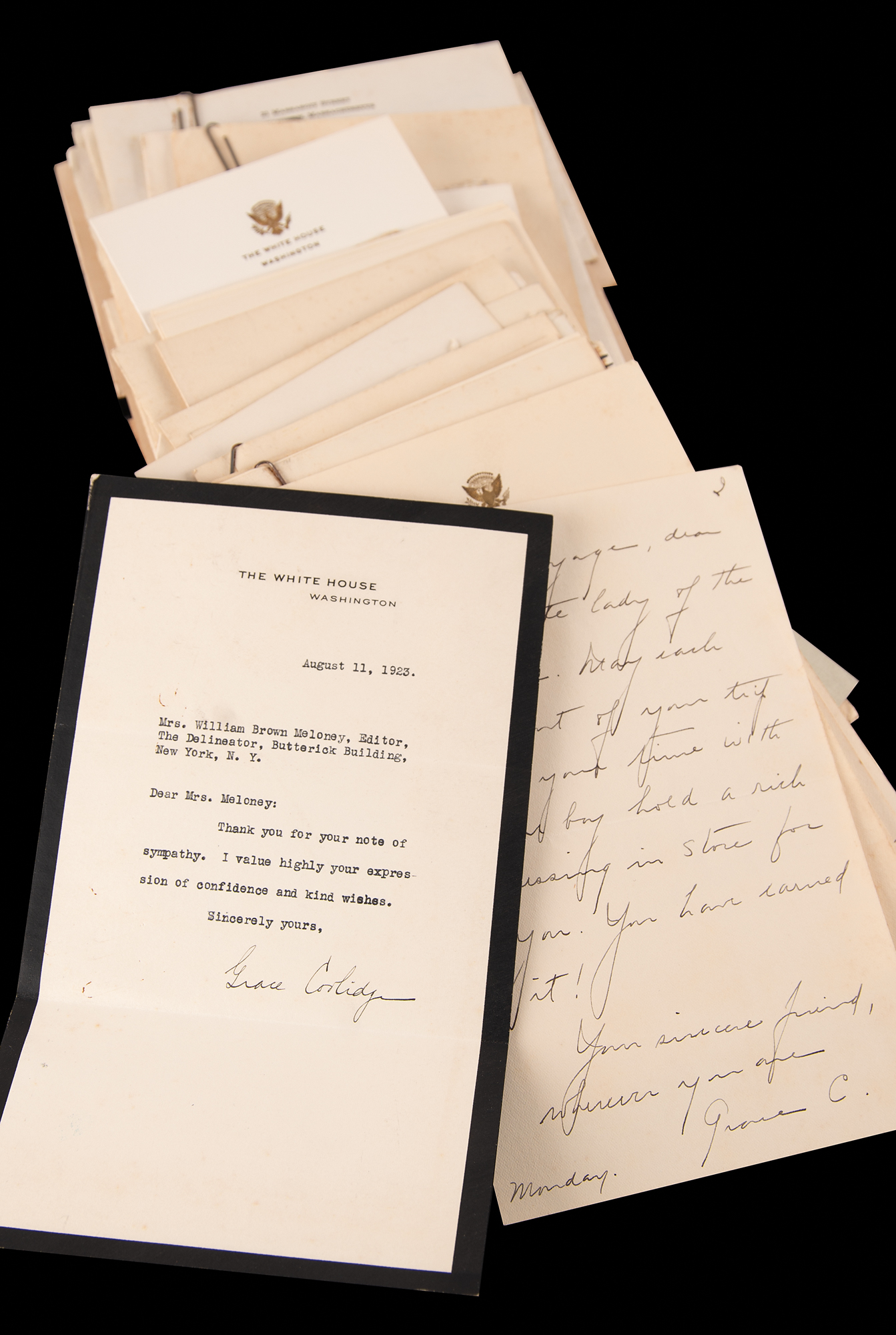
Covering nearly the full span of Coolidge’s time in the White House as vice president and president, as well as the years following his departure from office, the archive contains a total of 58 letters (61 total pages) from Calvin and 44 from Grace (100 total pages), with the Calvin letters comprised of 29 TLSs as president (September 28, 1923–September 26, 1928), 13 TLSs and one ALS as vice president (May 30, 1921–March 24, 1923), and 13 letters signed post-presidency. The Grace letters consist of 22 ALSs and one TLS as first lady, and 14 ALSs and seven TLSs dated to her life after the White House. The letters are typed or handwritten on their respective Vice President, White House, or personal letterhead or stationery.
While much of the correspondence consists of formalities—such as thank-you letters and updates on family and health—it also contains substantive material relating to initiatives associated with Marie Meloney’s wide-ranging work, including the historic 1921 White House visit of Marie Curie, the founding of the Better Homes in America movement, efforts to fund relief for World War I soldiers, and her collaboration with the U.S. Department of Agriculture on health and nutrition. Representative letters from Calvin Coolidge, written during his tenure as vice president and president, include:
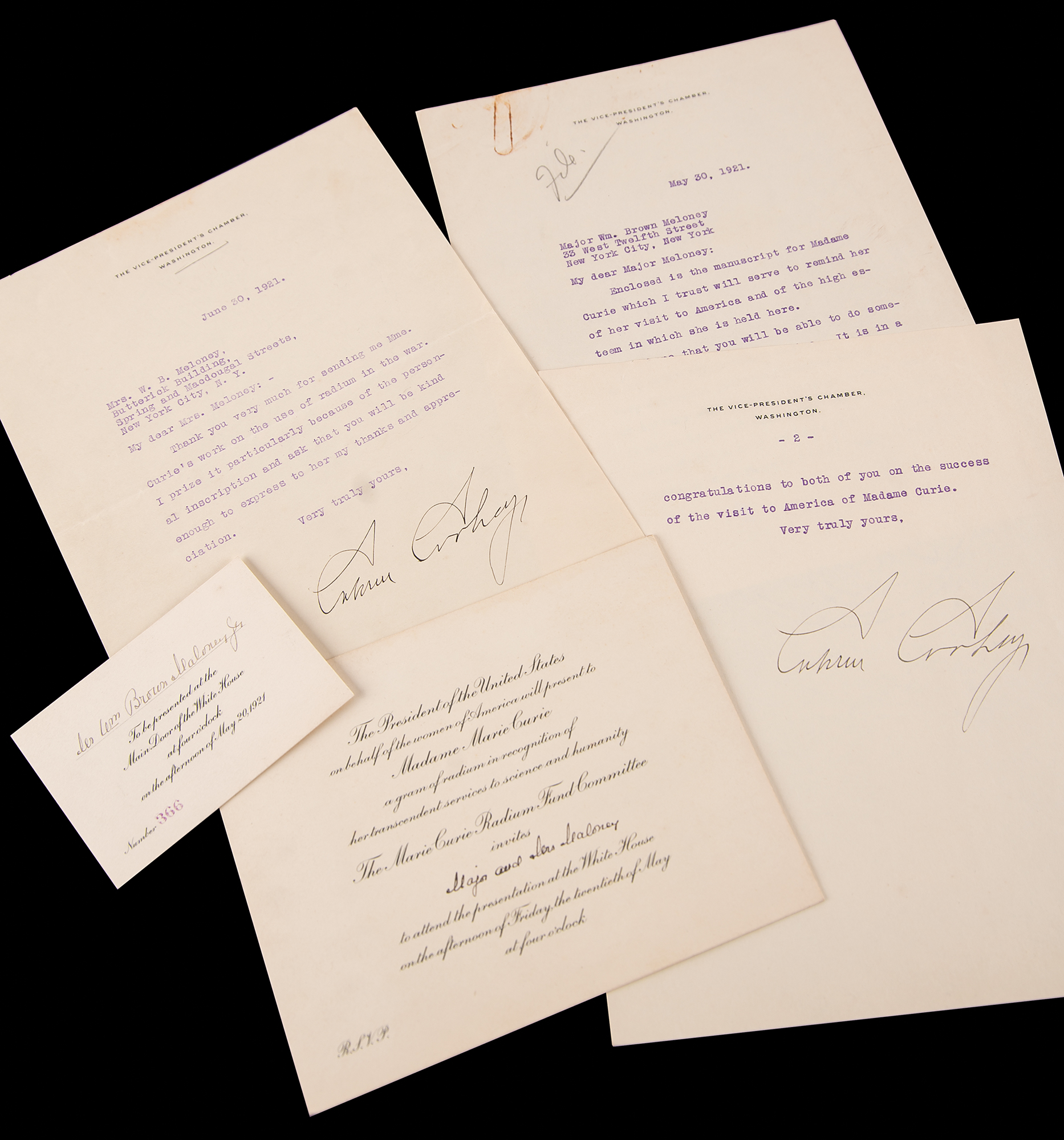
May 30, 1921: “Enclosed is the manuscript for Madame Curie which I trust will serve to remind her of her visit to America and of the high esteem in which she is held here…Please give my regards to Mrs. Meloney and my congratulations to both of you on the success of the visit to America of Madame Curie.”
June 30, 1921: “Thank you very much for sending me Mme. Curie's work on the use of radium in the war. I prize it particularly because of the personal inscription and ask that you will be kind enough to express to her my thanks and appreciation.”
March 27, 1922: “About one man in four, or one million, have made application to the Government for money in one form or another. You can comprehend, through your connection with publications which have a large circulation what that number means, and how almost impossible it becomes to get the real facts in cases, give relief to those who are entitled to it, and withhold it from those who are not entitled to it. There cannot fail to be many mistakes on both sides of this line…The United States Government is undertaking to do parish work. It cannot be done successfully. In order to administer relief fairly, it needs to be done by the locality, by someone who is acquainted with the surroundings, who has personal touch with the applicant. Otherwise, there grows up fraud on one side, lack of relief on the other. We have attempted to remedy this by dividing the country into fourteen districts, with one hundred and forty sub offices, keeping in touch with local Legion Posts, Red Cross headquarters and local charities. But this is a second or third-hand method, and of course secures the consequent results. We are spending a million and a quarter dollars each day on this kind of work.”
January 13, 1923: “I have been extremely interested in the report of the Better Homes campaign and am very glad that it was so successful. You had many obstacles to overcome and it was largely due to your energy and enthusiasm that so much was accomplished.”
April 16, 1926: “I wish to express my hearty approval of your suggestion that the United States Department of Agriculture call a conference on the food habits of the American people. The direct connection between food and health is universally recognized. An adequate supply of food of the right kinds and amounts is of fundamental importance to any nation…National economy is based upon a combination of efficient production and wise consumption. The home is the greatest consumer of agricultural products. If this consumption is to be guided along lines that make for health and physical efficiency, more detailed facts must be known about present food habits.”
Other notable inclusions of the archive:
Two official White House invitation cards issued to the Meloneys by President Warren G. Harding and “The Marie Curie Radium Fund Committee,” to attend a presentation at the White House on May 20, 1921, where “Madame Marie Curie” will be presented with “a gram of radium in recognition of her transcendent services to science and humanity.” The event’s original admission pass, numbered “366” and issued to William Brown Meloney, is included.
Period printed “Address of President Coolidge at the Observance of the Tenth Anniversary of the Armistice” booklet, dated November 11, 1928, signed on the last page in black ink by Coolidge.
10-page typed manuscript of an article written by Calvin Coolidge on George Washington, which he forwarded (along with two TLSs) to Marie Meloney, who was then serving as editor of the Sunday magazine of the New York Herald Tribune. In part: “The celebration of the bicentennial of the birth of the first American which occurs on the twenty-second day of February of the present year should, of course, include a proper estimate of him as a great statesman and a great soldier.”
A typed manuscript on White House stationery signed by Calvin Coolidge, which discusses the founding of the Better Homes in America movement: “The American home is the source of our national well-being. In it our high traditions of service and integrity are fostered. From the true home there emerges respect for the rights of others, and the habit of cooperating for worthy ends. Through sharing its common enterprises and common sacrifices, the child develops that sturdiness of character which distinguishes the manhood and womanhood of our land.”
An 11-page typed manuscript signed by Grace Coolidge, containing detailed instructions for knitting her “Great Grandmother’s Counterpane,” which is accompanied by three printed booklets published by the Herald Tribune Magazine, “Mrs. William Brown Meloney, Editor.” A 7-page ALS as first lady references this project and booklet.
A four-page typed manuscript signed by Grace Coolidge entitled “A Coverlet for the Ages,” which pertains to the coverlet she crocheted for the Lincoln Bed in 1927. A four-page ALS as first lady references this project. In overall fine condition. Accompanied by an impressive array of over 75 signed letters from the Coolidges’ secretaries, the majority of which belong to Edward T. Clark and Mary Randolph.

