The 30 Minute Rule begins May 21 at 7:00 PM EDT. An Initial Bid Must Be Placed By May 21 at 6:00 PM EDT To Participate After 6:00 PM EDT
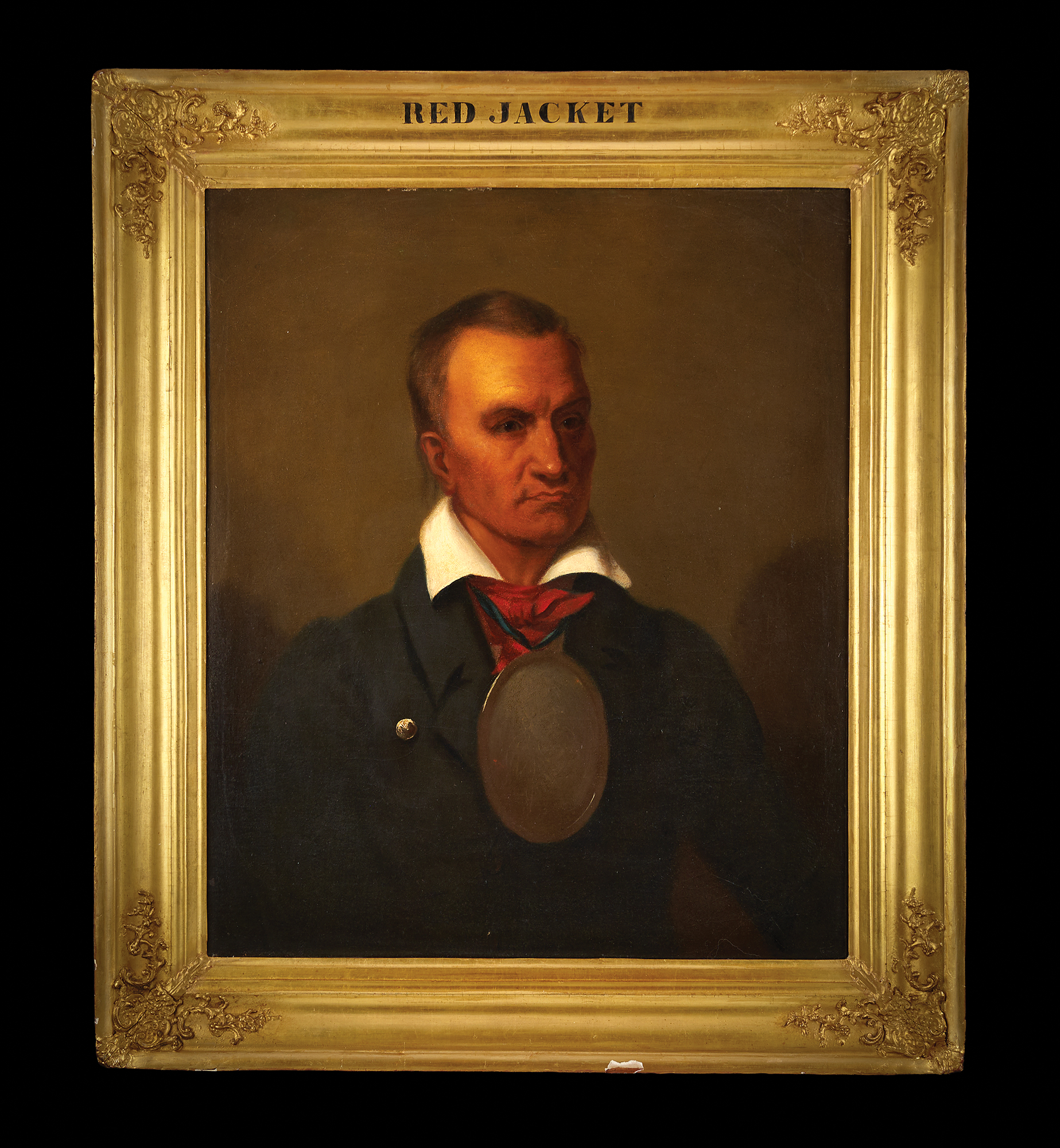
Exceptional original 25 x 29.5 oil painting of Red Jacket accomplished by fashionable 19th-century Philadelphia portraitist John B. Neagle, oil on canvas laid down on Masonite, showing the celebrated Seneca leader in a bust-length pose, dressed in a navy blue coat, bright red cravat, and the large 'Peace Medal' given to him by George Washington in 1792. Impressively framed to an overall size of 33 x 38, with a block-letter caption, "Red Jacket," painted at the top. In very good to fine condition, with some chipping and old repairs to the frame.
Provenance: Property from the Philadelphia History Museum at the Atwater Kent (Acquired in 1855), Lot 36, Christie's, September 25, 2012.
Exhibition history: The Pennsylvania Academy of the Fine Arts, Exhibition of Portraits by John Neagle, April 12-May 13, 1925; illustrated in the exhibition catalogue, p. 80.
Also illustrated in The Indian Legacy of Charles Bird King by H.J. Viola, Washington, D.C., 1976, p. 141, as attributed to Charles Bird King. A label from the Historical Society of Pennsylvania on the reverse also misattributes the work to King.
John B. Neagle (1796–1865), among the most accomplished portraitists active in Philadelphia during the early 19th century, rose to prominence through a combination of technical discipline and influential artistic associations. He began his training as an apprentice to Thomas Wilson, a noted sign and coach painter, whose connections introduced Neagle to leading figures in the city’s artistic circles, including Bass Otis and, later, the celebrated portraitist Thomas Sully. Under this guidance, Neagle refined a meticulous approach to likeness and developed a particular aptitude for portraiture, establishing his reputation by the mid-1810s with a series of small but finely executed works. By 1818, he had committed himself entirely to portrait painting, quickly becoming one of the foremost practitioners in Philadelphia.
Neagle’s career gained significant momentum in 1823 when he exhibited an oil study of the renowned Seneca orator Red Jacket (Sagoyewatha). The work attracted widespread attention and cemented his status among the leading artists of his day. Known for his ability to capture both the physical presence and psychological depth of his sitters, Neagle would go on to produce some of the most compelling portraits of prominent American figures of the period.
Red Jacket himself was a figure of considerable interest to artists and audiences alike. A principal chief of the Seneca and a member of the Wolf Clan, he was widely admired for his eloquence and leadership, particularly in negotiations with the United States government. His receipt of a large 'Peace Medal' from President George Washington in 1792 symbolized his diplomatic importance and became a defining attribute in his portraiture. As a result, he sat for, or inspired, numerous likenesses by leading artists including Charles Bird King and George Catlin.
Although Neagle is known to have produced portraits from life sittings with Red Jacket, the present work appears to draw inspiration from an earlier composition by Charles Bird King, reflecting the broader circulation and reinterpretation of iconic Native American subjects among 19th-century artists.
The Western Americana auction of Jochen Zeitz.

