Sold For $168,213
*Includes Buyers Premium
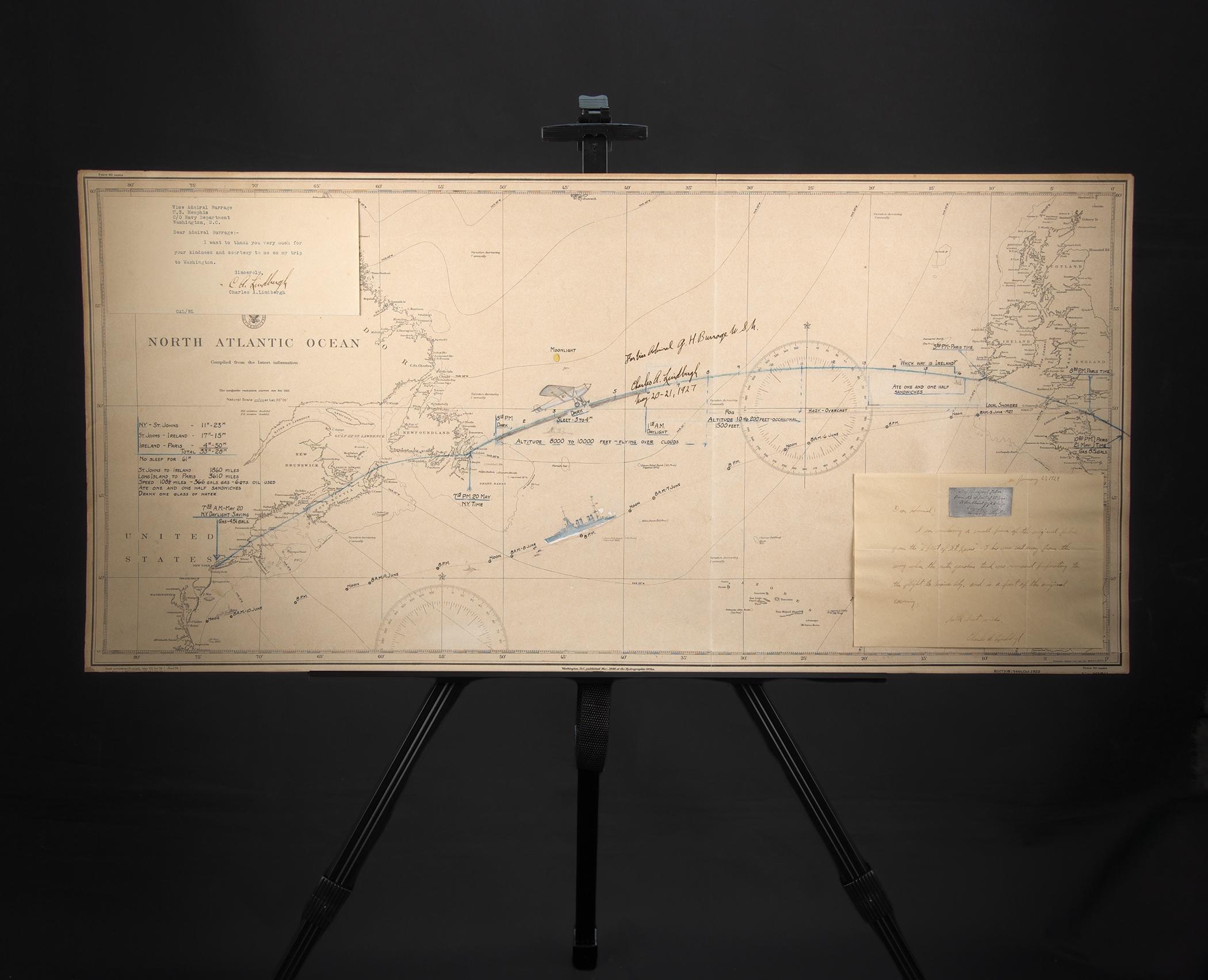
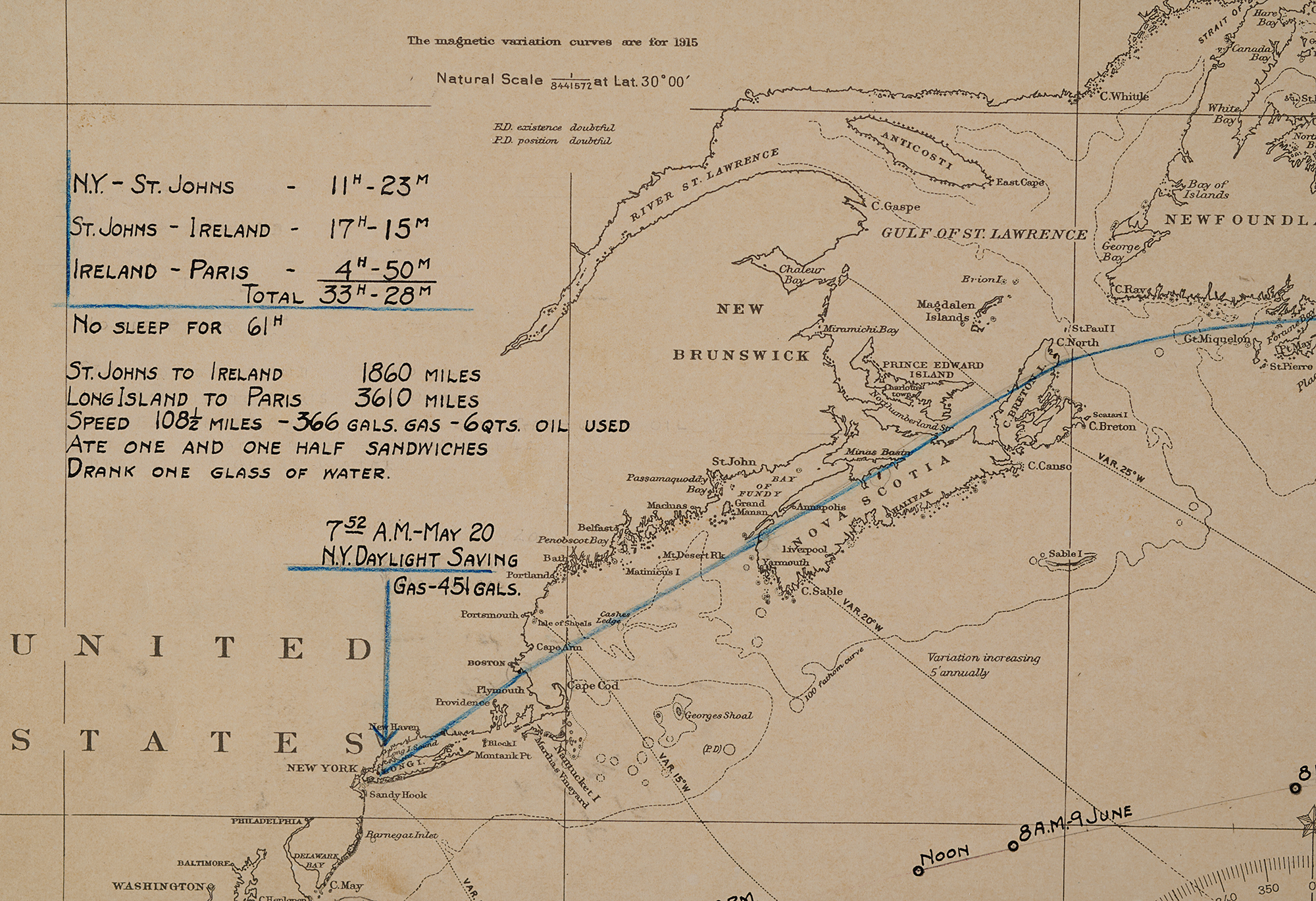
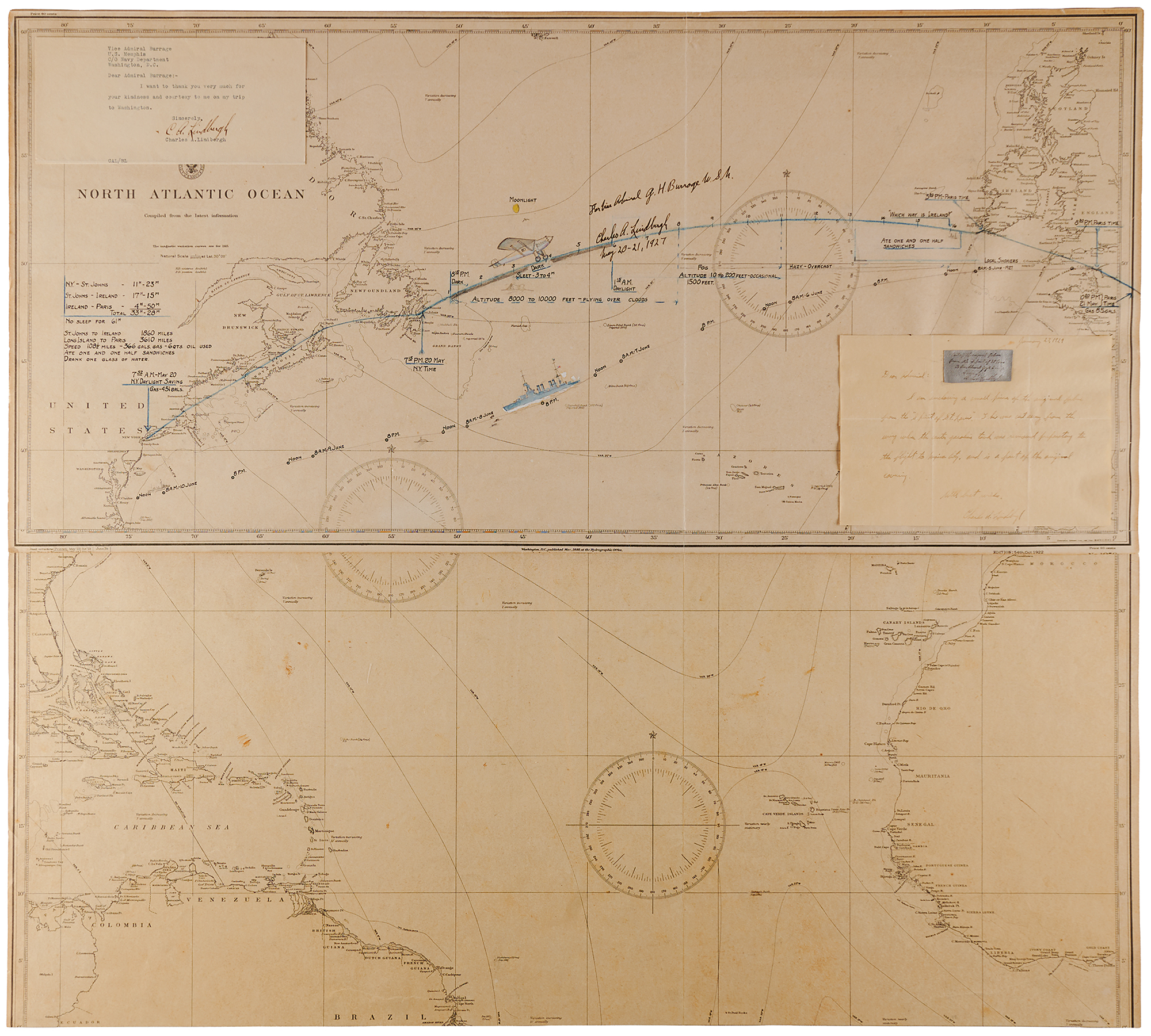
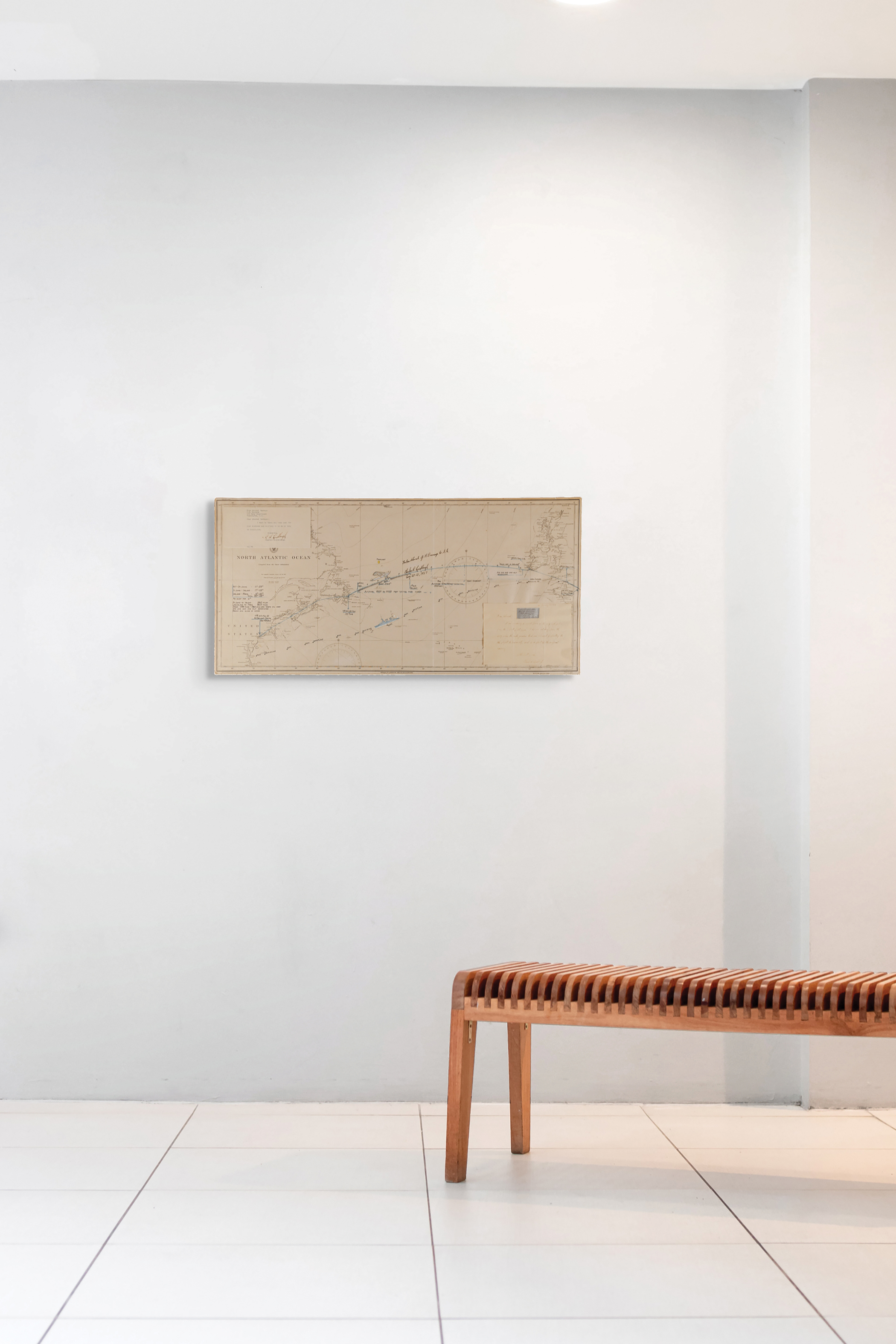
The left side of the map is annotated with a summary of flight times and fuel consumption: "N.Y.–St. Johns - 11H-23M, St. Johns–Ireland - 17H-15M, Ireland–Paris - 4H-50M, Total 33H-28M. No sleep for 61H. St. Johns to Ireland 1860 Miles, Long Island to Paris 3610 Miles, Speed 108 1/2 Miles - 366 Gals. Gas - 6 Qts. Oil Used, Ate one and a half sandwiches. Drank one glass of water."
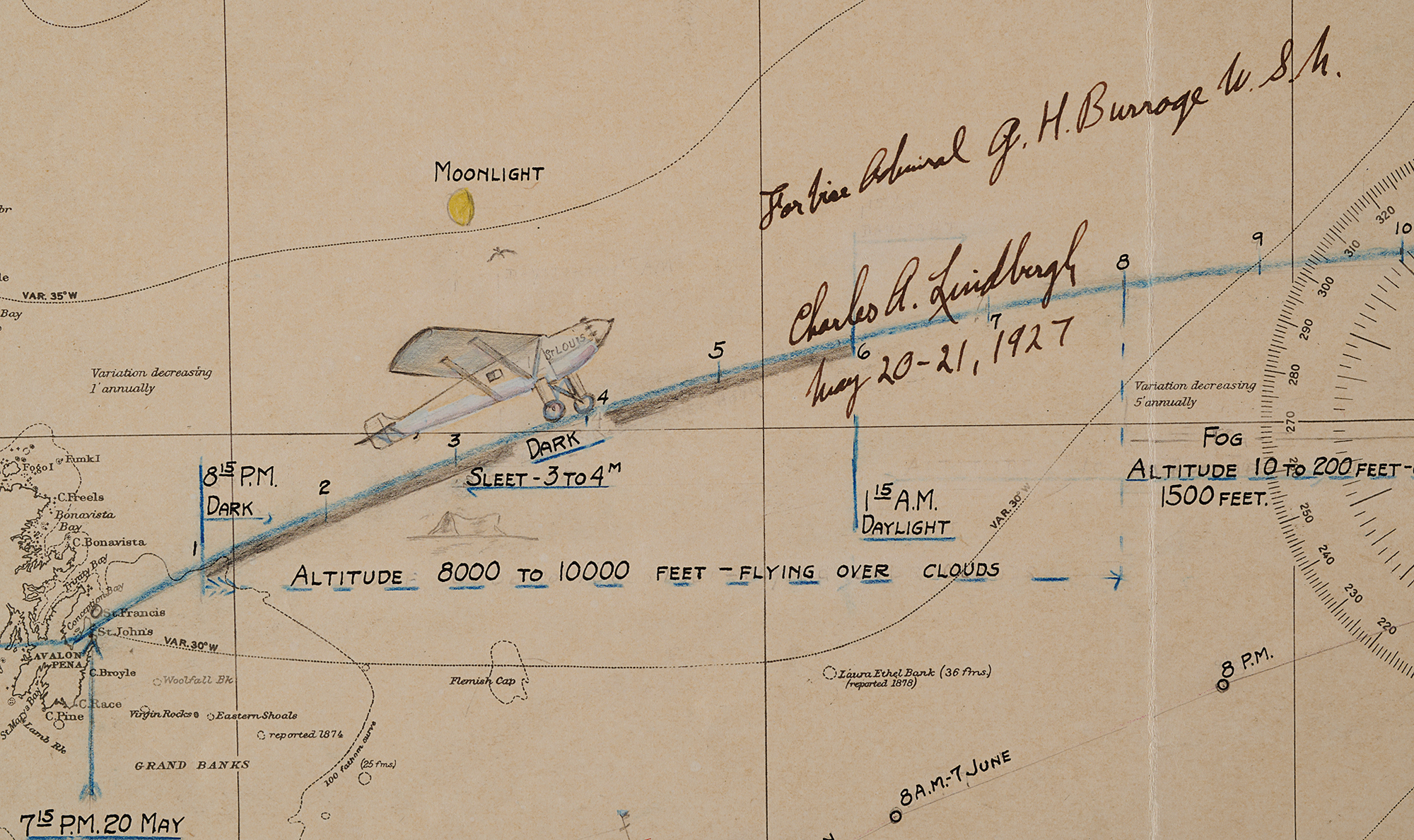
The flight path is traced below, from Roosevelt Airfield in Garden City, New York, to Aéroport Le Bourget in Paris, which lies slightly off the chart in the right margin. Times, conditions, and notable events are indicated along the route, starting with takeoff: "7:52 a.m. - May 20. NY Daylight Savings Time. Gas - 451 Gals." The Spirit of St. Louis's journey is traced in blue pencil, up the New England coast and over St. John's, Newfoundland at "7:15 P.M., 20 May, N. Y. Time." By 8:15 Lindbergh is over the open Atlantic—and in darkness, climbing in altitude from "8000 to 1000 feet—flying over clouds."
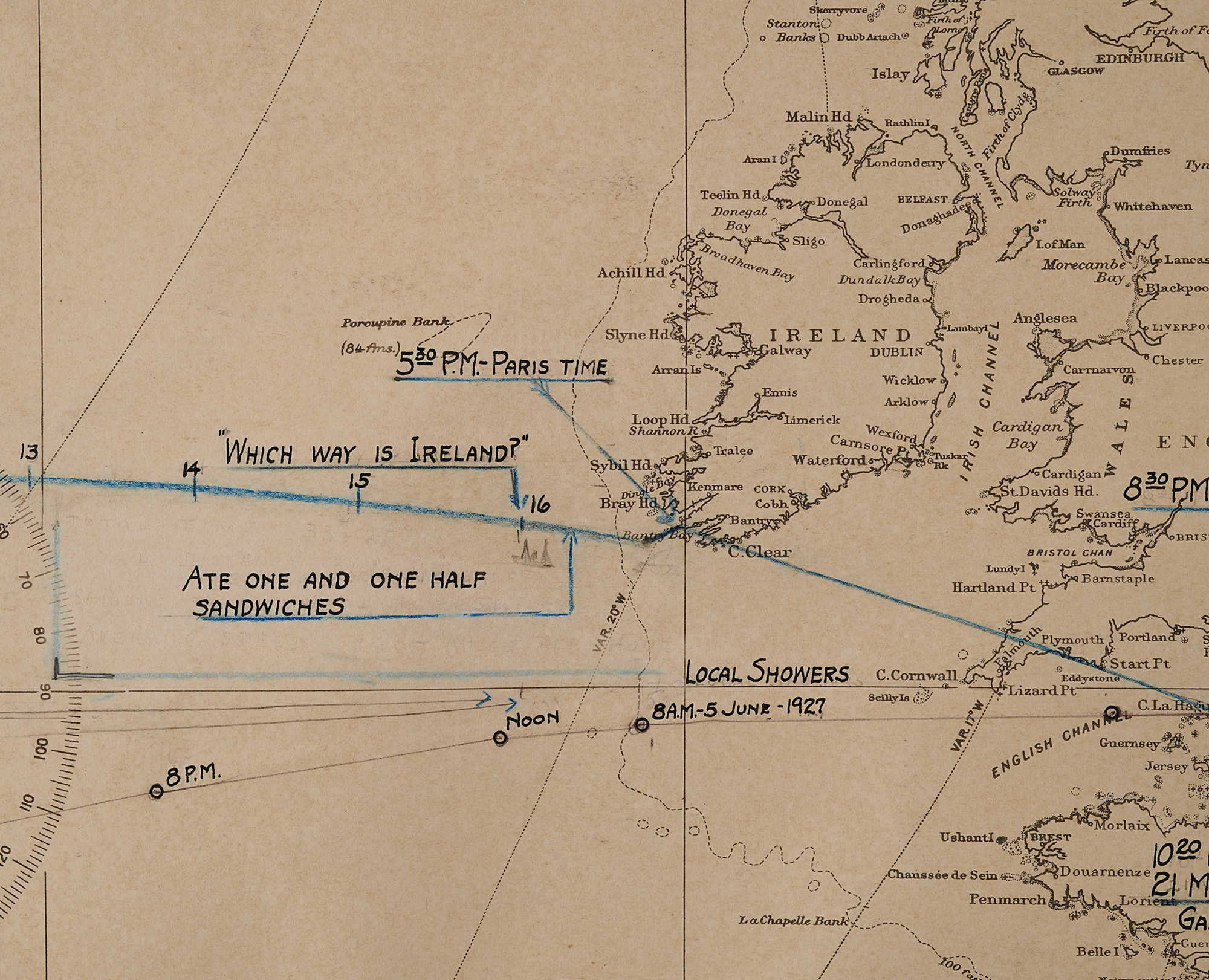
Lindbergh meets the rising sun at 1:15 A.M., as he is about midway across the ocean. "Daylight…Fog, altitude 10 to 200 feet—occasional 1,500 feet. Hazy-overcast." Nearing land, Lindbergh grows concerned about his navigation due to fog and fatigue; spotting some fishing boats, he descends to a low altitude to ask for directions, hoping to yell, "Which way is Ireland?," but he sees no fishermen to ask. As it turns out, he was over two hours ahead of schedule and less than three miles off course. He eats "one and one half sandwiches" off the Irish coast, passes over Cornwall, and flies above the coastal French town of Cherbourg as the sun sets at "8:30 P.M. Paris Time." At "10:20 P.M, 21 May, Paris Time," Lindbergh reaches his destination—with 85 gallons of gas to spare.
On arriving at Paris, Lindbergh circles the Eiffel Tower, then flies to Le Bourget Aerodrome. Because the airfield is not marked on his map, he briefly mistakes it for an industrial complex—the bright lights are actually tens of thousands of spectators’ car headlights, creating Paris’s largest-ever traffic jam. About 150,000 people rush the field, pull Lindbergh from the plane, and carry him on their shoulders for half an hour—a hero's welcome. Souvenir hunters damage the Spirit of St. Louis by tearing off pieces of its linen covering before French soldiers can secure the aircraft and move it to safety.
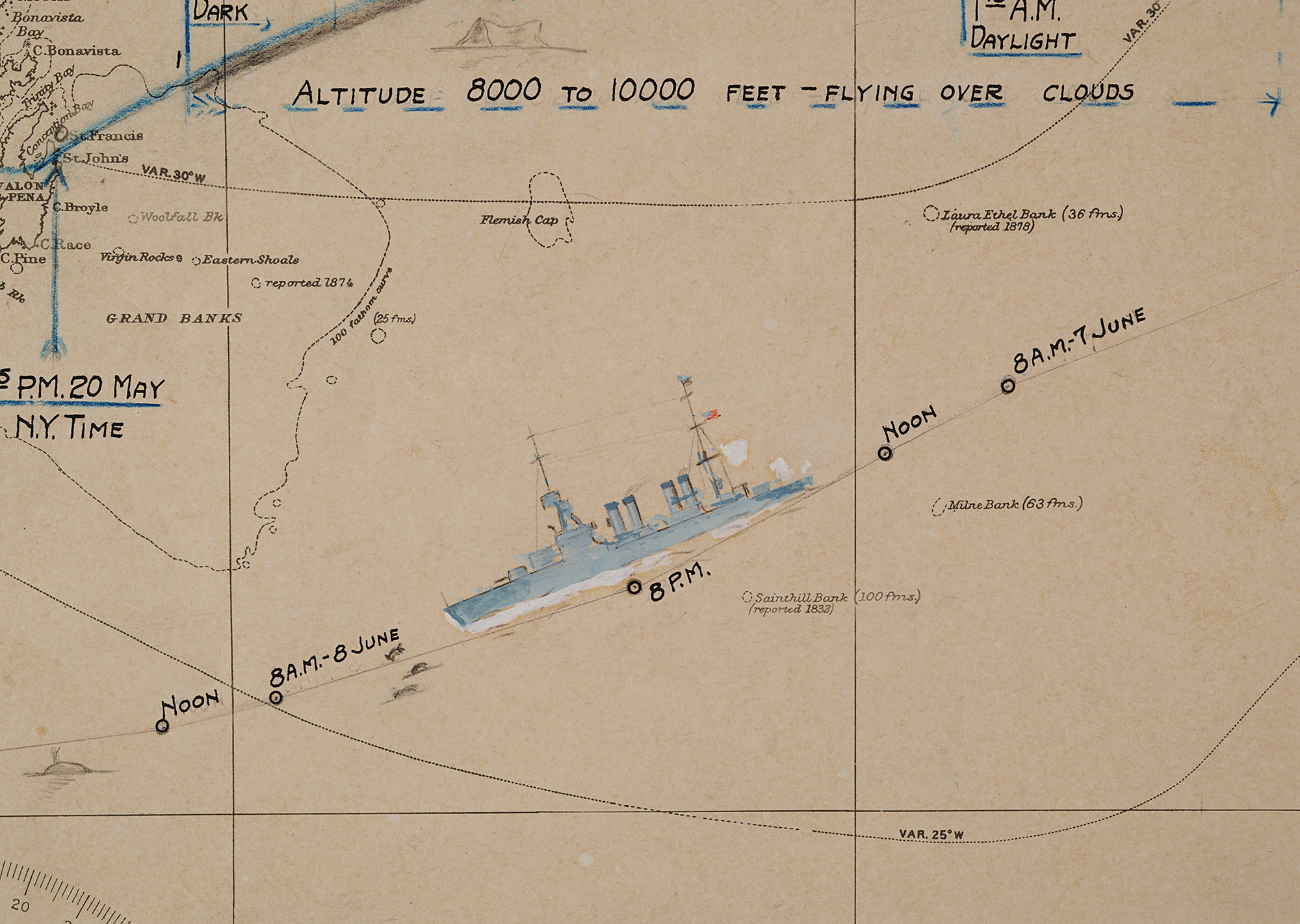
The triumphant Lindbergh is fêted throughout Europe with receptions in France, Belgium, and Britain, eliciting massive media coverage, countless gifts and invitations, and drawing enormous crowds wherever he goes. After this brief, celebratory tour, on June 4, 1927, Lindbergh and his 'Spirit of St. Louis' airplane leave Europe aboard the USS Memphis—commanded by Guy Burrage—bound for the United States. Their weeklong voyage home is traced in pencil, with times and dates inked in black; the paths are further illuminated with sketches of the Spirit of St. Louis and USS Memphis. Upon arriving, a fleet of warships and multiple flights of military aircraft escort the Memphis up the Potomac River to the Washington Navy Yard, where President Calvin Coolidge awards Lindbergh with the Distinguished Flying Cross.
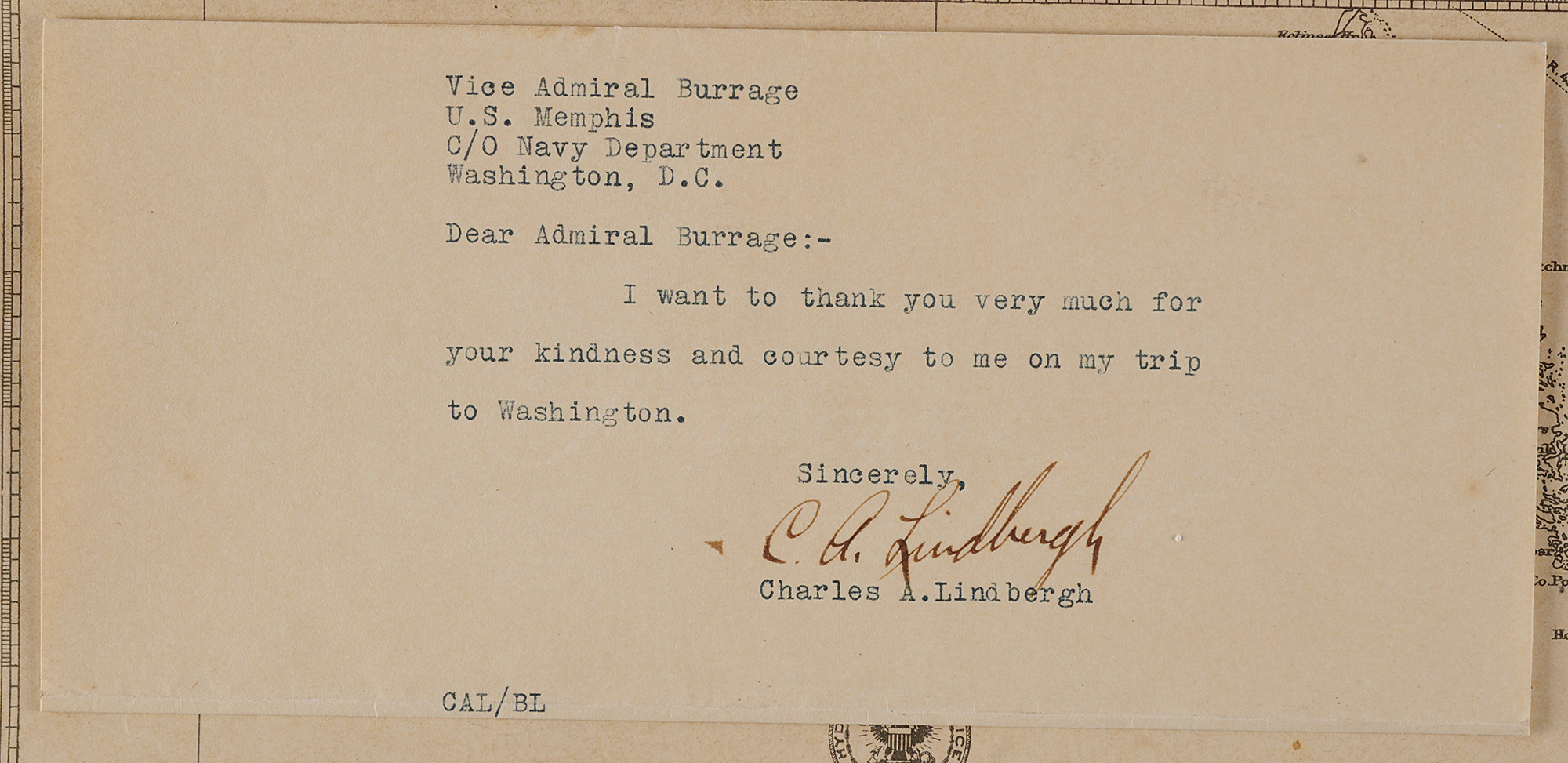
Affixed to the map are two letters to Burrage from Lindbergh. At the upper left is a TLS, signed "C. A. Lindbergh," no date but probably 1927, shortly after this historic voyage. In full: "I want to thank you very much for your kindness and courtesy to me on my trip to Washington."
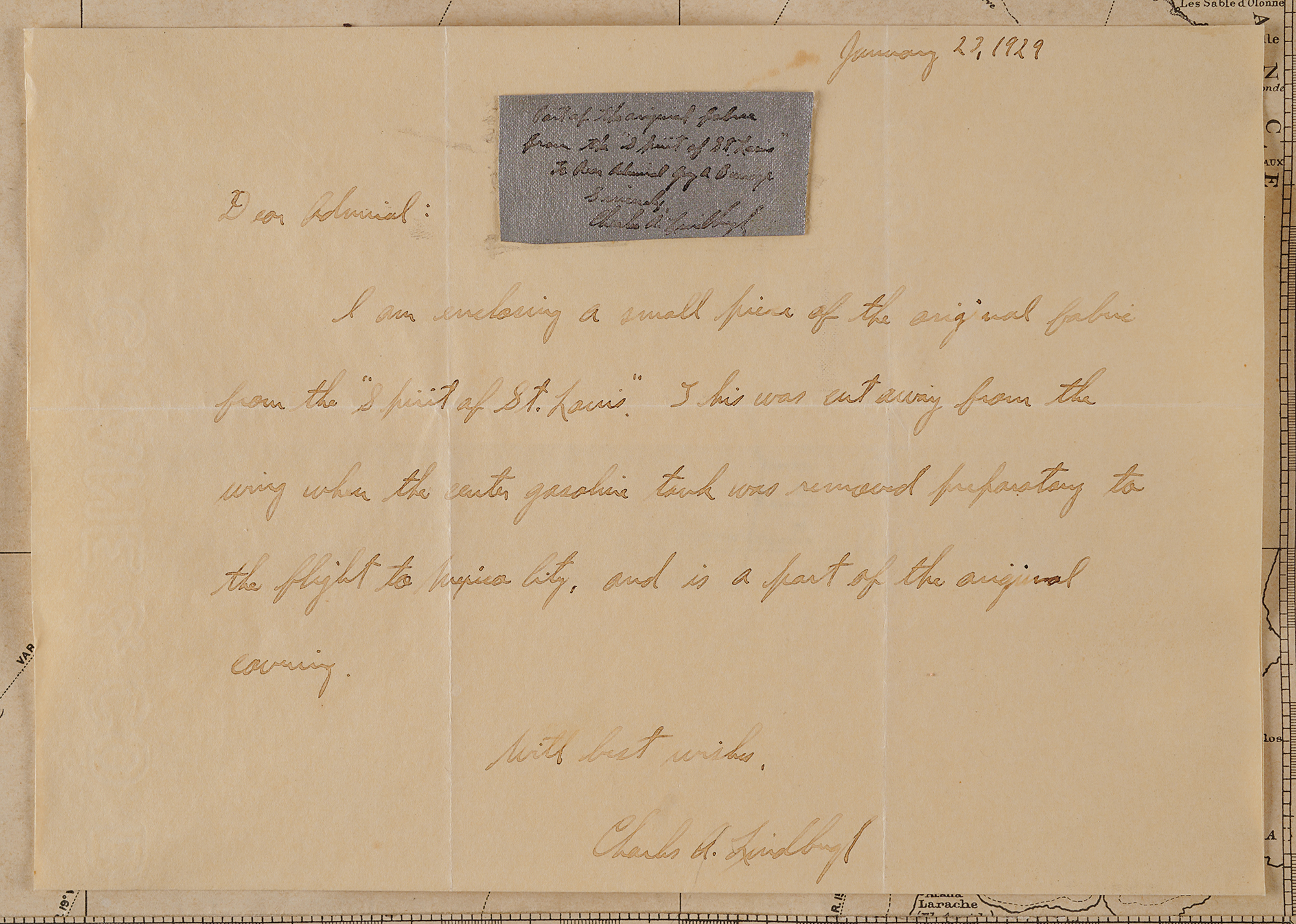
At the lower right is an ALS signed "Charles A. Lindbergh," January 23, 1929, in full: "I am enclosing a small piece of the original fabric from the 'Spirit of St. Louis.' This was cut away from the wing when the center gasoline tank was removed preparatory to the flight to Mexico City, and is a part of the original covering," with the silvery two-inch swatch affixed above, also identified and signed by the aviator: "Part of the original fabric from the 'Spirit of St. Louis,' to Rear Admiral Guy H. Burrage, Sincerely, Charles A. Lindbergh." In fine condition.
An extraordinary, likely unique, cartographic record of Charles Lindbergh’s 1927 transatlantic flight, annotated under his direction and preserved with signed letters and original aircraft fabric from the Spirit of St. Louis.

