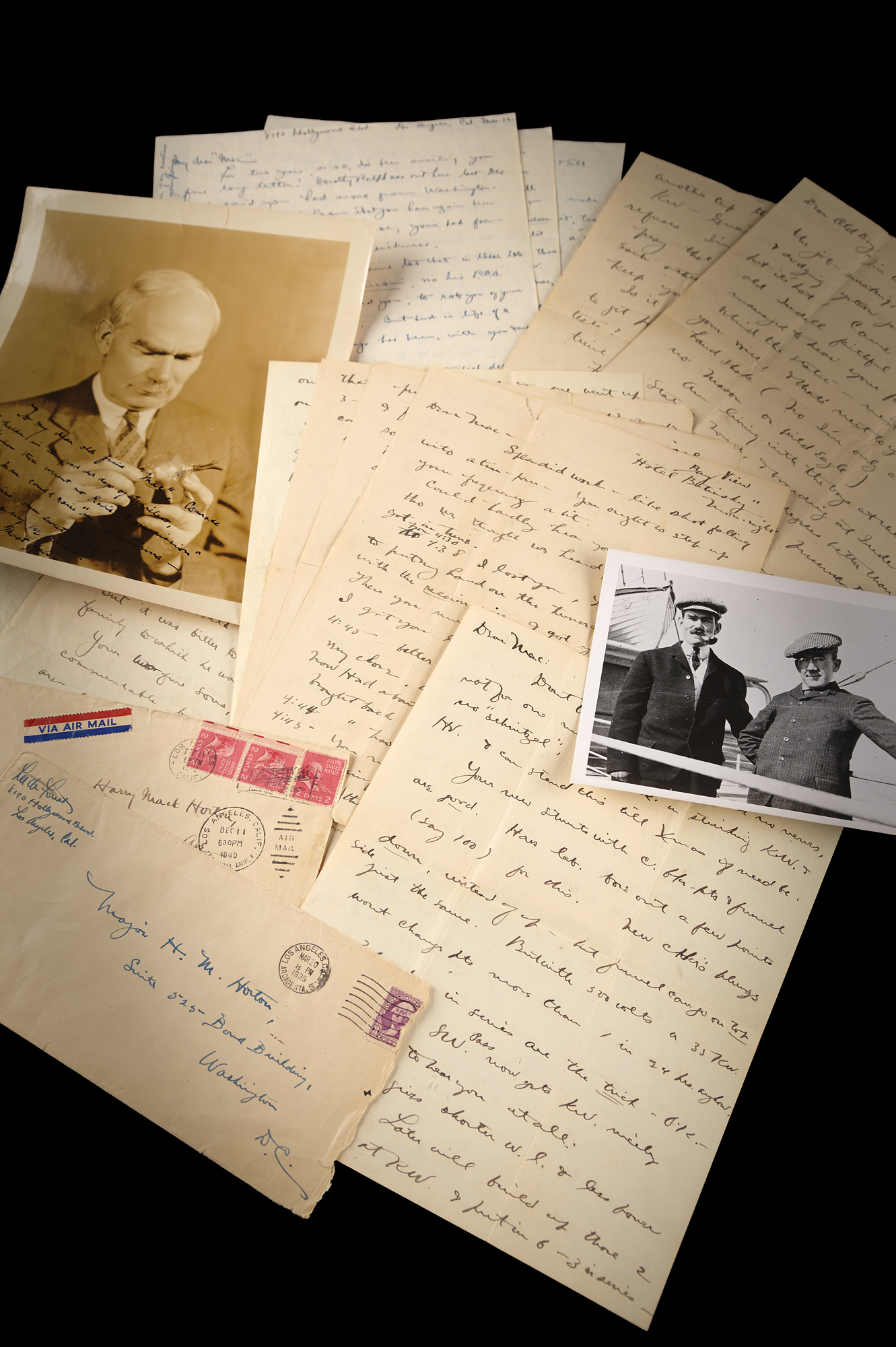
Prolific American inventor (1873-1961) often referred to as 'the father of radio' for his pioneering work in wireless telegraphy. Extraordinary archive of five handwritten letters by Lee DeForest, three signed "Doc," two signed "Lee de Forest," and one unsigned, totaling 24 pages, all about 8 x 10, dated from circa 1905 to 1940. De Forest writes to his chief technician, Harry Mack Horton, with remarkable commentary on his early radio experiments and a fantastic letter in which he criticizes Marconi.
Excerpts from the letters:
No date [c. 1905]: "Splendid work—like shot falling into a tin pan—You ought to step up your frequency a bit. Could hardly hear you till 4:30 tho we thought we heard you. Then I got in tune. From 4:30 to 4:38 I lost you, then I happened to put my hand on the tuner slide connected with the receiver wire, I got you well. Then you must have made some change, for I got you loud again, without hand on. 4:45—better yet. Tuning on impedance by close, as you found.
Now had about ¼ of that spool in which I brought back from Cleveland. 4:44 'how is it now' 'how is it now.' 4:45 You made a change. I had cut down imped. to 1/5 the coil—& didn't get you then so loud as previously. 4:50 Got you louder when I did not touch receiver wire slider…
This is very interesting—what was your combination before when putting hand on this slider brought you up greatly? It appears that when your wave is such that putting hand on slide decreases sound that then you can tune quite closely on the tuner; but for another wave-length, where putting hand on slide increases the sound, that tuning on tuner is not so close.
Still this may not be the rule. Anyway, for certain wave-lengths putting hand on slider will increase, & for other wave-lengths this will decrease sound. I think it has to do with the location of one of the nodes in the closed circuit. When the node should fall near the slide, then putting a hand, or a capacity there aids in forcing a node there, & this brings the receiver nearer the loop of the wave & aids the sound whereas for another wave length the node should not be located near the slide because if so it throws the loop to a point in the circuit far from the receiver, and this hurts the sound…Keep full notes, especially about this noise business, & how to kill static. There's lots to learn about this loop circuit of mine."
July 31, [c. 1905]: "Is it absolutely impossible for you to get power say 4 a.m. for a few tests? We will send at any old time to you when we get fixed up. Found some of these wires 216 ft. some 193 ft. long—& the skyline sagging a good 25 ft. in middle. Am putting in a light steel cable in place…will make all lines same length, & split the four—a la—Buffalo. Found Iredell using 3 osc. & 22 antenna—not much chance to get us on such a tune, I figure ¾ & 12, or 1 ¼ & 14 are in tune (by hot-wire ammeter, which I bought) & think you will have a better chance on such tunes. ('George Barbour'). Our height is 20 ft. less than it should be, even with horizontal skyline & if all these tricks don't get us in, will holler to Manney to raise top masts, as per original specs. But you must get us with 180 ft. masts—450 miles—sure thing—easy. 2000 ft. antenna coming from New Orleans, & new pan-cake timer-V.C.'s."
August 25, [c. 1905]: "Don't feel 'you have runned away'—not for one moment my boy…Your new stunts…are good. Have lab. bore out a few points (say 100) for this…with 500 volts a 35KW won't change pts more than 1 in 24 hrs. anyhow…Later will build up those 2 top trays at KW. I put in 6—3 in series."
March 12, [1935]: "I'm so sorry to learn that you have again been fearfully ill. You poor dear, you've had far more than your share of sickness. And it's a damned shame too that in these late years the curses of Marconi, via his R.C.A. bastard child, has followed you, to rob you of your well-earned deserts. But such is life of a wireless Man—& always has been, with you Mac, it would seem! Yet you & I have very much to feel deeply thankful for—each a queen of a wife—at last—& you with 2 fine sons; & lots of grit & courage, & philosophy to look upon the sunny side of life, to see its good points, its humor, & some of its fineness which doesn't cost much in money if one has acquired the character to appreciate it all.
How I relish reading your fine, flowing 'fist' again, Mac. Don't be so sparing of it henceforth. The bright spot of that trip east in 1932 was the half day or so I spent with you, reliving the brave old days at the start of this century, when we were young & full of ideas & courage-& foolishness. We started big things then, Boy, in a small way, warily & determinedly; But we were too honest, too trusting, to go on with the fine start we made when the wolves & the Hebrews of Wall St. got a scent of our blood. Many a time have I looked back & thought how different would have been the history of American Wireless had I had sense enough to sell a few hundred thousand dollars worth of my Am. De F. W. stock in 1905, & laid by a 'war-chest,' to buy in the Co's. assets after the collapse of White & Wilson. Any wise boy could have foreseen what was bound to befall the enterprise under their brigand management. But I was not wise."
December 10, 1940, to Harry Mack Horton's widow: "Dear Sally, you were a wonderful & devoted wife to the best friend my profession ever revealed. You have the comforting assurance that you made Mac's life a blessing, after all the sorrow and tragedy he had passed through before you entered his life…Poor Harry Mac—I knew him and loved him like a Brother. Through those early years of our struggle against overwhelming odds and opposition we stood side by side, shoulder to shoulder, and we showed the world what was American Wireless, and with it licked creation! We did. I am proud, have always been proud, to have found, so early, so faithful and staunch a helper and support. The History of American Wireless Telegraphy would not be what it is today, had it not been for the fine, undaunted, undiscouraged, determined efforts, in face of every form of obstacle, delay and set-back—which Mac, and a few loyal fighters like him waged by my side—from 1901 to 1910.
My memory is filled with comforting recollections, some of them grim, many light and humorous, of the days we worked together; at Washington, Toronto, Key West, Ireland, New York—long days of toil and dark nights of watching, side by side—determined, the two of us, like two brother soldiers, to win the battle, never mind the hardship, nor the lack of proper support from those for who we loyally struggled. Some of our labors, our adventures, would well form a Saga of Wireless."
Includes two of the original mailing envelopes, both addressed in de Forest's hand, incorporating his full name, "Lee de Forest," in the return address area, plus a vintage glossy 8 x 10 photo of the inventor , signed and inscribed in fountain pen, "To my dear old friend 'Mac,' Comrade & helper in the good old days of Wireless, 'When there weren't no Radio Commission' and a man could raise an antenna—to suit his own sweet trill! And how many we raised! Yours till the mast falls—'Doc.'" In overall very good to fine condition.

