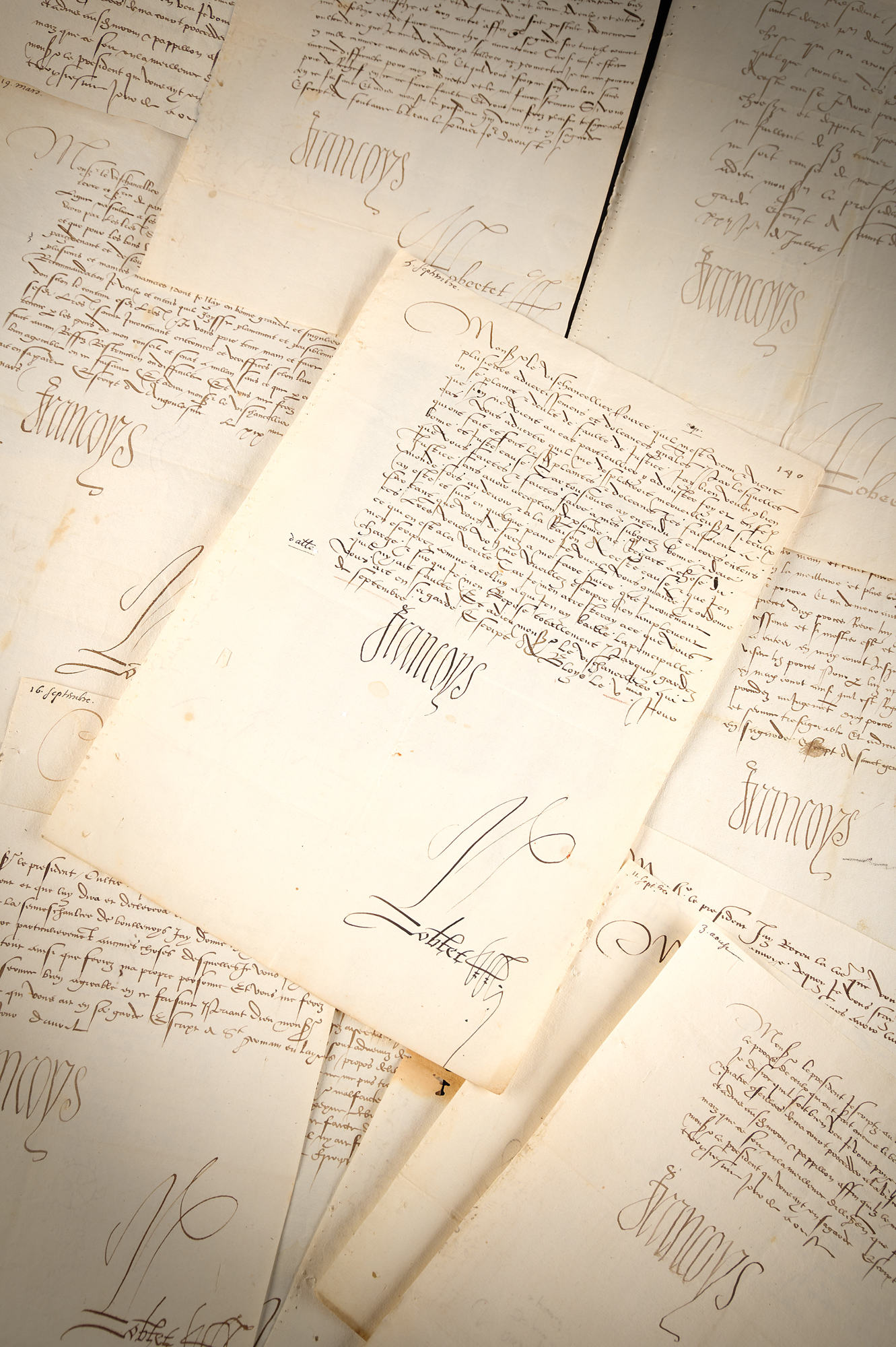
King of France (born 1494) who reigned from 1515 until his death in 1547. Known as the 'Father and Restorer of Letters,' the cultured and well-read Francis, himself a poet, ushered in the Renaissance in France with generous support for a number of writers and ambitious construction projects. Archive of eleven scarce LSs in French, all signed "Francoys," each one page, 7.75 x 8 to 8.25 x 11.75, dated from September 5, [1519], to December 23, [1523]. Excerpts from the letters:
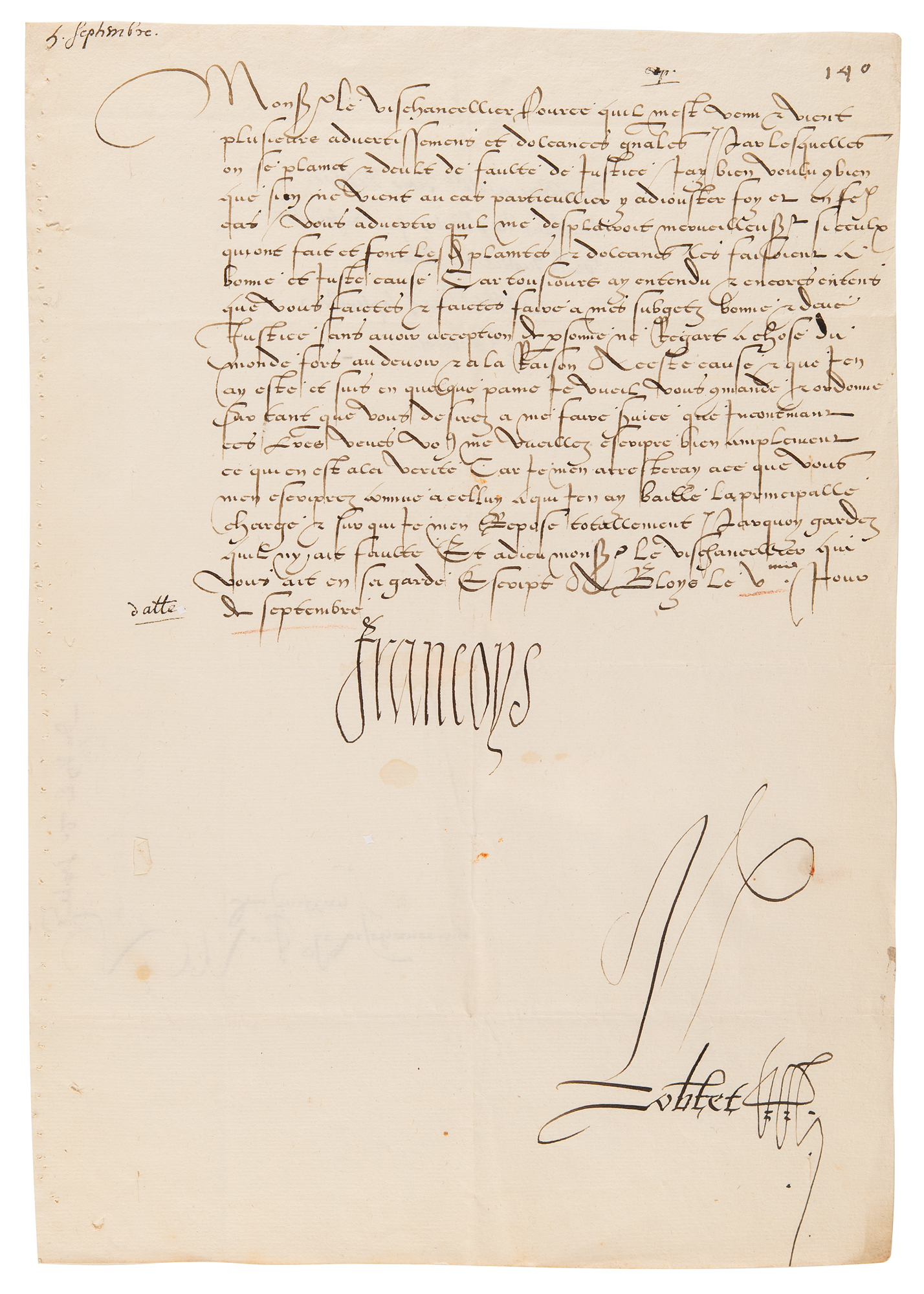
September 5, 1519: King Francis I writes to Jean de Selve, the Vice-Chancellor of Milan, explaining that he has received complaints regarding justice in Milan, which he hopes are unfounded, for he understands "that you are administering and having administered to my subjects good and due justice without regard to any person or anything in the world except duty and reason."
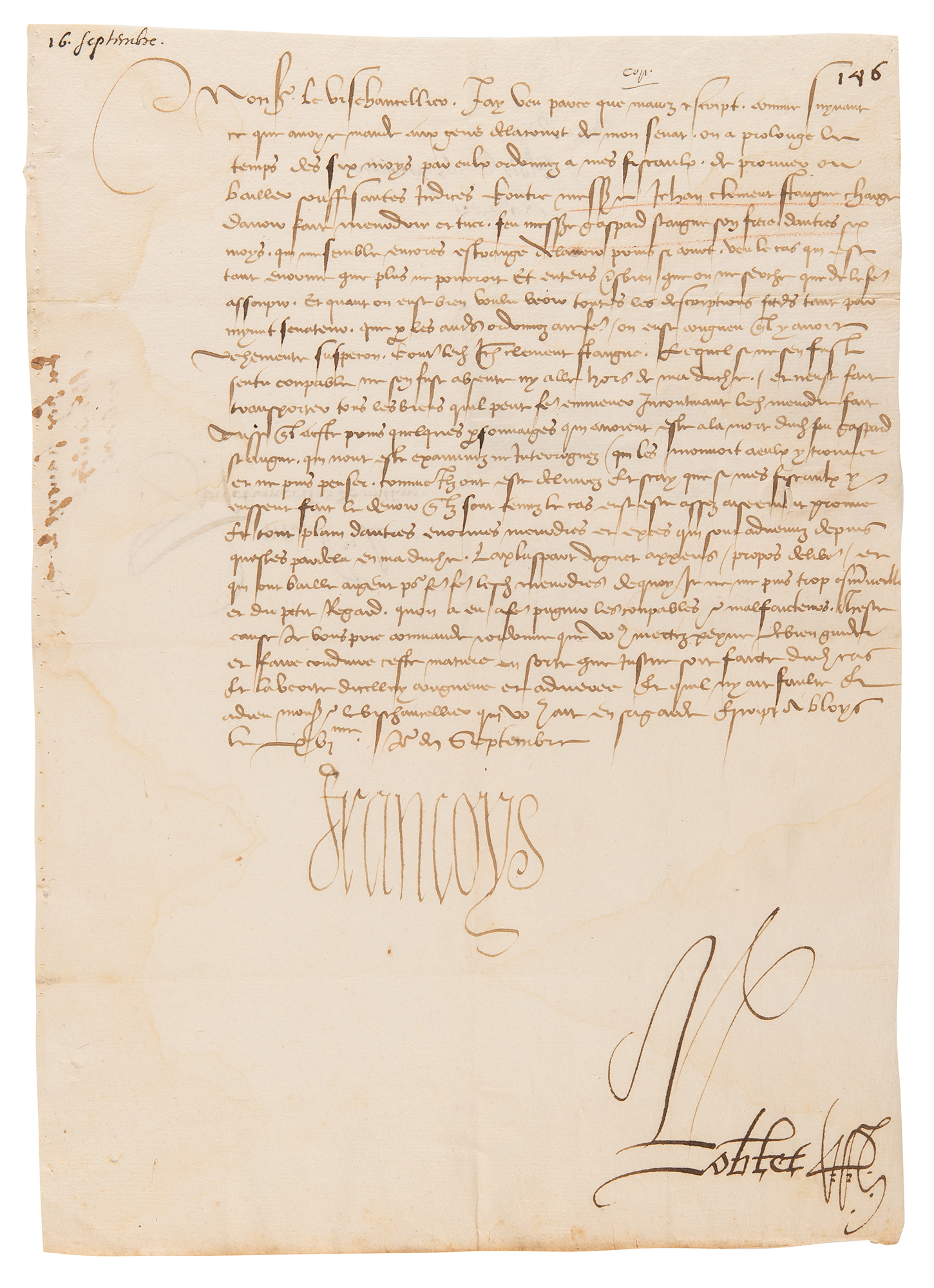
September 16, 1519: King Francis I writes concerning the case of Jehan Clément Stangue, accused of having murdered and killed the late Sir Gaspard Stangue, his brother, who was able to leave the Duchy of Milan and transfer all his possessions.
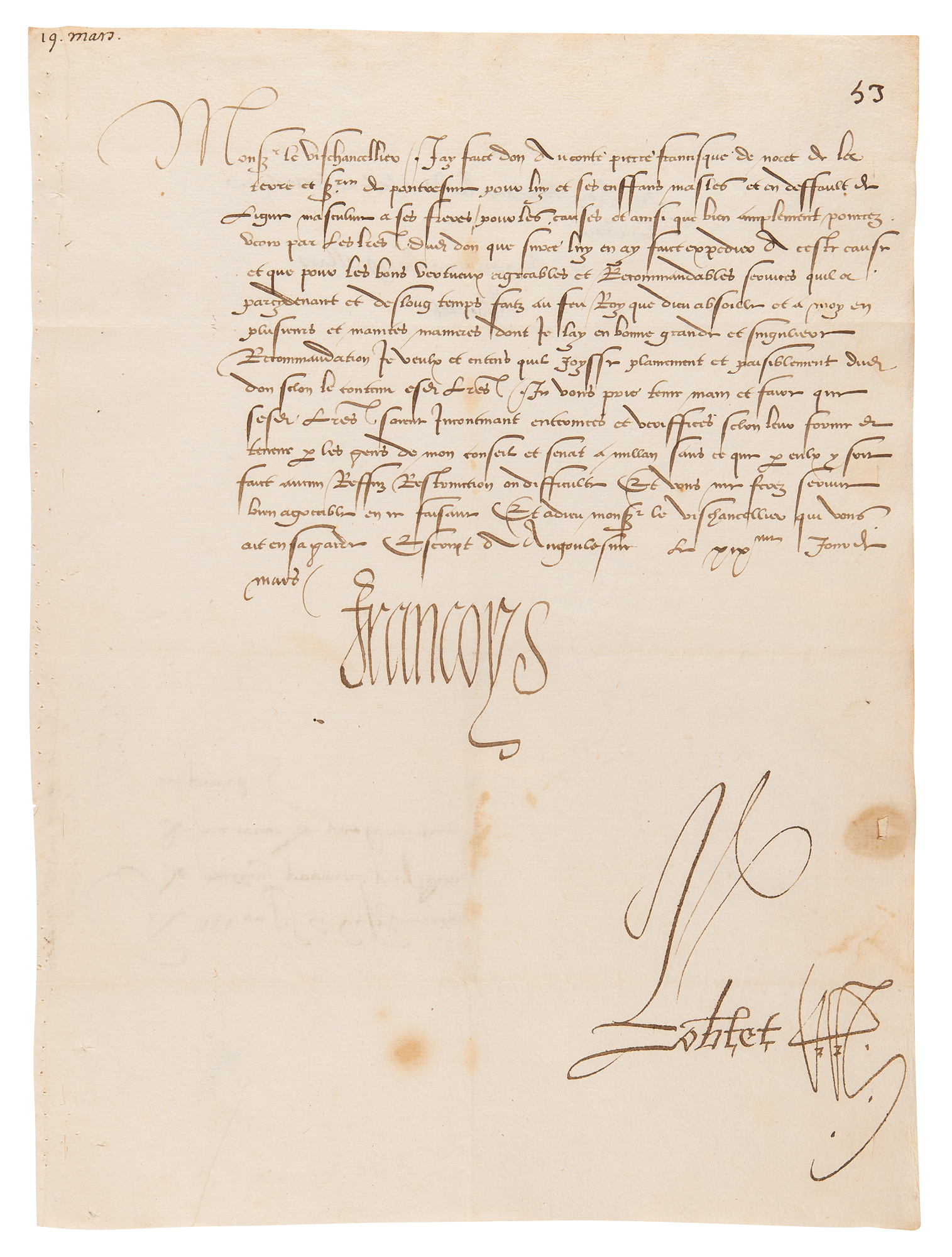
March 19, 1520: King Francis I writes to Jean de Selve, the Vice-Chancellor of Milan, in part: "I have been informed by my cousin, the Lord of Lautrec, that there are several statutes in our Duchy of Milan concerning the punishment incurred by criminals," the execution of which is harmful and requires reform, in order to "provide for the good of justice and the profit and utility of the public good."
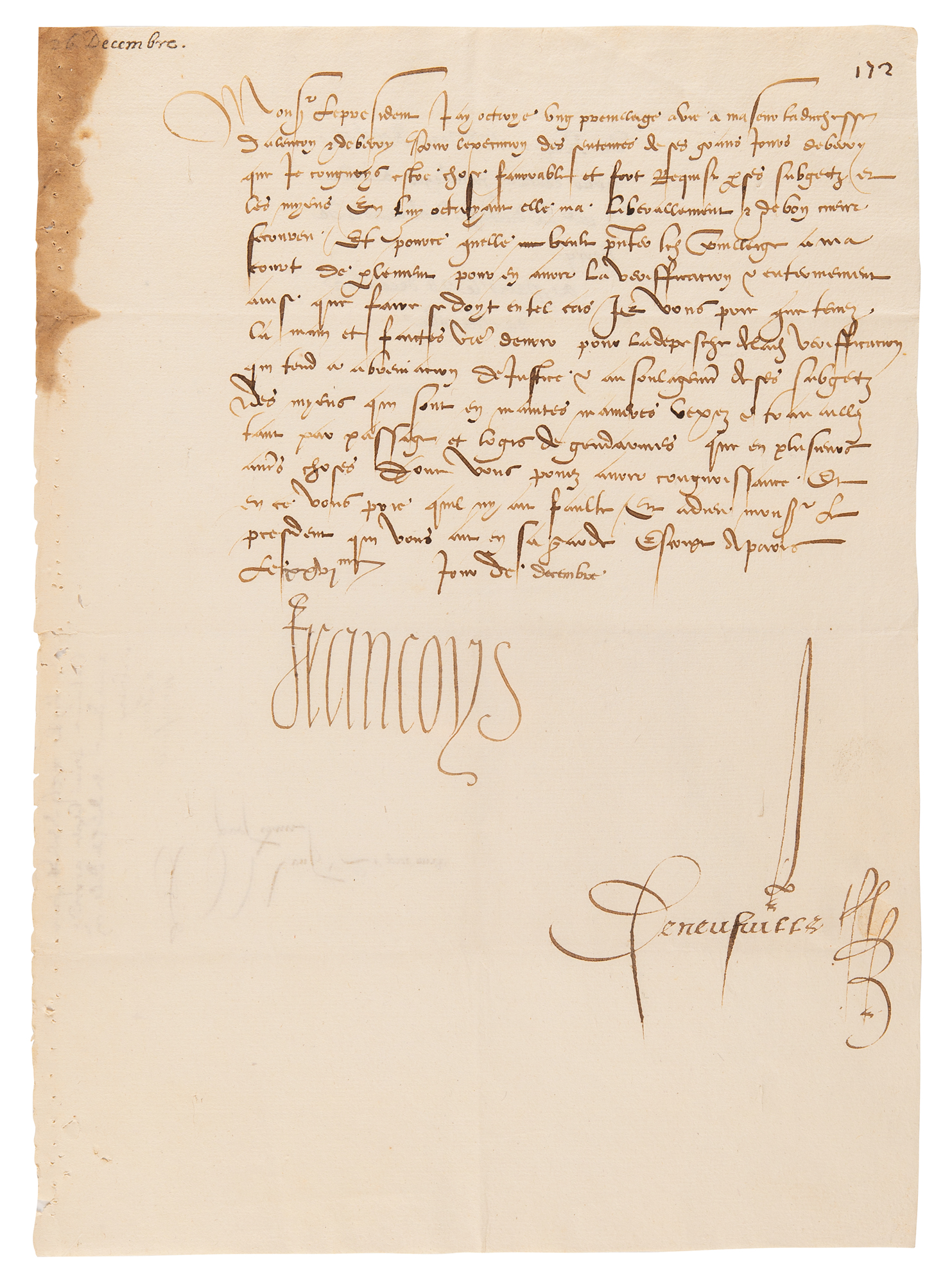
December 26, 1522: King Francis I explains: "I have granted a lifetime privilege to my sister the Duchess of Alençon and Berry (Marguerite d'Angoulême) for the execution of the sentences of her High Courts of Berry, which I know to be a favorable and much-needed measure for her subjects and mine. By granting it, she has liberally and wholeheartedly assisted me.” He requests verification of this, "for the relief of his subjects and mine, who are in many ways vexed and troubled by the passage and lodging of gendarmes."
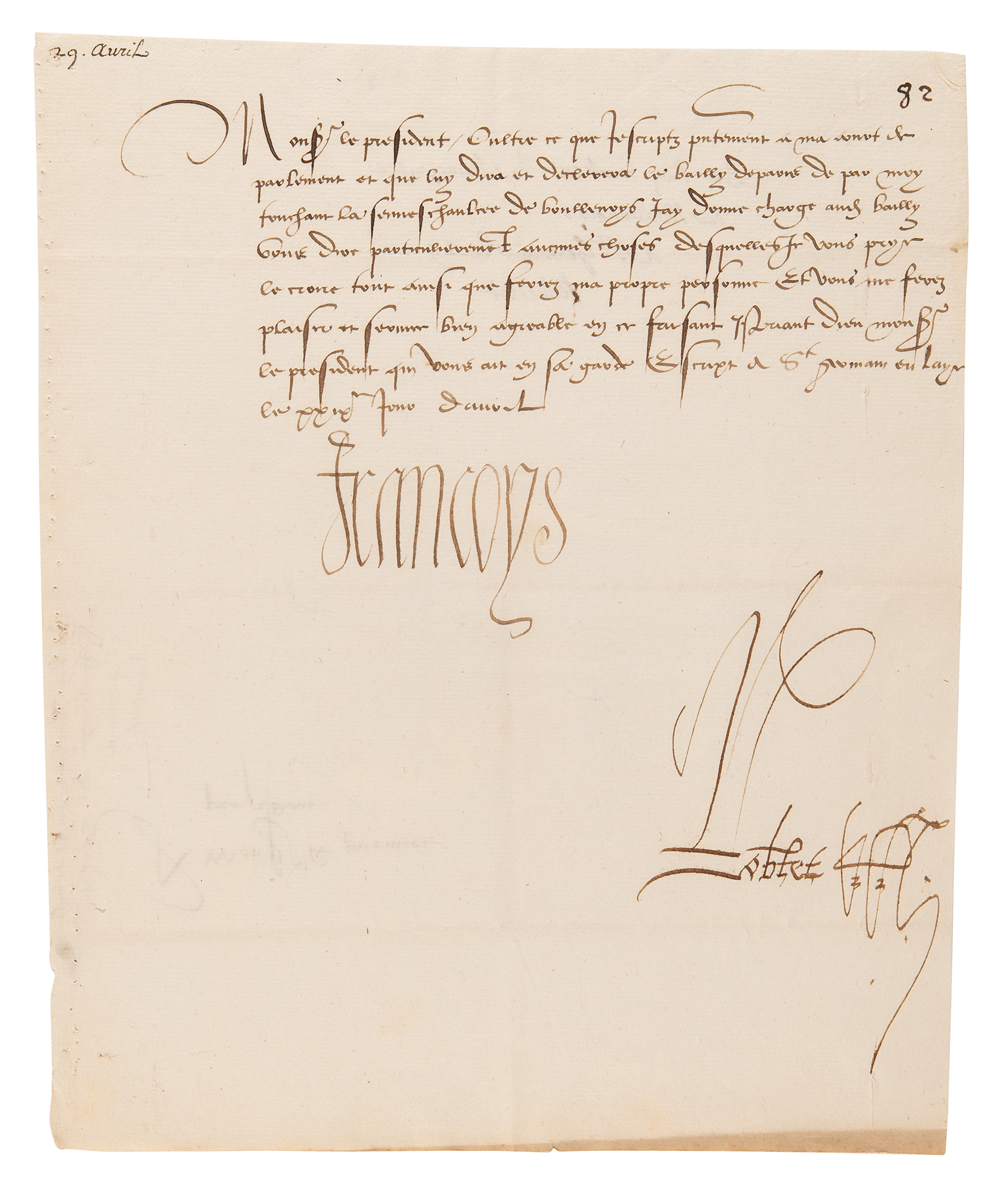
April 29, 1523: King Francis I sends the bailiff of Paris to Parliament to inform them of his intentions "concerning the seneschalship of Boulogne."
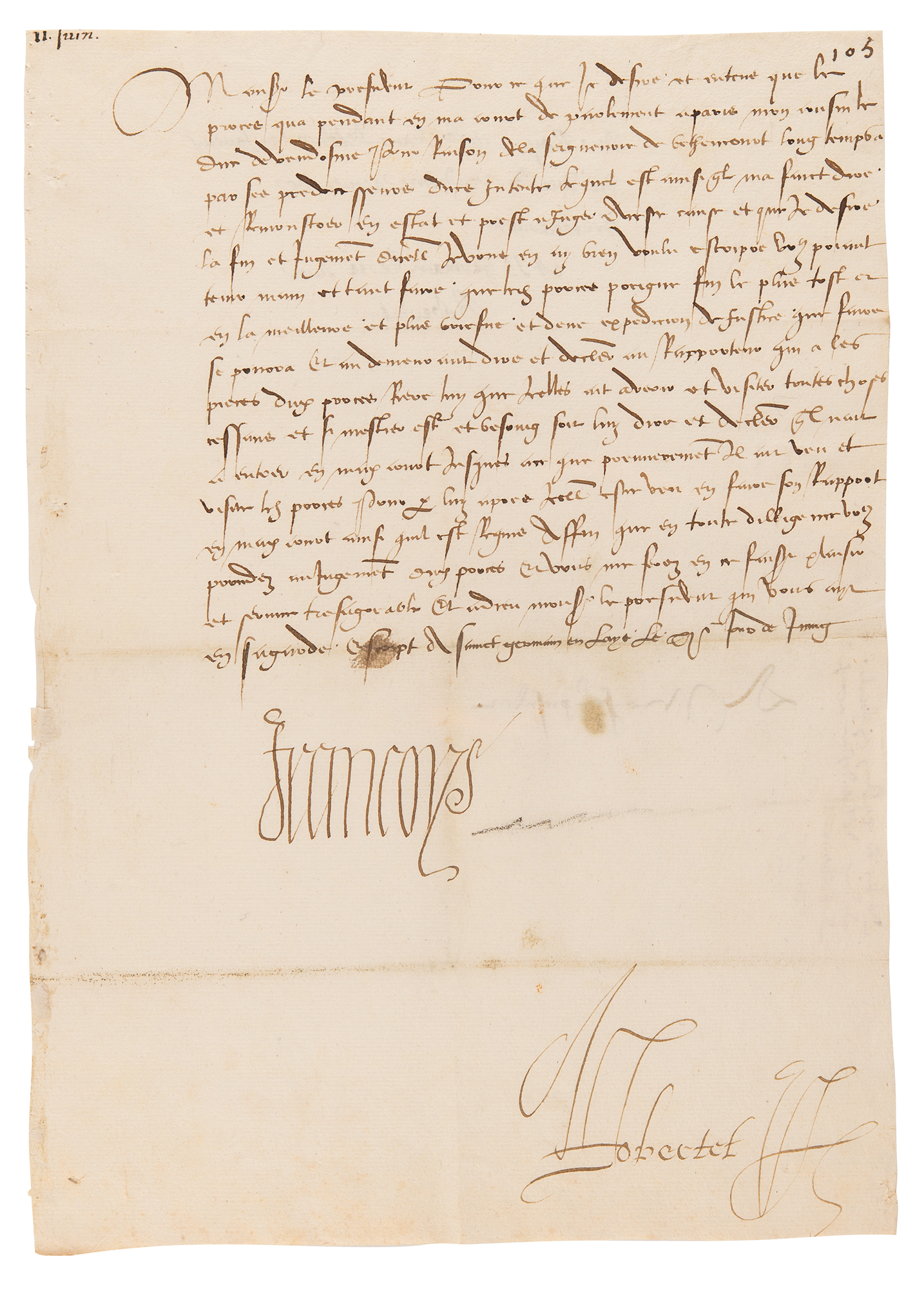
June 11, 1523: King Francis I writes regarding the expedition of the trial of the Regalia of Angers, delayed by his departure for Blois, but which he now wants to be promptly expedited.
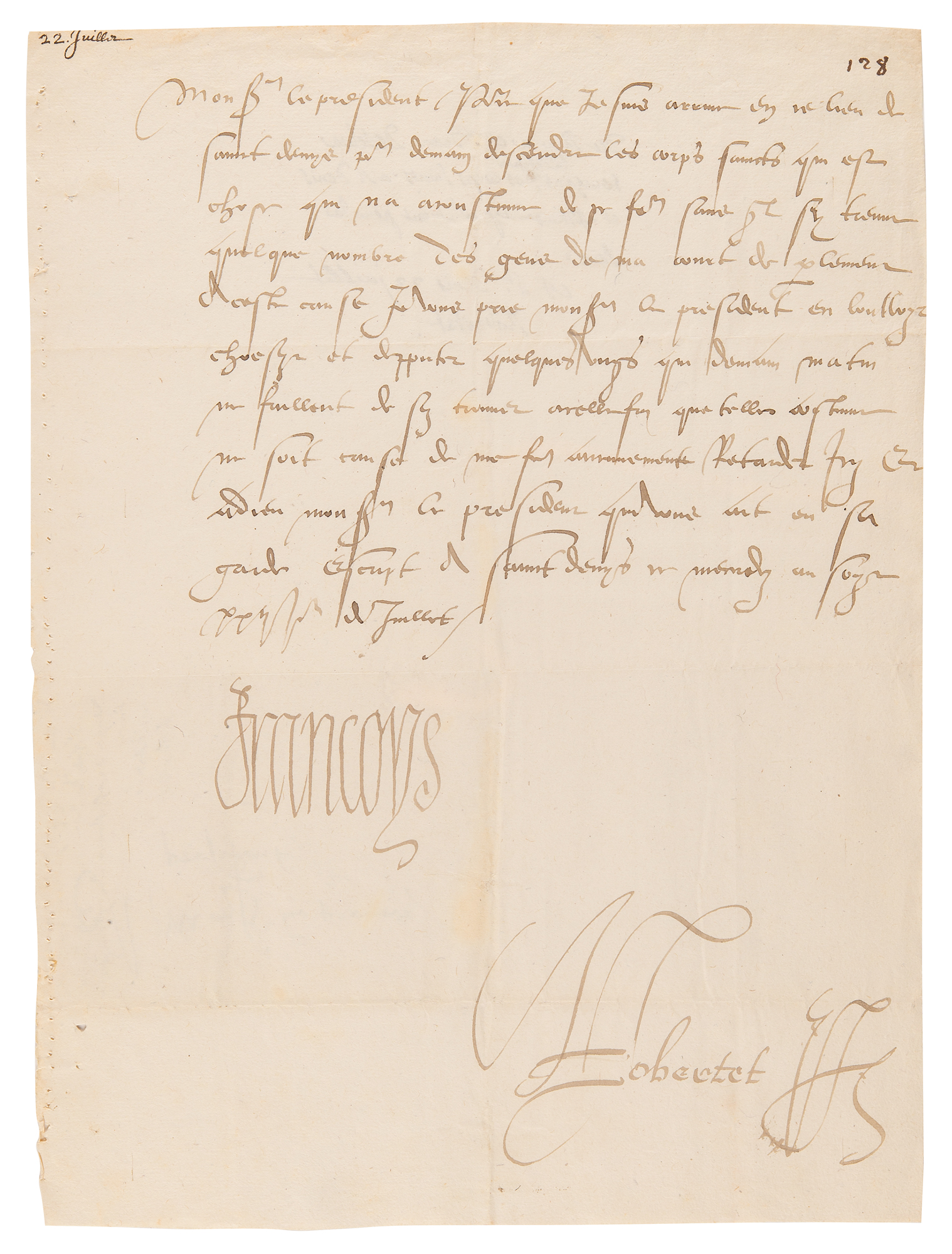
July 22, 1523: King Francis I writes of holy relics: "Because I have arrived in this place of Saint-Denis to bring down the holy relics tomorrow, which is something that is not usually done without some number of people from my Parliament being present. To this end, I beg you…to choose and appoint some of them."
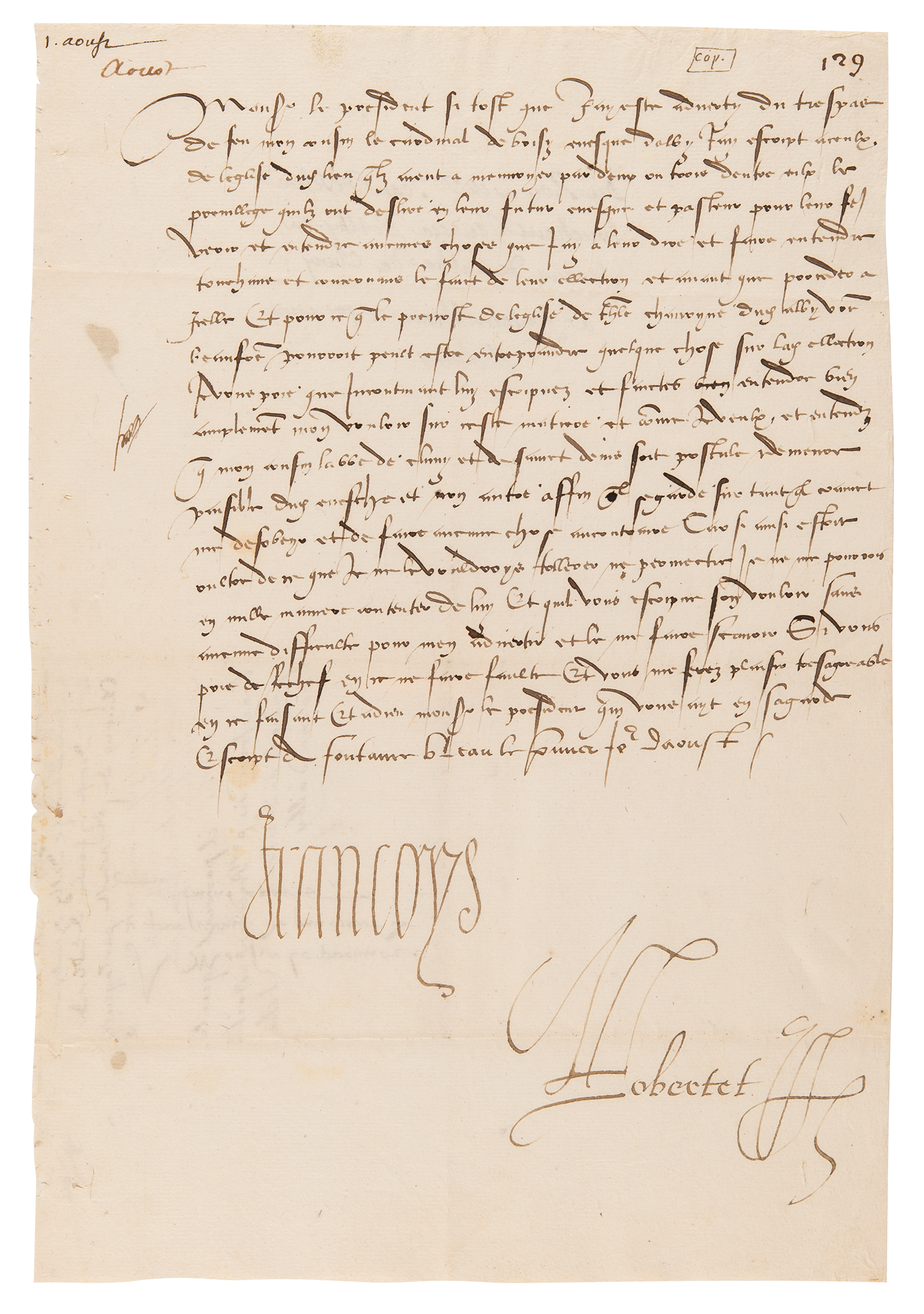
August 1, 1523: King Francis I has learned of the death of his cousin Cardinal de Boisy [Adrien Gouffier de Boisy], Bishop of Albi, and asked the people of the church of Albi to send him "the privilege they have of electing their future bishop and pastor." He asks Selve to instruct his brother-in-law, provost of the church of Toulouse and canon of Albi, to make his wishes known "that my cousin the abbot of Cluny and Saint-Denis be nominated."
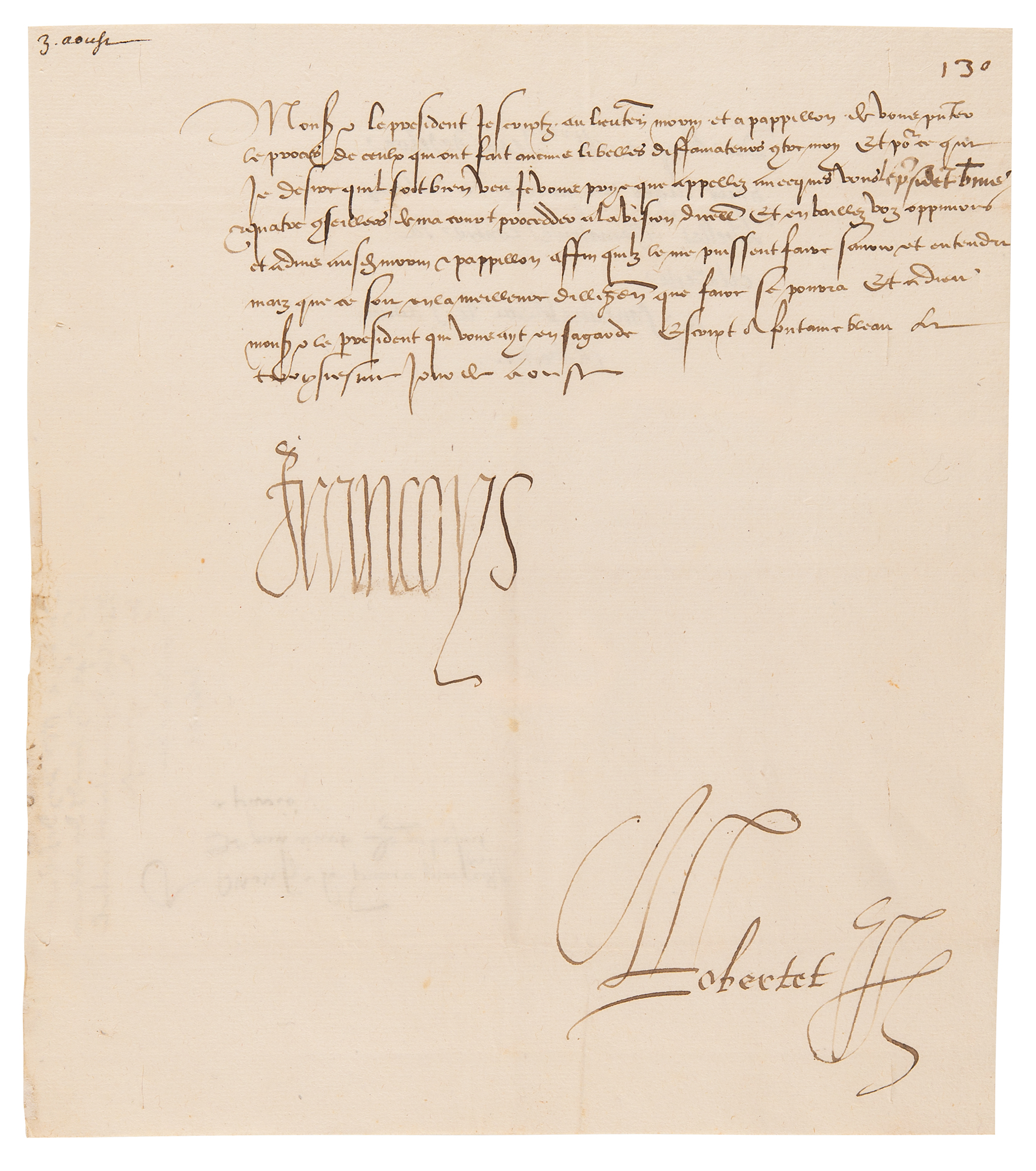
August 3, 1523: King Francis I requests that the "trial of those who have made defamatory libels against me" be proceeded with diligently.
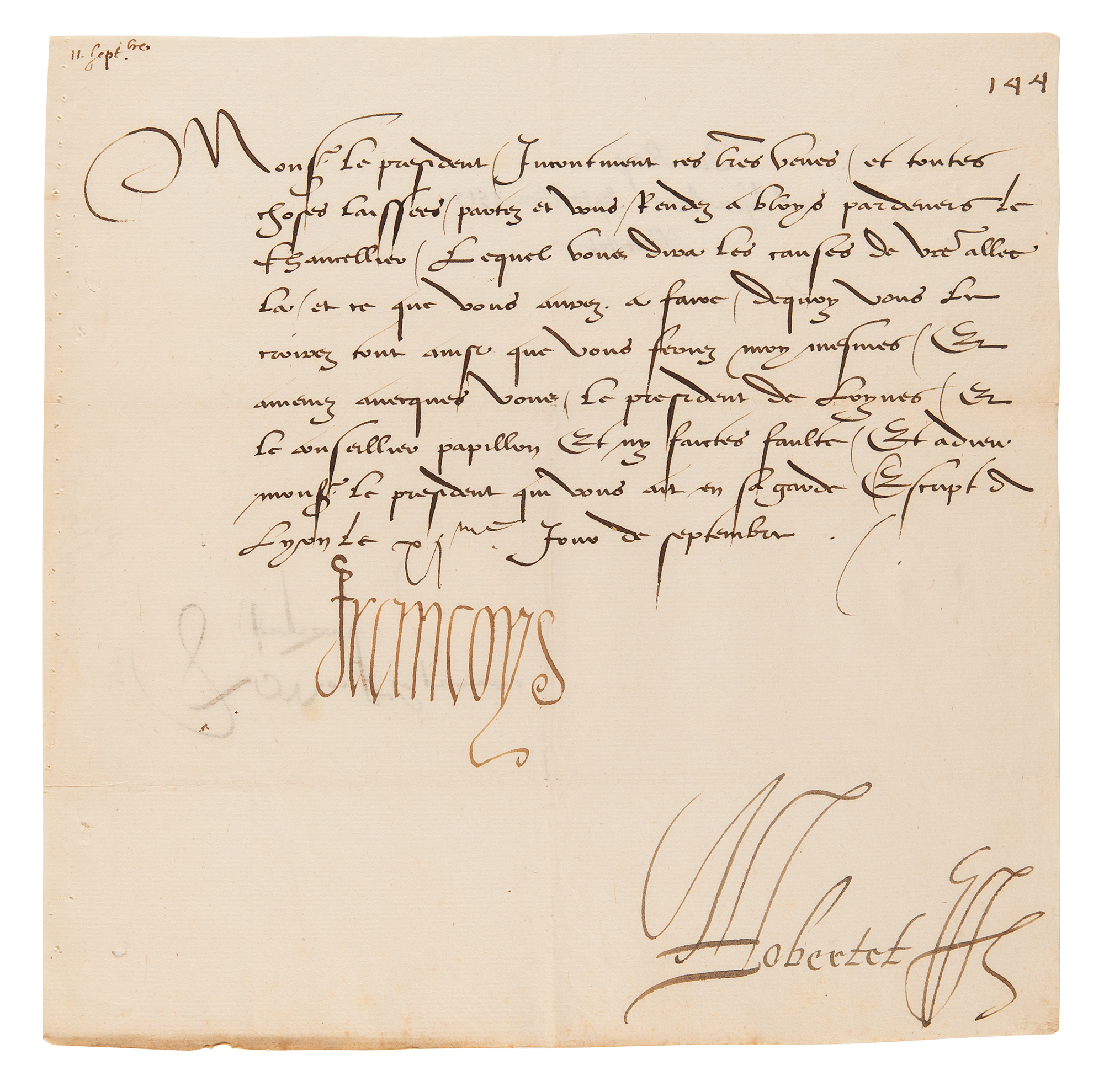
September 11, 1523: King Francis I sends an order to go to Blois to see the "Chancellor [Duprat], who will tell you the reasons for your going there, and what you are to do, and you will believe him just as you would believe me, and bring with you President de Loynes and Councillor Papillon; do not fail to do so."
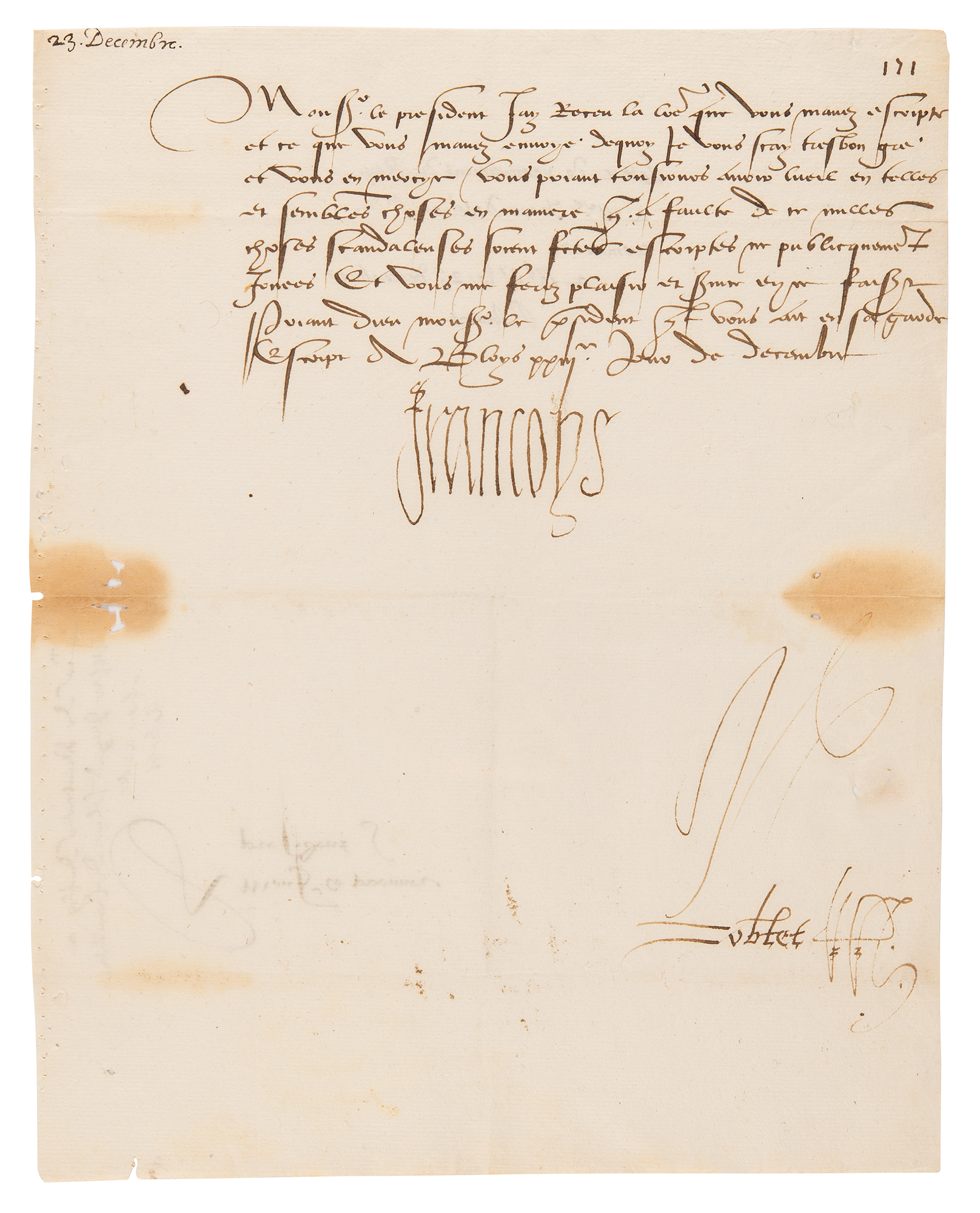
December 23, 1523: King Francis I thanks de Selve for his letter, and asks him "to always keep an eye on such matters so that, for lack of this, a thousand scandalous things may not be done, written, or publicly performed."
In overall fine condition, with occasional small stains.

