Sold For $6,250
*Includes Buyers Premium
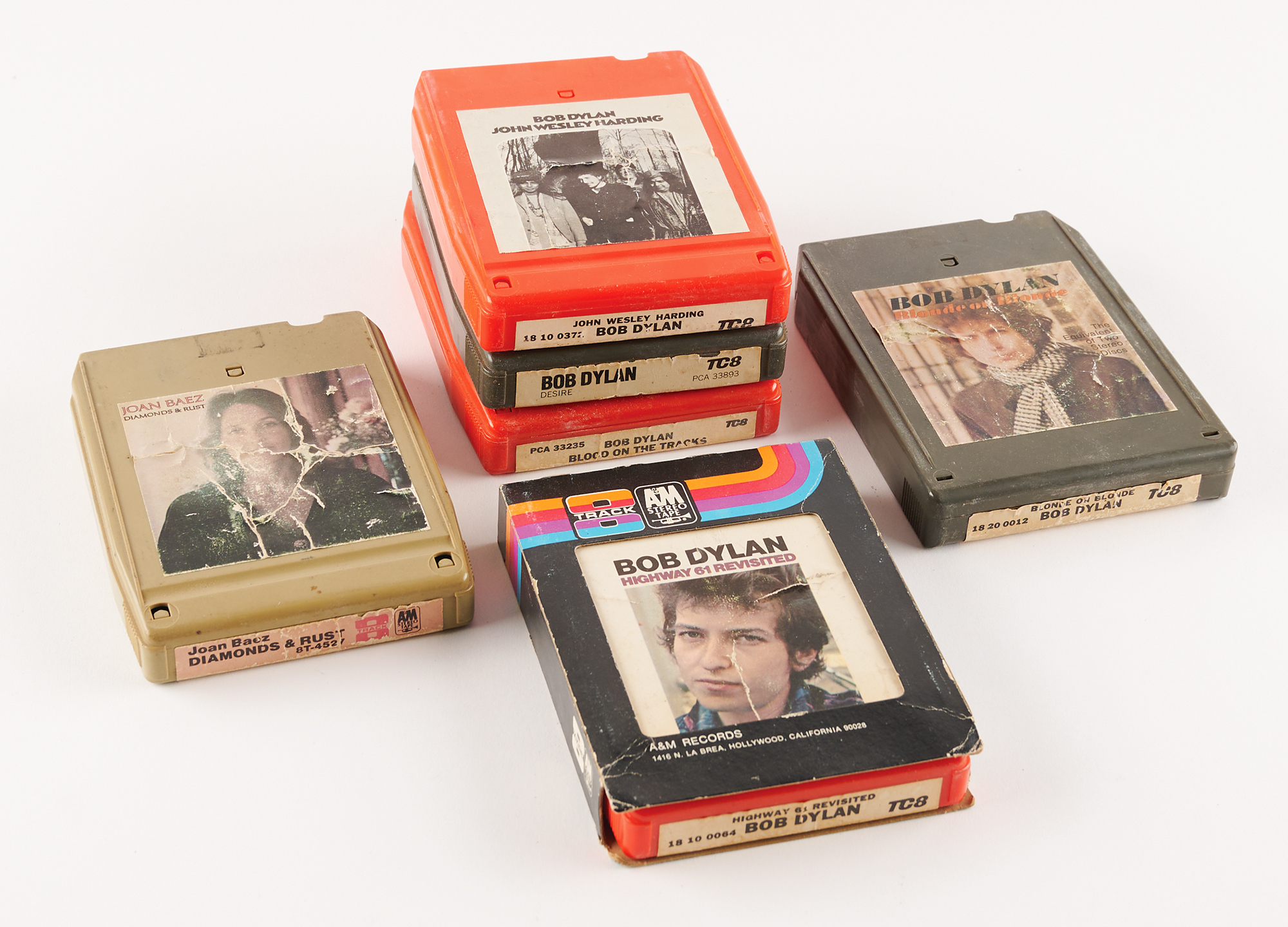
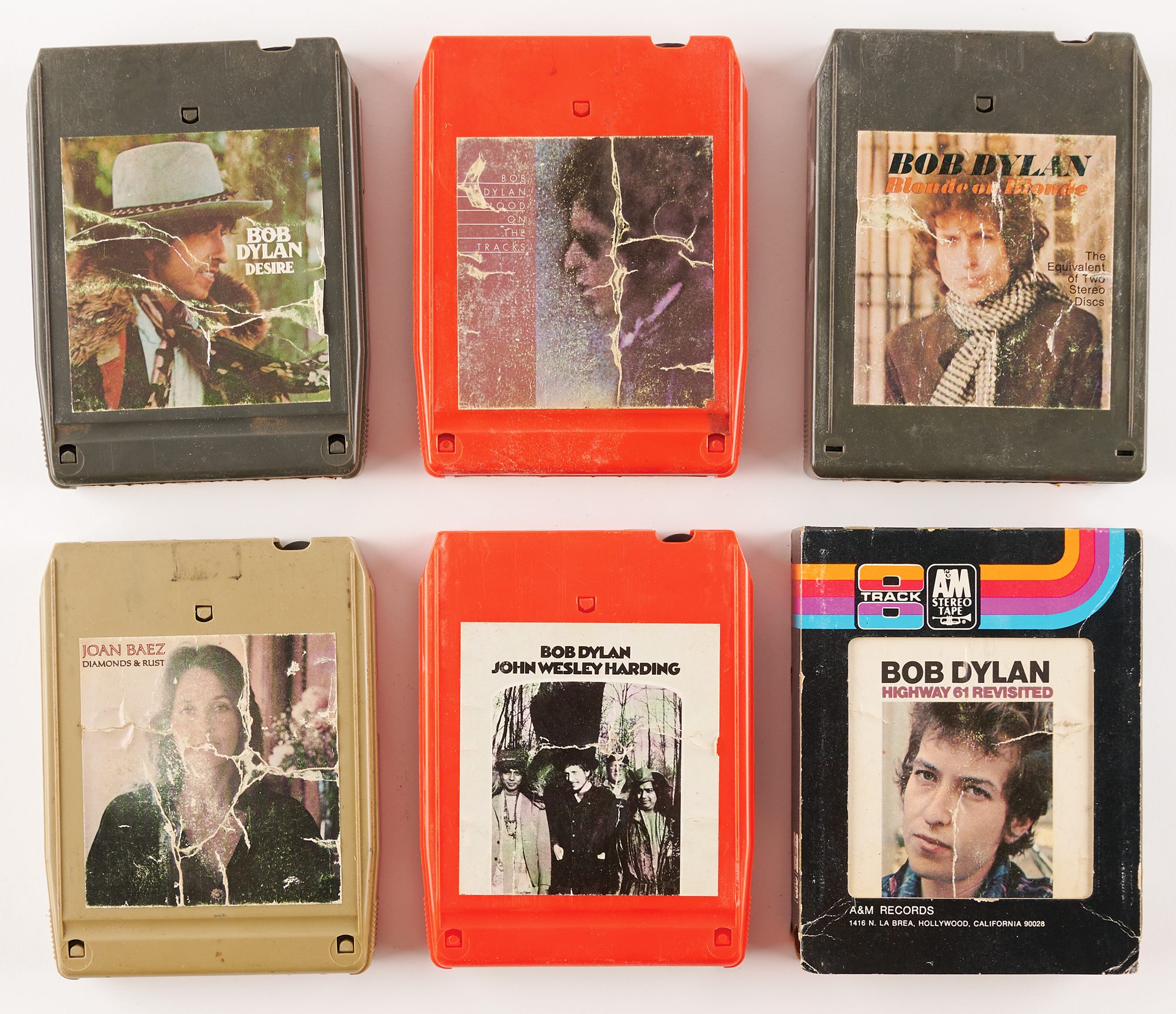
Six of Steve Jobs's personally-owned 8-track tapes—five by Bob Dylan (Highway 61 Revisited, Blonde on Blonde, John Wesley Harding, Blood on the Tracks, and Desire) and one by Joan Baez (Diamonds & Rust)—retrieved from the bedroom closet of his boyhood home. The tapes are well worn, with evidence of extensive use—including heavy wear to the labels and scratches to the plastic. In overall good to very good condition.
The music of Bob Dylan and Joan Baez played a pivotal role in Steve Jobs's life, and, indeed, the formation and success of Apple itself. According to Walter Isaacson's biography of Steve Jobs, Apple co-founder Steve Wozniak turned Jobs on to the music of Dylan shortly after they met, and part of their early friendship was built upon chasing down live bootlegs of Dylan concerts: "'The two of us would go tramping through San Jose and ask about Dylan bootlegs and collect them,' said Wozniak. 'We'd buy brochures of Dylan lyrics and stay up late interpreting them. Dylan's words struck chords of creative thinking.' Added Jobs, 'I had more than a hundred hours, including every concert on the '65 and '66 tour…Instead of big speakers I bought a pair of awesome headphones and would just lie in my bed and listen to that stuff for hours'" (p. 25–26).
His Dylan 8-tracks are mentioned in a later passage, as his friend Elizabeth Holmes—who had joined a religious cult in San Francisco—recalls an odd car ride: "[Jobs] arrived at the cult house in his Ford Ranchero one day and announced that he was driving up to Friedland's apple farm and she was to come. Even more brazenly, he said she would have to drive part of the way, even though she didn't know how to use the stick shift. 'Once we got to the open road, he made me get behind the wheel, and he shifted the car until we got up to 55 miles per hour,' she recalled. 'Then he puts on a tape of Dylan's 'Blood on the Tracks', lays his head in my lap, and goes to sleep. He had the attitude that he could do anything, and therefore so can you. He put his life in my hands" (p. 51–52).
While working on the development of the pioneering Macintosh computer, Jobs was introduced to Joan Baez through her sister, Mimi Fariña. Writes Isaacson: "He was twenty-seven and Baez was forty-one, but for a few years they had a romance. 'It turned into a serious relationship between two accidental friends who became lovers,' Jobs recalled in a somewhat wistful tone. Elizabeth Holmes, Jobs's friend from Reed College, believed that one of the reasons he went out with Baez—other than the fact that she was beautiful and funny and talented—was that she had once been the lover of Bob Dylan. 'Steve loved that connection to Dylan,' she later said" (p. 251).
At the Apple shareholder's meeting on January 24, 1984—during which Steve Jobs publicly unveiled the Macintosh—he opened his remarks by quoting from "part of a twenty-year-old poem by Dylan, that's Bob Dylan," reciting the second verse of his enduring protest anthem: "Come writers and critics who prophesize with your pens, and keep your eyes wide, the chance won't come again, and don't speak too soon, for the wheel's still in spin, and there's no tellin' who that it's namin', for the loser now will be later to win, for the times they are a-changin'."
Jobs would go on to meet Dylan in 2004, when the legendary songwriter was playing near Palo Alto. Jobs recalled: 'We sat on the patio outside his room and talked for two hours. I was really nervous, because he was one of my heroes….He was as sharp as a tack. He was everything I'd hoped. He was really open and honest. He was just telling me about his life and about writing his songs. He said, 'They just came through me, it wasn't like I was having to compose them'" (p. 415–416).
A few years after introducing the iPod and iTunes store, after a few years of effort, Jobs was able to lure Dylan into a distribution and marketing agreement. In 2006, in conjunction with the release of Modern Times, Dylan allowed Apple to sell a $199 digital boxed set of all the music he had ever recorded, and appeared in a commercial for the iPod. Jobs was intimately involved with the creation of the ad—he even convinced Dylan to retape the entire thing when he was dissatisfied with the first version. The campaign was a massive success, and helped propel Dylan to the top of the charts for the first time since 1976, when Desire—Jobs's own copy included here—reached No. 1 on the Billboard Pop Albums chart. The next year, Jobs would play "Like a Rolling Stone," off of Dylan's celebrated Highway 61 album, during his introductory demonstration of the iPhone.
Dylan’s influence on Jobs—and by extension, on Apple—was profound. Jobs admired Dylan’s relentless reinvention and artistic fearlessness, traits he sought to emulate in his own work. The ethos of challenging convention, simplifying to essentials, and forging new paths that Dylan embodied became foundational to Apple’s identity. From quoting Dylan in his most important product unveilings to personally shaping the iPod campaign that brought Dylan back to the top of the charts, Jobs continually wove the songwriter’s spirit into Apple’s narrative. These well-worn tapes, pulled from the closet of his childhood home, thus represent more than youthful listening—they are artifacts that reflect the creative DNA that helped shape one of the modern world's most influential companies.
Provenance: from the personal collection of John Chovanec, stepbrother of Steve Jobs.

