Sold For $8,868
*Includes Buyers Premium
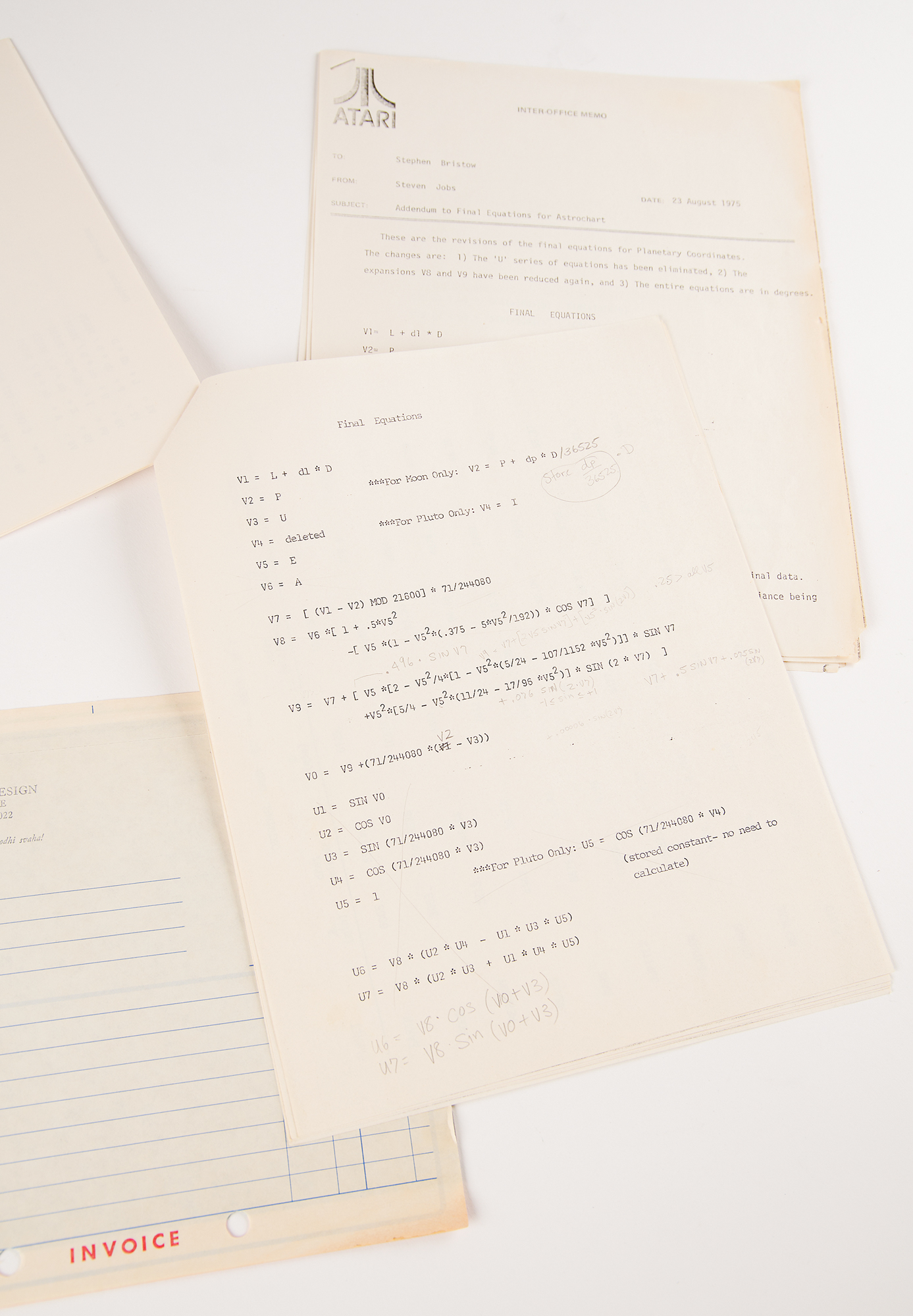
Archive pertaining to the development of "Astrochart," an astrology/horoscope application that Steve Jobs was working on for Atari in the summer of 1975, once preserved inside his childhood desk. The archive includes:
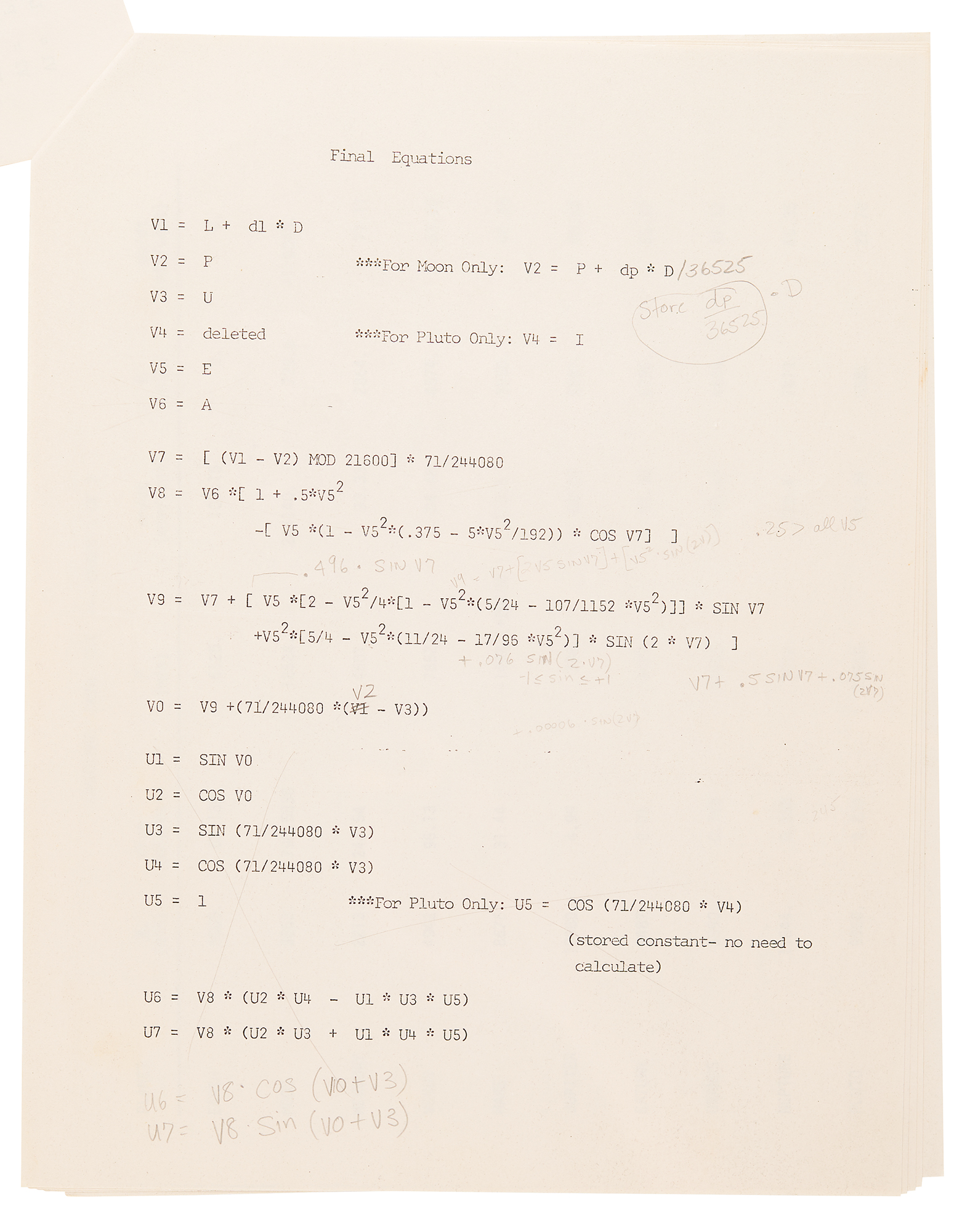
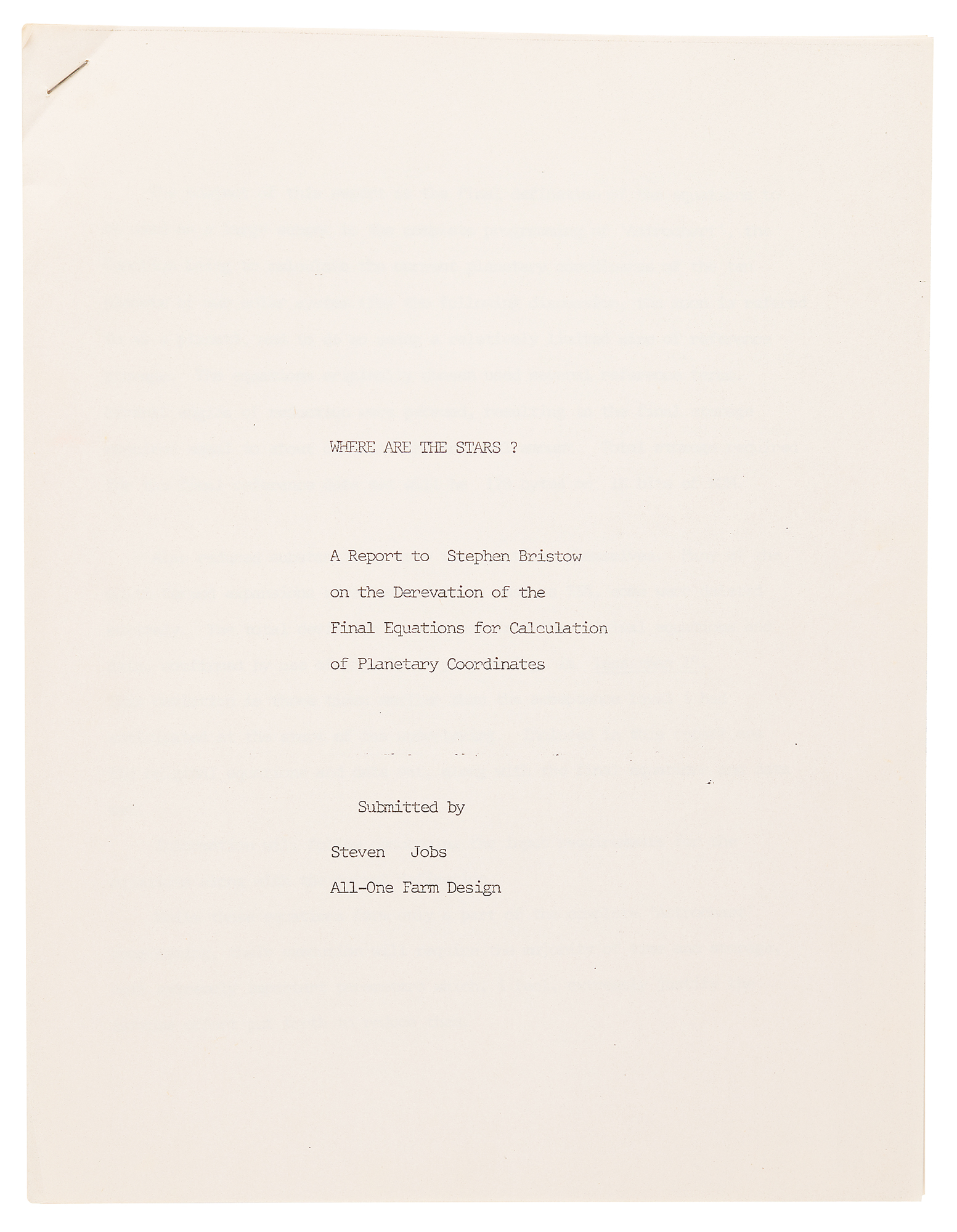
- a ten-page typescript report by Jobs, the cover sheet reading, "Where Are the Stars? A Report to Stephen Bristow on the Derevation of the Final Equations for Calculation of Planetary Coordinates, Submitted by Steven Jobs, All-One Farm Design," which proposes to be "the final definetion of the equations to be used as a large subset in the complete programming of 'Astrochart,' the function being to calculate the current planetary coordinates of the ten planets of our solar system (for the following discussion, the moon is refered to as a planets), and to do so using a reletively limited size of reference storage." One page of equations is heavily annotated in pencil in Jobs's hand, making extensive revisions to several of the calculations.
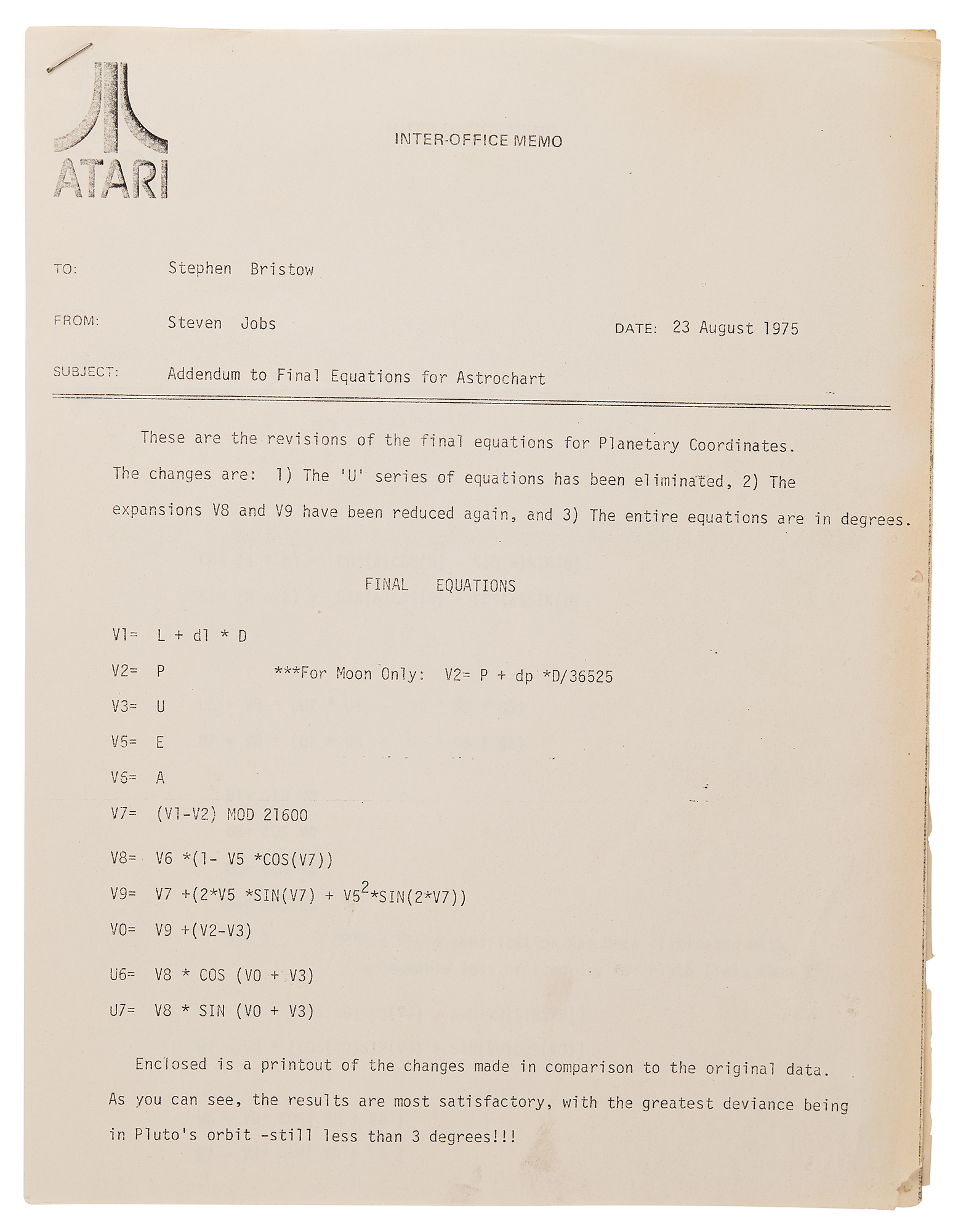
- a four-page Atari inter-office memo from Jobs to Bristow, dated August 23, 1975, headed: "Addendum to Final Equations for Astrochart." The addendum contains "revisions of the final equations for planetary coordinates" and encloses a "printout of the changes made in comparison to the original data. As you can see, the results are most satisfactory, with the greatest deviance being in Pluto's orbit—still less than 3 degrees!"
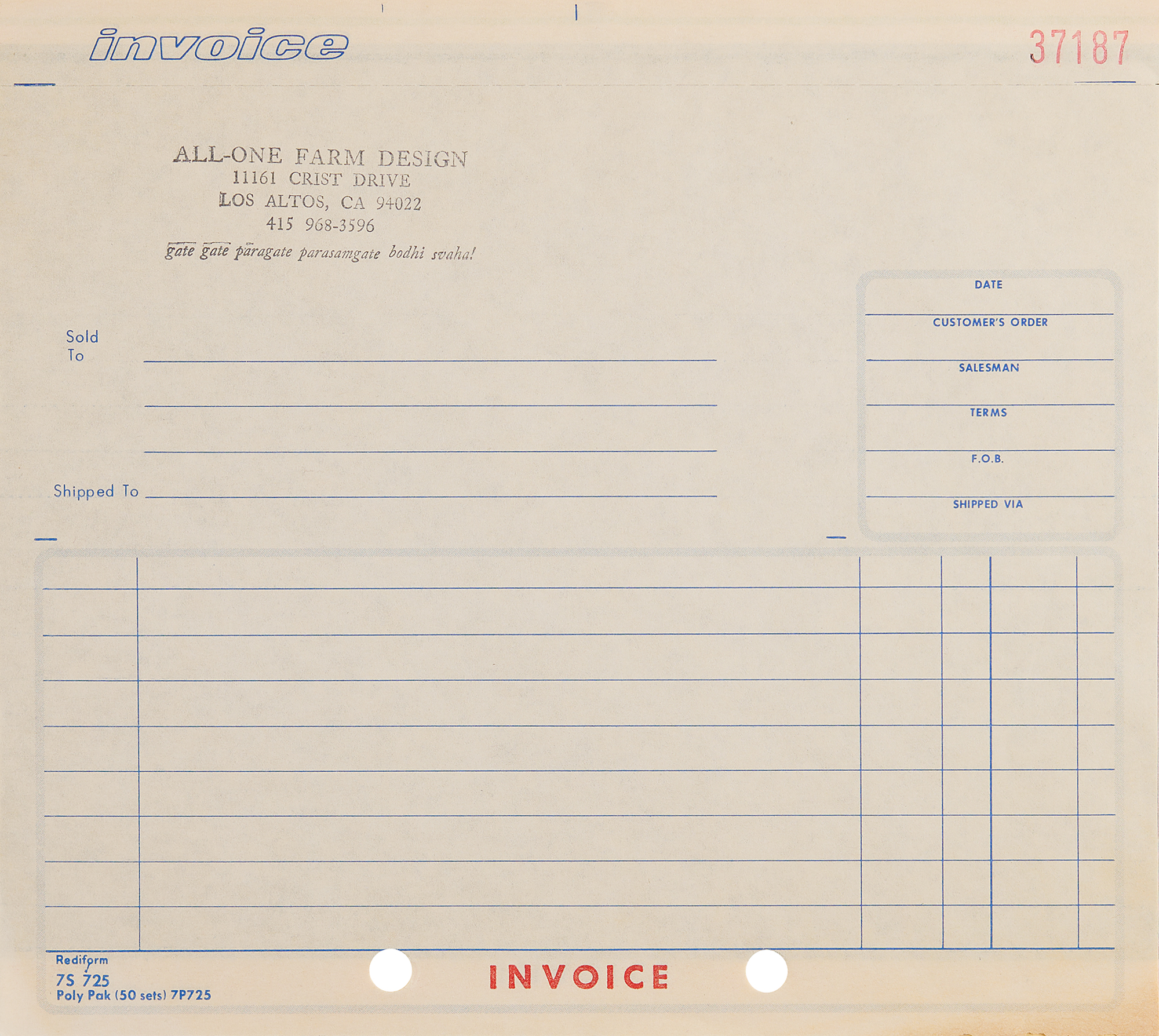
- a blank invoice form for Jobs's early company, "All-One Farm Design"—a name Jobs appropriated from the commune he frequented at the time—giving the address of his parents' house in Los Altos, backed by two carbon copy layers.
In overall fine condition.
In 1974, Jobs was perusing the tech industry's help-wanted classifieds in the San Jose Mercury when an Atari headline caught his eye: 'Have fun, make money.' When the unkempt teen showed up in Atari's office—and refused to leave until they gave him a job—the personnel manager didn't know whether to let him in or call the cops. Knowing that the dropout youngster would be cheap to hire, Atari's chief engineer—Pong creator Allan Alcorn—said: 'Send him in!' Since Jobs knew how to solder and wire wrap, he was hired on as a technician.
At Atari, Jobs learned to keep user interfaces simple and intuitive—after all, the company's success was rooted in Pong's simplicity: 'Deposit Quarter, Avoid Missing Ball for High Score.' This sort of elegant user-friendliness would become a hallmark of Jobs's later products—from the one-button mouse to the touchscreen iPhone. He also refined his business acumen—Jobs famously farmed out the engineering of the Atari 'Breakout' prototype to his friend, Steve Wozniak, who implemented several innovative cost-savings circuit designs. Jobs earned a $5000 bonus for the project’s success and reportedly kept it a secret.
In this archive, Jobs provides some "Astrochart" equations and concepts to his supervisor, Stephen Bristow—the video game pioneer who helped develop the design concept of Breakout, and assigned Jobs to that project. In an interview with retrogamer.net, Bristow recalled: 'Steve Jobs always had an appreciation of his own ability. He wasn’t allowed onto the production floor because he wouldn’t wear shoes, only sandals. There was a special-ness to him.'
Provenance: from the personal collection of John Chovanec, stepbrother of Steve Jobs.

