Sold For $19,375
*Includes Buyers Premium
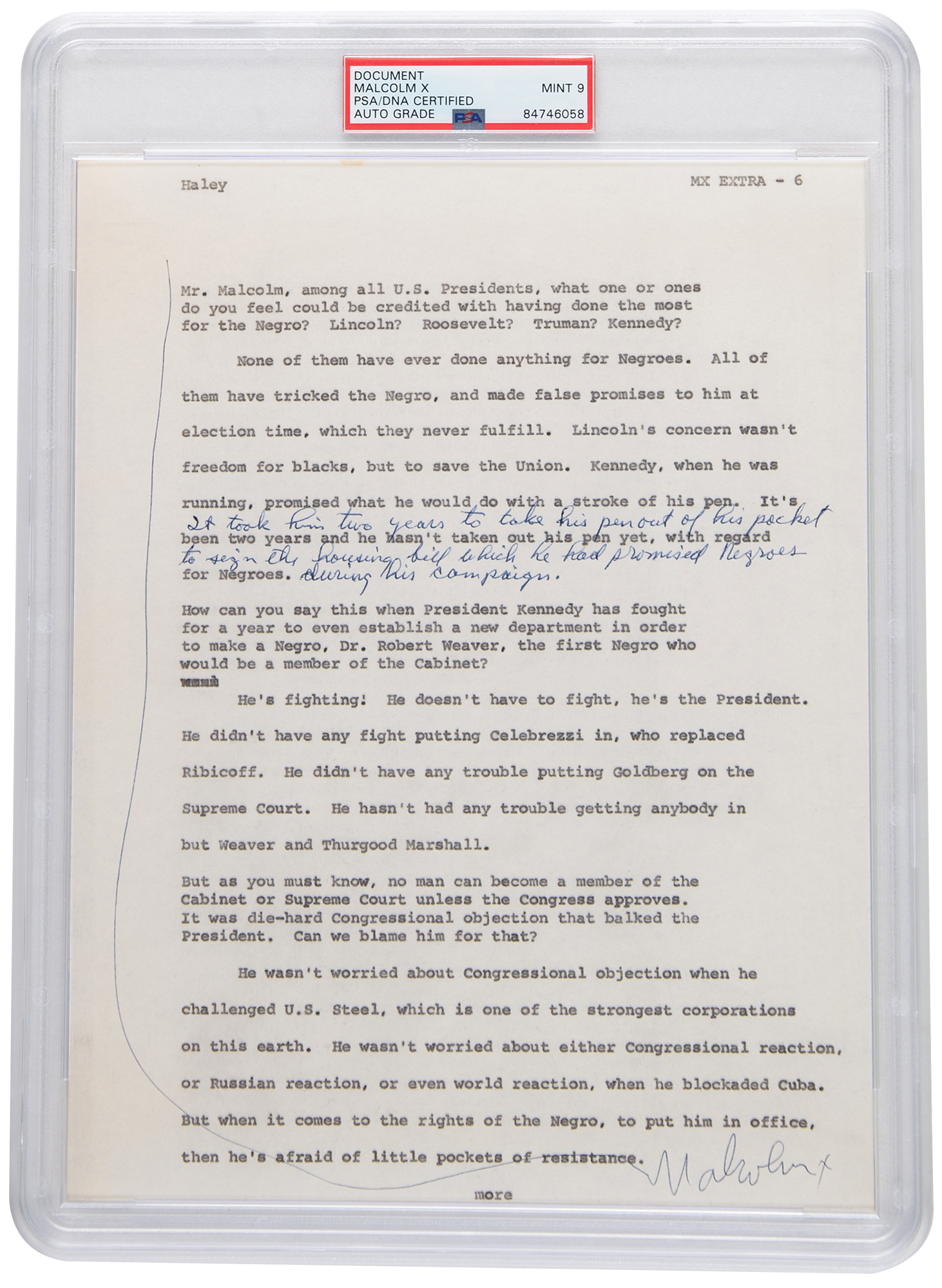
Page marked “MX EXTRA – 6” from the original typescript of Alex Haley’s 1963 interview of Malcolm X for Playboy magazine, one page, 8.5 x 11, signed "Malcolm X" in the bottom margin (with a marginal line indicating his approval of the contents). In full: [Haley] Mr. Malcolm, among all U.S. Presidents, what one or ones do you feel could be credited with having done the most for the Negro? Lincoln? Roosevelt? Truman? Kennedy?
[Malcolm X] None of them have ever done anything for Negroes. All of them have tricked the Negro, and made false promises to him at election time, which they never fulfill. Lincoln's concern wasn't freedom for blacks, but to save the Union. Kennedy, when he was running, promised what he would do with a stroke of his pen. It’s been two years and he hasn’t taken out his pen yet, with regard for Negroes.
[Haley] How can you say this when President Kennedy has fought for a year to even establish a new department in order to make a Negro, Dr. Robert Weaver, the first Negro who would be a member of the Cabinet?
[Malcolm X] He's fighting? He doesn't have to fight, he's the President. He didn't have any fight putting Celebrezzi in, who replaced Ribicoff. He didn't have any trouble putting Goldberg on the Supreme Court. He hasn't had any trouble getting anybody in but Weaver and Thurgood Marshall.
[Haley] But as you must know, no man can become a member of the Cabinet or Supreme Court unless the Congress approves. It was die-hard Congressional objection that balked the President. Can we blame him for that?
[Malcolm X] He wasn't worried about Congressional objection when he challenged U.S. Steel, which is one of the strongest corporations on this earth. He wasn't worried about either Congressional reaction or Russian reaction, or even world reaction, when he blockaded Cuba. But when it comes to the rights of the Negro, to put him in office, then he's afraid of little pockets of resistance.” An editorial hand has amended one of Malcolm X’s comments to read: “It took him two years to take his pen out of his pocket to sign the housing bill which he had promised Negroes during his campaign.” In fine condition. Encapsulated and graded by PSA/DNA as “MINT 9.”
Playboy's May 1963 interview with Malcolm X was one of the most famous of Haley’s career and gave most readers their first in-depth look at Malcolm X’s teachings and personality. Supporters and critics viewed the Muslim minister in very different terms. Admirers saw him as a courageous advocate for the rights of African-Americans and condemned crimes against black Americans; detractors accused him of preaching racism, black supremacy, and violence. Nevertheless, he has been described as one of the greatest and most influential African-American leaders in history. Within a year of granting this interview, with America still gripped by ever-growing racial tension, the once-combative black nationalist Malcolm X had repudiated almost every stance in the interview. He had broken with the Nation of Islam movement, fallen out with its leader, Elijah Muhammad, renounced black supremacy, and embraced racial equality and human rights. He was assassinated in Harlem in 1965.
The Marc and Mary Perkins Collection.

