Sold For $8,748
*Includes Buyers Premium
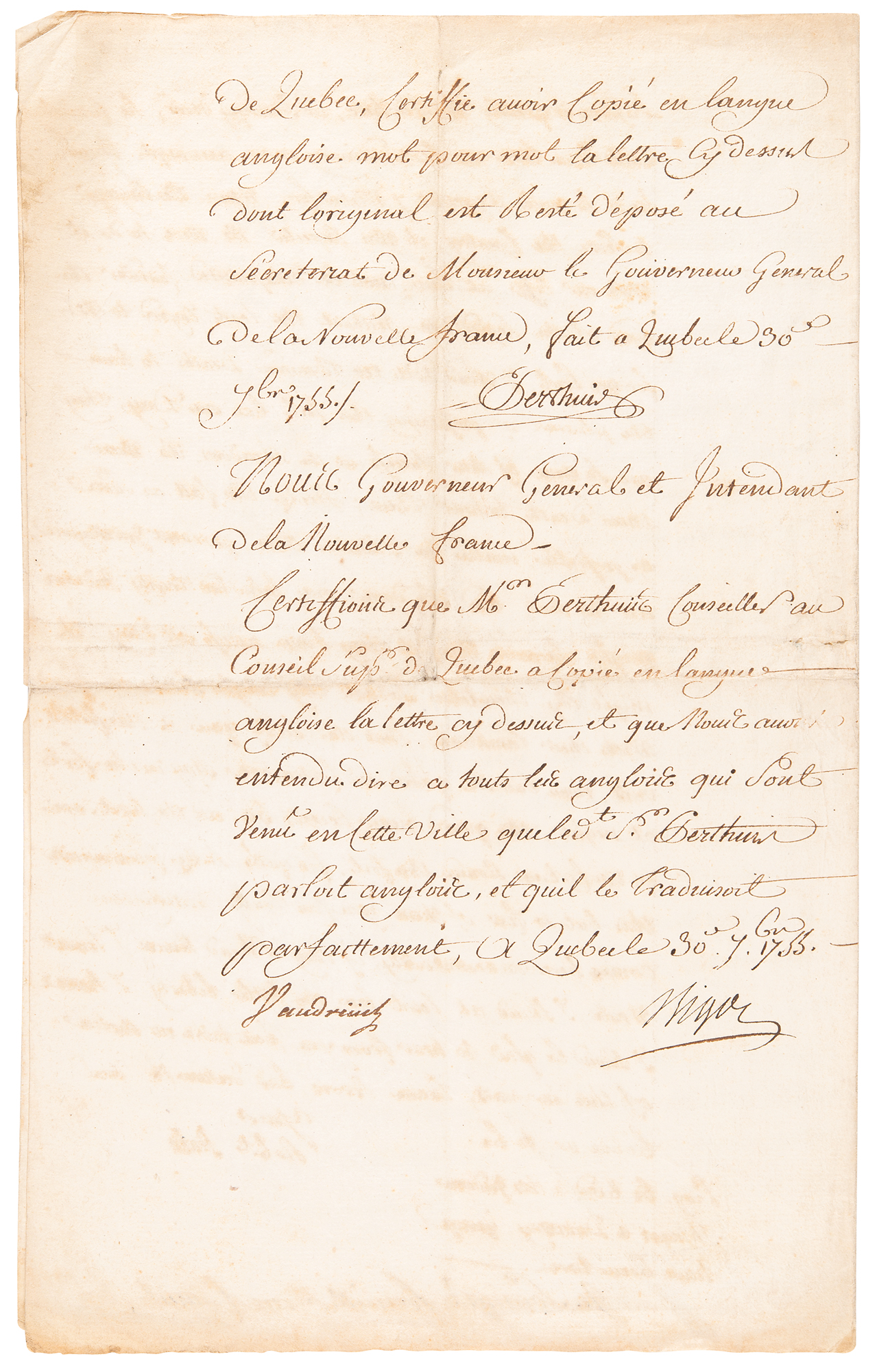
Contemporary manuscript copy of Robert Stobo's letter of July 28, 1754, written from captivity at Fort Duquesne, three pages on two adjoining sheets, 8 x 12.75, certified on the reverse by Joseph Perthuis (1714-1782), merchant and counselor to the Superior Council of Québec; Pierre de Rigaud de Vaudreuil (1698-1778), last governor of New France; and François Bigot (1703-1778), intendant of New France. Their authentications, penned on the reverse, read (translated): "I, the undersigned councilor at the Superior Council of Quebec, certify that I have copied in English word for word the above letter, the original of which has been deposited at the secretariat of the Governor General of New France, made in Quebec on 30 September 1755. Perthuis." Then, underneath: "We, the Governor General and Intendant of New France, certify that Mr. Perthuis, advisor to the Superior Council of Quebec, has copied the above letter in English, and that we have heard from all the Englishmen who came to this city that the said Sr. Perthuis spoke English, and that he translated it perfectly. At Quebec City, 30 September 1755. Vaudreuil. Bigot."
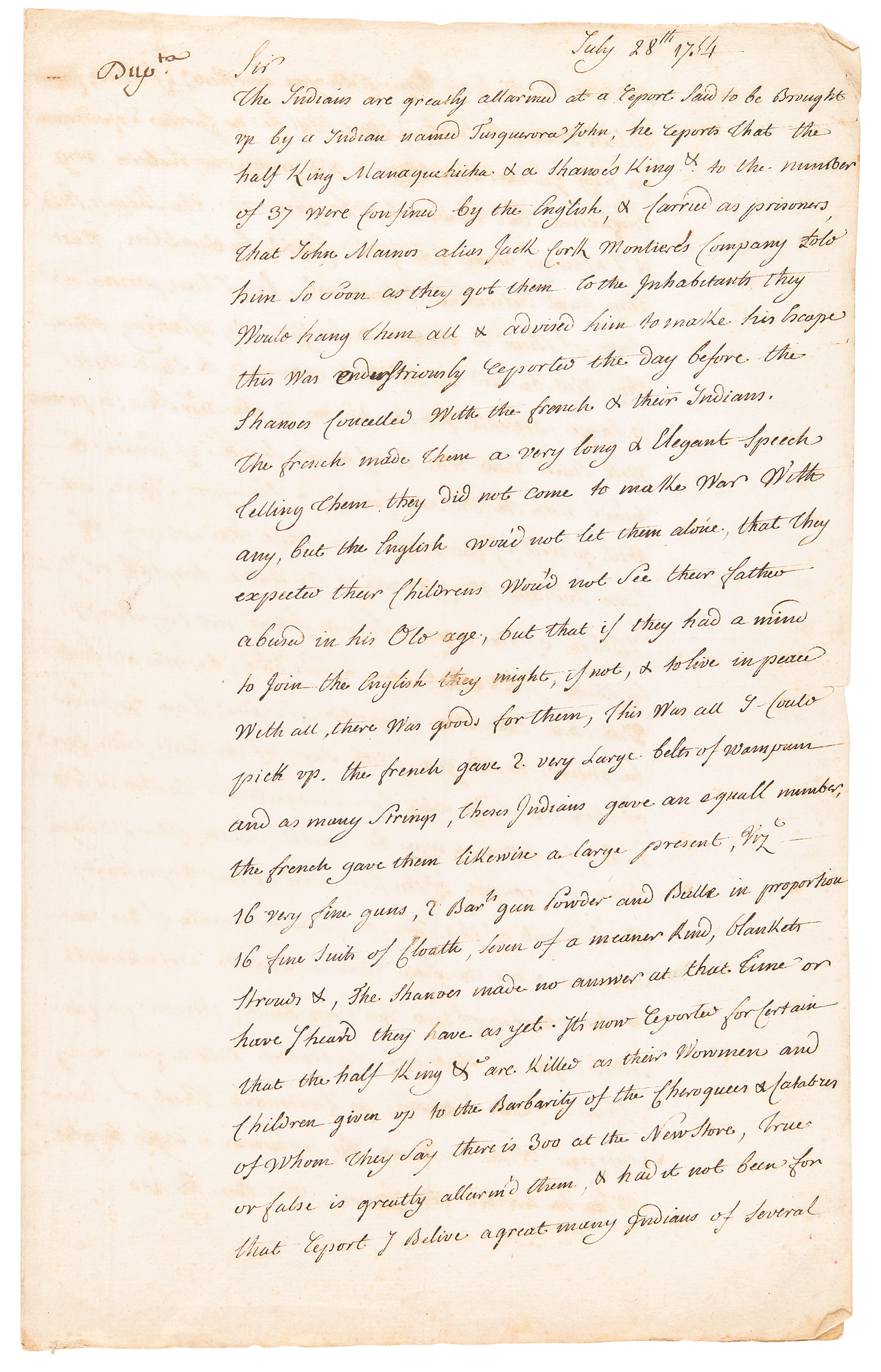
The text of Stobo's letter, in part: "The Indians are greatly alarmed at a Report said to be brought up by an Indian named Tusquerora John. He reports that the Half King Monecatootha, & a Shanoe's King, & to the number of 37, were confined by the English & carried as Prisoners, that John Meinor alias Jack Cork, of Montour's Company, told him so soon as they got them to the Inhabitants they would hang them all & advised him to make his Escape. This was industriously reported the Day before the Shawonese counselled with the French & their Indians. The French made them a very long & elegant speech telling them they did not come to make war with any, but the English wou'd not let them alone, that they expected their children would not see their father abused in his old age, but that if they had a mind to join the English they might, if not, & to live in peace with all, there were goods for them. This was all I could pick up. The French gave 2 very large belts of wampum and as many strings, their Indians gave an equall number. The French gave them likewise a large present, viz 16 very fine guns, 2 bar'ls gun powder and bullets in proportion…
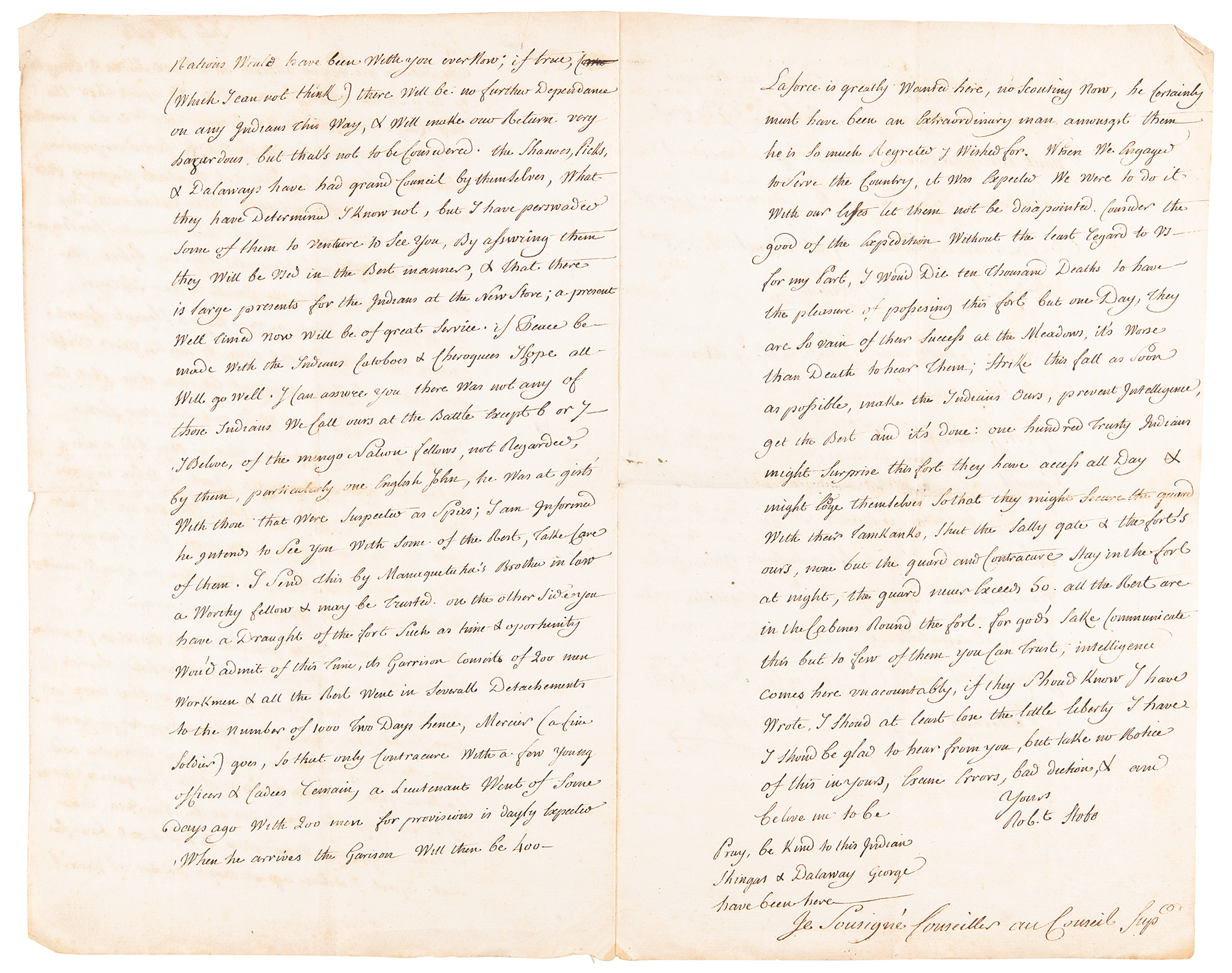
It's now reported for certain that the Half King &c are killed as their women and children given up the barbarity of the Cheroquees & Catabas of whom they say there is 300 at the New Store, true or false it greatly alarmed them, & had it not been for that report I believe a great many Indians of several Nations would have been with you ever now; if true, (which I can not think) there will be no further dependence on any Indians this way, & will make our return very hazardous, but that's not to be considered. The Shanoes, Picks, & Dalaways have had grand council by themselves, what they have determined I know not, but I have persuaded some of them to venture to see you. By assuring them they will be used in the best manner, & that there is large presents for the Indians at the New Store; a present well timed now will be of great service. If Peace be made with the Indians Catoboes & Cheroquees I hope all will go well. I can answer you there was not any of those Indians we call ours at the Battle except 6 or 7—I believe, of the Mingo Nation, fellows, not regarded, by them, particularly one English John, he was at Guests with those that were suspected as Spies.
I am informed he intends to see you with some of the rest, take care of them; I send this by Monecatootha's brother in law, a worthy fellow & may be trusted. On the other side you have a draught of the fort such as time & opportunity wou'd admit of this time, its garrison consists of 200 men, workmen & all the rest went in several detachments to the number of 1,000 two days hence, Mercier (a fine soldier) goes, so that only Contracure with a few young officers & Cades remain, a Lieutenant went of some days ago with 200 men for provisions is daily expected. When he arrives the Garrison will then me 400.
Laforce is greatly wanted here, no scouting now, he certainly must have been an extraordinary man amongst them. He is so much regretted and wished for. When we engaged to serve the Country, it was expected we were to do it with our lifes, let them not be disappointed. Consider the good of the Expedition without the least regard to us—for my part, I would die then thousand deaths to have the pleasure of possessing this fort but one day, they are so vain of their success at the meadows, it's worse than Death to hear them; strike this fall as soon as possible, make the Indians ours, prevent intelligence, get the best and it's done: one hundred trusty Indians might surprize this Fort, they have Access all day & might lodge themselves so that they might secure the Guard with their Tomhawks, shut the Sally Gate & the fort's ours, none but the guard and Contracure stay in the fort at night. For God's sake communicate this but to few of them you can trust; intelligence comes here unaccountably, if they should know I have wrote, I should at least lose the little liberty I have. I should be glad to hear from you, but take no notice of this in yours." In fine condition.
In July 1754, a young George Washington suffered a notable defeat at the Battle of the Great Meadows, also known as the Battle of Fort Necessity. This early clash in the French and Indian War saw Washington lead a force of colonial militia and allied Native Americans to establish a crude fortification in the Ohio Country. The French, under Captain Louis Coulon de Villiers, quickly surrounded the fort with a superior force. After a day-long siege in heavy rain on July 3, Washington was forced to surrender. This was his first and only formal surrender, and the terms—written in French—would later become a source of controversy, as Washington unknowingly accepted responsibility for the 'assassination' of French officer Jumonville, which had occurred weeks earlier during a skirmish. The defeat marked a significant setback for British ambitions in the region and helped spark broader hostilities in what would become the global Seven Years’ War.
To ensure that Washington’s forces complied with the terms of surrender, the French detained Robert Stobo and Jacob Van Braam as prisoners of war. While in open captivity, Stobo used the opportunity to sketch Fort Duquesne and devise strategies for its destruction. Believing that even a small force of Native allies could seize it, he passed his intelligence to British commanders via a Lenape warrior named Keekyuscung. Unfortunately, these plans were discovered by the French after their victory at the Battle of the Monongahela. Stobo was tried in Quebec as a spy and sentenced to death, though the punishment was reduced to confinement. He later escaped and made his way to British lines in Louisbourg, where he joined General James Wolfe’s campaign against Quebec. There, Stobo provided crucial intelligence, including guidance on landing sites that contributed to the British capture of the city.

