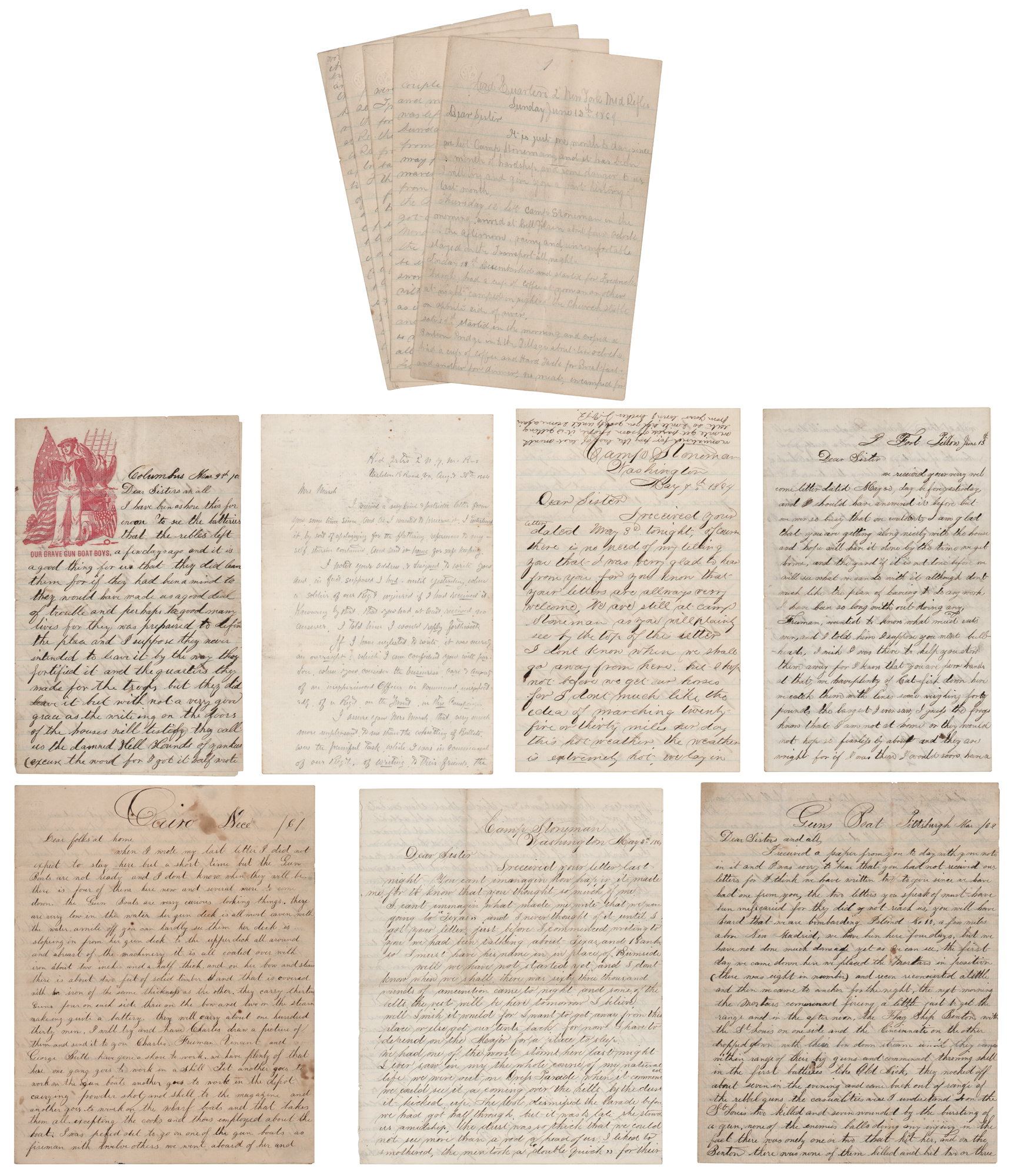
Archive of eight Civil War–dated autograph letters signed by John V. Bedell, totaling 50 pages, dated from 1861 to 1864. Bedell found work on a gun boat at the outset of the war, before mustering into Company K, New York 2nd Mounted Rifles, on September 19, 1863, was promoted to 2nd Lieutenant in February 1864, and was wounded at Petersburg about June 17, 1864. Bedell died of his wounds at Buffalo, New York, on July 8, 1864, at the age of 20. In the letters, he writes home to his friends and family, principally his sister. The early letters describe the construction and deployment of ironclad gunboats on the Mississippi River and the bombardment of Confederate positions such as Island No. 10, while later letters recount time spent in Washington, D.C., and at Camp Stoneman, awaiting deployment amid brutal heat, storms, and equipment delays. The final and most detailed letter chronicles a month of grueling marches, skirmishes, and life on the front lines during the Overland Campaign, capturing both the physical hardship and emotional toll of war.
Excerpts from Bedell's letters:
December 1861, from Cairo: "The Gun Boats are not ready and I don't know when they will be. There is four of them here now and several more to come down. The Gun Boats are very curious looking things. They are very low in the water her gun deck is all most even with the water. A mile off you can hardly see them. Her deck is sloping in form her gun deck to the upper deck all around and abreast of the machinery it is all coated over with iron about two inches and a half thick, and on her bow and stern there is about two feet of solid timber and that is covered with iron of the same thickness as the other. They carry thirteen guns four on each side three on the bow and two on the stern making quite a battery."
March 1862, from Pittsburgh: "You will have heard that we are bombarding Island No. 10, a few miles above New Madrid, we have been here four days but we have not done much damage yet as we can see, the first day we came down here we placed the mortars in position…the next morning the mortars commenced firing a little just to get the range and in the afternoon the Flag Ship Benton, with the St. Louis on one side and the Cincinnati on the other, dropped down…within range of their big guns and commenced throwing shell…they nocked off about seven in the evening and came back out of range of the rebel guns. The casualties were I understand on the St. Louis two killed and seven wounded by the bursting of a gun, none of the enemies balls doing any injury in the fact there was only one or two that hit her, and on the Benton there was none of them killed and but two or three wounded and those from splinters from a ball that came through the deck."
March 9, 1862, from Columbus: "I have been ashore this forenoon to see the batteries that the rebels left a few days ago and it is a good thing for us that they did leave them for if they had been a mind to they would have made us a good deal of trouble and perhaps a good many lives for they was prepared to defend the place and I suppose they never intended to leave it by the way they fortified it…they call us the damned Hell Hounds of Yankees (excuse the word for I got it half wrote before I thought) and every thing else they can think of. I have got some of their money and I will send a specimen. I never saw so many bottles in one place in my life, the ground is perfectly covered with them…every corner with prime old Rye and fourth proof Brandy."
June 13th, [1862], from Fort Pillow: "I am glad that you are getting along nicely with the house and hope will have it done by the time we get home…Freeman wanted to know what mudcats were, and I told him I suppose you mint bullheads, I wish I was there to help you…we have plenty of cat-fish down here we catch them with lines some weighing forty pounds the longest I ever saw." The page includes an additional letter in another hand, apparently written by a neighbor serving with Bedell: "The Pittsburgh has been lying quietly at Fort Pillow for several days, the rest of the fleet having gone down the river. Today the Cairo came up from Memphis to relieve us and we shall probably start for Cairo shortly to repair Ship. We have taken one prize since the fleet left us, a small steamer…The south is excessively warm, nights cool and fishing tolerable. Bullheads have become mudcats. I was not aware of the change. But then we are way down South in Dixie…surprising changes have taken place here, for I have not only learned to eat butter but positively to like it, so have a good stock on hand."
March 8, 1864, from Washington, D.C.: "We have arrived at our journey's end, safe and sound as a brick. We got in here this afternoon about four o'clock after a tedious journey three nights and two days and a half after we got off from the cars we were conducted to the soldier's rest where the men got some supper. Tomorrow we will draw our Tents and start for Camp of Instruction…Today I went up to the Capitol and went through the grounds which are perfectly magnificent. They have got the Goddess of Liberty pretty near finished and the building you cannot imagine anything so grand and beautiful. All of solid marble. I wish you could see it for I can't describe it and do it justice."
May 3, 1864, from Camp Stoneman, Washington, D.C.: "I can't imagine what made me write that we were going to 'Texas.' and I never thought of it until I got your letter…We have not started yet and I don't know when we shall. There was sixty three thousand pounds of ammunition came to night…We had one of the worst storms here last night I ever saw in the whole course of my natural life. We were out on Dress Parade when it commenced we could see it a coming over the hills by the dust it kicked up…The dust was so thick that we could not see more than a rod ahead of us."
May 7, 1864, from Camp Stoneman, Washington, D.C.: "I don't know when we shall go away from here, but I hope not before we get our horses for I don't much like the idea of marching twenty five or thirty miles per day…the weather is extremely hot, we lay in our tents lolling like a dog but the evenings are very pleasant and the nights are almost uncomfortably cold…There is no necessity of your feeling anxious about my sticking to the company for I am going to stay unless they try to keep us as Infantry. If they do I consider my contract with the government broken. They promised to mount us and give us a good gun and that was the conditions that we enlisted our men under."
June 12, 1864, from "Head Quarters, 2 New York Mtd Rifles," a remarkable 24-page chronology of his activities of the prior month: "It is just one month 6 days since we left Camp Stoneman and it has been a month of hardship and some danger…I will try and give you a part history of last month. Thursday 12: Left Camp Stoneman in the morning…Friday 18th: Disembarked and started for Fredericksburgh, had a cup of coffee at noon…Sat. 14th: Started in the morning and crossed at Pontoon Bridge in to the Village about ten o'clock, had a cup of coffee and hard tack for Breakfast and another for dinner, no meat…Monday 16th: This morning Mr. Fegan and I went up to see Gen. Grant, saw him with his aids, smoking as cool as a cucumber in front of his Tent, then we went up to the Hospital saw four men waiting to be buried, a tent full of men minus one leg, and two or three legs without any bodies to them…Monday 23: Heard heavy firing at the front thought our regt. might be engaged so buckled on my sword and started to catch up with the Co. but did not succeed as it was dark…Tuesday 24th:…heard heavy musketry firing on top of the hill, as soon as we got across we marched on top of the hill and then formed in line of Battle…it commenced to rain, and our condition was not very pleasant for it was quite cold, about dark, The rebs made a charge on the line that was in front of us, with horrid yells. The line broke and came tearing through outs like mad they told us to get across the river as quick as we could for the rebs were coming in overwhelming force. I drew my revolver and told the men that the first one that attempted to leave the ranks I would shoot on the spot…Friday 27th: in the morning we formed in line, some of the boys showed themselves through the trees and drew from the Reb sharpshooters a few balls one of them took effect…it was only a slight flesh wound but enough to send him to the rear, I don't know where he is now but probably he is at home he was very lucky, for he escaped all these hard marches…Sunday morning 29th…our cavalry had a fight with the rebs here the day before, there was a good many dead bodies laying around but they were soon buried. I had a cup of coffee and felt some better…Wed. 1st: we were relieved about 1 o'clock and joined the regt. and were under marching orders, when the rebs fell on the pickets that relieved us and drove them in. We layed down behind our works and let the front line do the fighting, several shells burst near us but there was only two or three in the regt. hurt…Thursday 2nd: our Corps made another flank movement, the rebs thought they would stop us so they pitched on our rear, our Brig. was the rear guard. The rebs pitched on our skirmishers and drove them in. The 2d Mtd Rifles & 4th Heavy Artillery, 24th Cavalry & 3 Maryland formed in line and advanced double quick, there happened to be an old rebel breatwork in front of our regt. we got behind that under cover…the 14th was exposed to all the rebel fire…the rebs sharpshooters got on our flank so that they could fire on our lines, the bullets whistled by awful close. One of my best boys was shot dead (with a ball through the head) another was hit in the shoulder."
Last is a letter signed by Nahum Ward Cady of the 2nd New York Mounted Rifles, August 30, 1864, to Bedell's sister, offering condolences and commentary on his tragic death. In part: "I assure you Mrs. Marsh that very much more unpleasant to me than the whistling of bullets was the painful task, while i was in command of our Regt., of writing to their friends, the sad tidings of the deaths of our officers…Though I am not brave, yet I would rather fight, if fighting must be done, than write & inform such persons of their sad bereavement…I know from the anxiety of my own mother & sisters, that a son & brother is missed at home, when death calls him away. Especially is it the case, with one so kind, generous, noble & patriotic as was your brother. When he was wounded we all rejoiced that it was not more serious or dangerous. But when we heard that he was dead, a universal expression of surprise & deep regret was in all the camp. I do not believe that the Lt. had an enemy in the Regt."
In overall very good to fine condition.
The Collection of Dr. Joseph Matheu.

