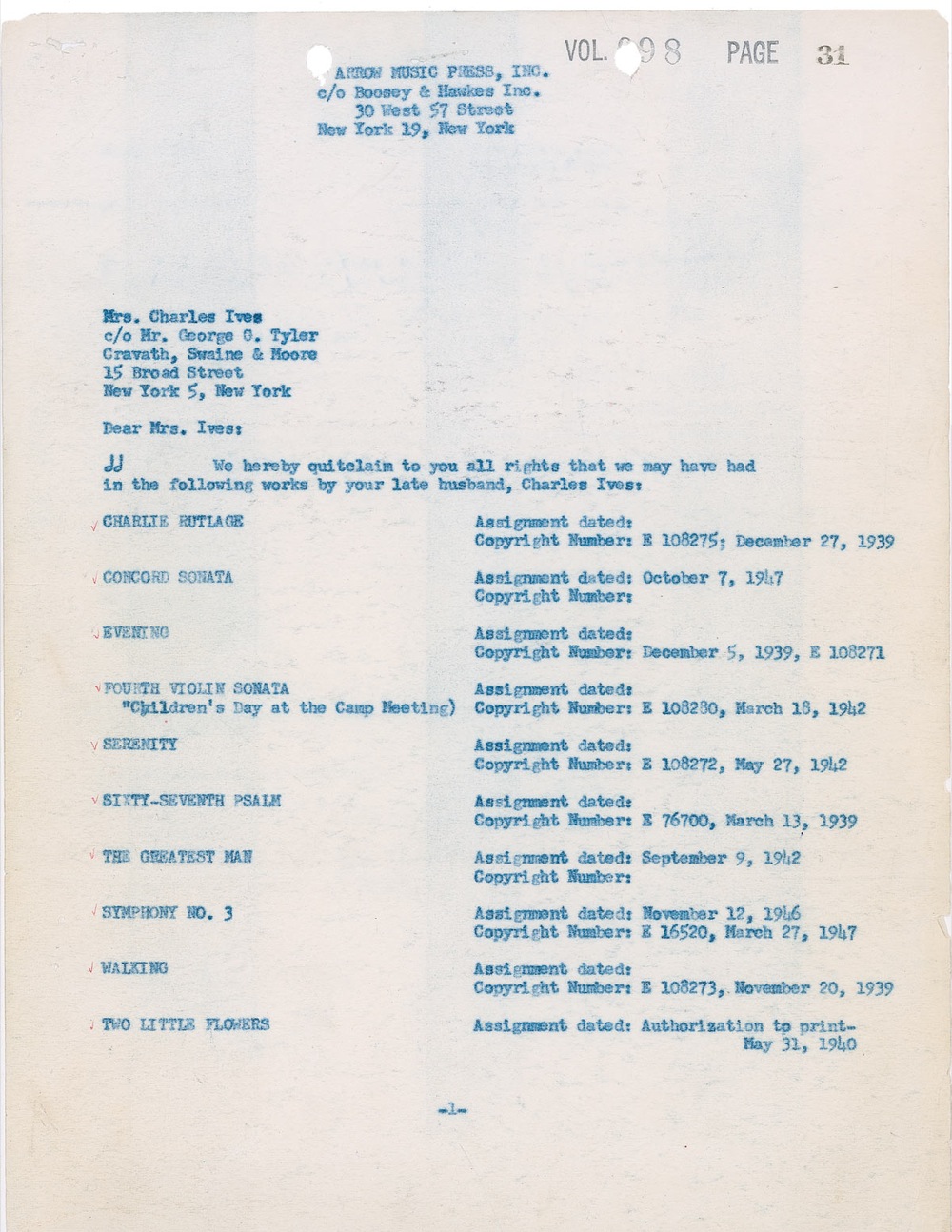
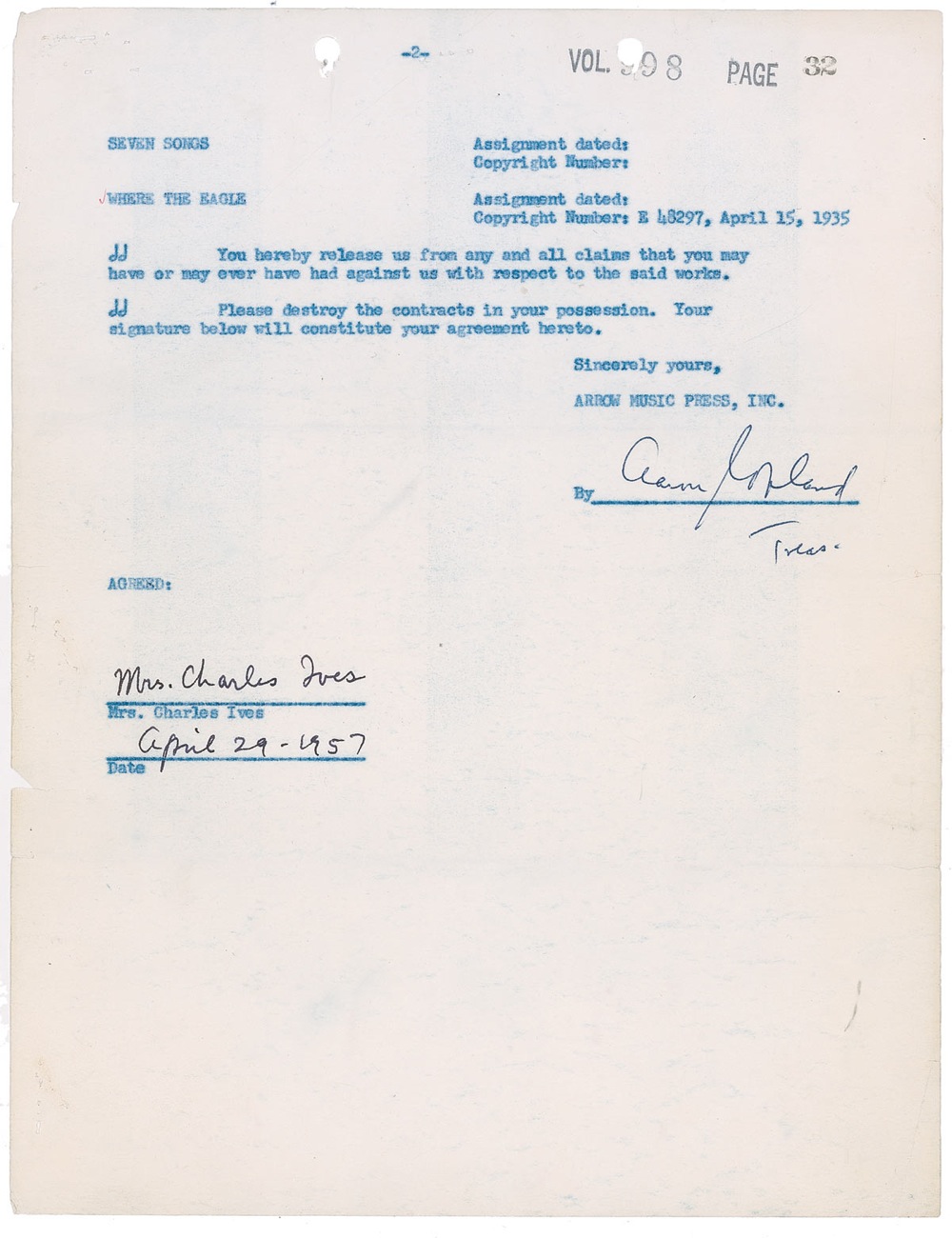
DS, signed “Aaron Copland, Treas.,” two pages, 8.5 x 11, April 29, 1957. Agreement between Arrow Music Press, Inc. and the widow of Charles Ives. In part: “We hereby quitclaim to you all rights that we may have had in the following works by your late husband, Charles Ives…You hereby release us from any and all claims that you may have or may ever have had against us with respect to the said works. Please destroy the contracts in your possession. Your signature below will constitute your agreement here.” Works involved are ‘Charlie Rutlage,’ ‘Concord Sonata,’ ‘Evening,’ ‘Fourth Violin Sonata,’ ‘Serenity,’ Sixty-Seventh Psalm,’ ‘The Greatest Man,’ ‘Symphony No. 3,’ ‘Walking,’ ‘Two Little Flowers,’ ‘Seven Songs,’ and ‘Where the Eagles.’ In very good condition, with horizontal folds, light creasing, wrinkling, two filing punch holes at the top of the page, staple holes at the upper left corner and along the left side, and office stamps.
Copland, who earned the title the ‘Dean of American Music,’ was also a co-founder of Arrow Music Press, a cooperative publishing venture created to support writers, artists, musicians, and photographers working representing ‘the ideas of American Democracy’—people like the reclusive Charles Ives, whose vast output brought him recognition as the most original and significant American composer of the late 19th and early 20th centuries. A decade before this document was signed, Ives received a Pulitzer Prize for his ‘Symphony No. 3.’ The fact that the copyright for that music was assigned to the publisher instead of the composer was the result of Ives' disdain for copyright in relation to his own work, and his desire to have his music distributed as widely as possible. He at first self-published and distributed volumes of his music free of charge, though before his 1954 demise he allowed some commercial publication of his music, but always assigned royalties to other composers. A scarce example from the music industry, as documents signed by Copland as the representative of Arrow Music are rarely encountered. RRAuction COA.

