Sold For $1,038
*Includes Buyers Premium
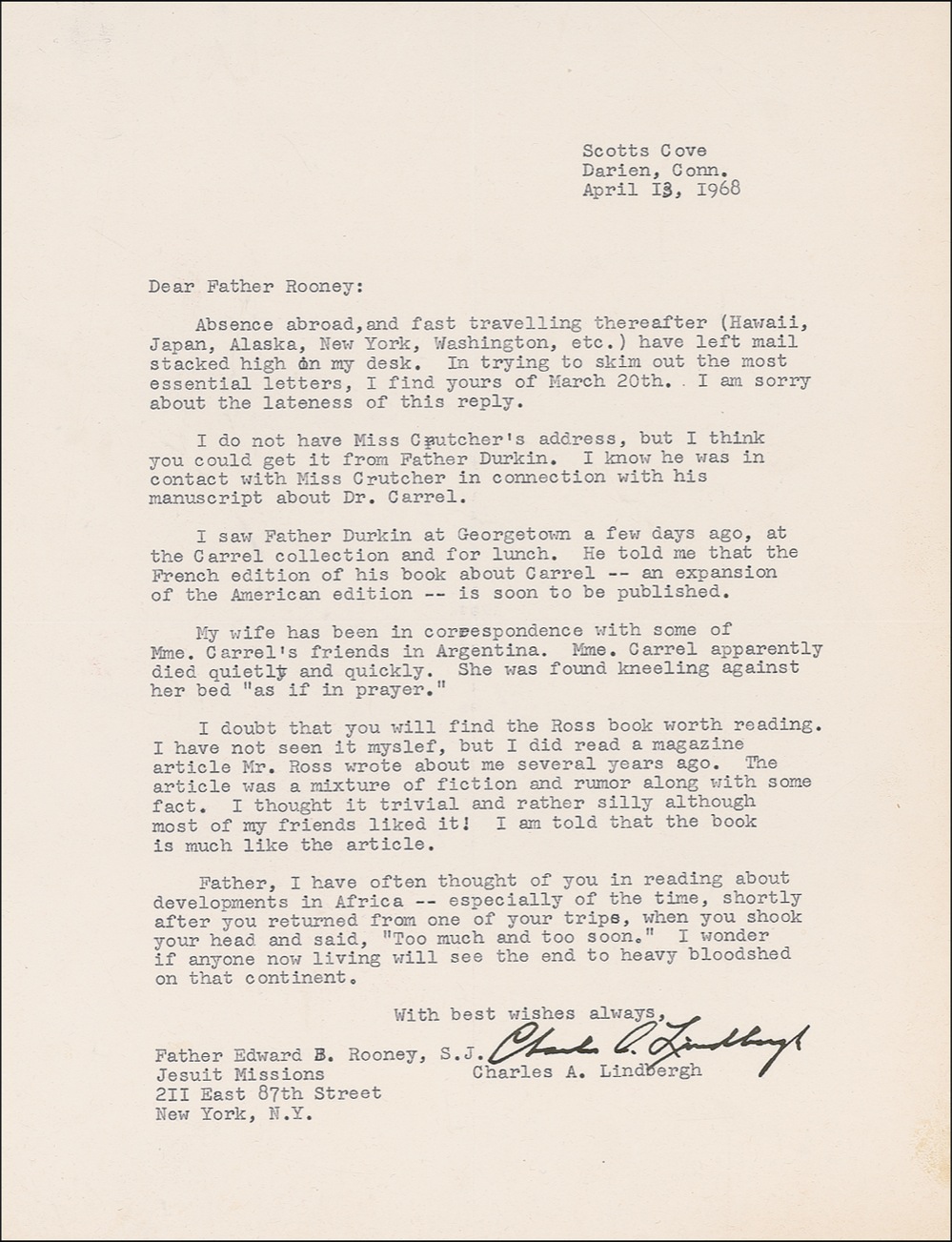
TLS signed “Charles A. Lindbergh,” one page, 8.5 x 11, April 13, 1968. Letter to Father Edward Rooney. In part: “I saw Father Durkin at Georgetown a few days ago, at the Carrell collection and for lunch. He told me that the French edition of his book about Carrel — an expansion of the American edition — is soon to be published. My wife has been in correspondence with some of Mme. Carrel’s friends in Argentina. Mme. Carrel apparently died quietly and quickly. She was found kneeling against her bed ‘as if in prayer.’ I doubt that you will find the Ross book worth reading. I have not seen it myself, but I did read a magazine article Mr. Ross wrote about me several years ago. The article was a mixture of fiction and rumor along with some fact. I thought it trivial and rather silly although most of my friends liked it! I am told that the book is much like the article. Father, I have often thought of you in reading about developments in Africa — especially of the time, shortly after you returned from one of your trips, when you shook your head and said ‘Too much too soon.’ I wonder if anyone now living will see the end to heavy bloodshed on that continent.” Dr. Alexis Carrel (1873-1944) co-authored a book with Lindbergh, The Culture of Organs, and worked with Lindbergh in the mid-1930s to create the "perfusion pump," which allowed living organs to exist outside of the body during surgery. The advance is said to have been a crucial step in the development of open-heart surgery and organ transplant. Carrel's fascist and Nazi sympathies, as well as his anti-Semitism, are said to have influenced Lindbergh. Lindbergh also makes reference to author Walter Ross, who wrote The Last Hero: Charles A. Lindbergh in 1964, which explored the mysterious post-kidnapping period of Lindbergh's life in the 1930s. In fine condition, with bisecting mailing folds, and a small spot of trivial toning to lower right. RRAuction COA.

