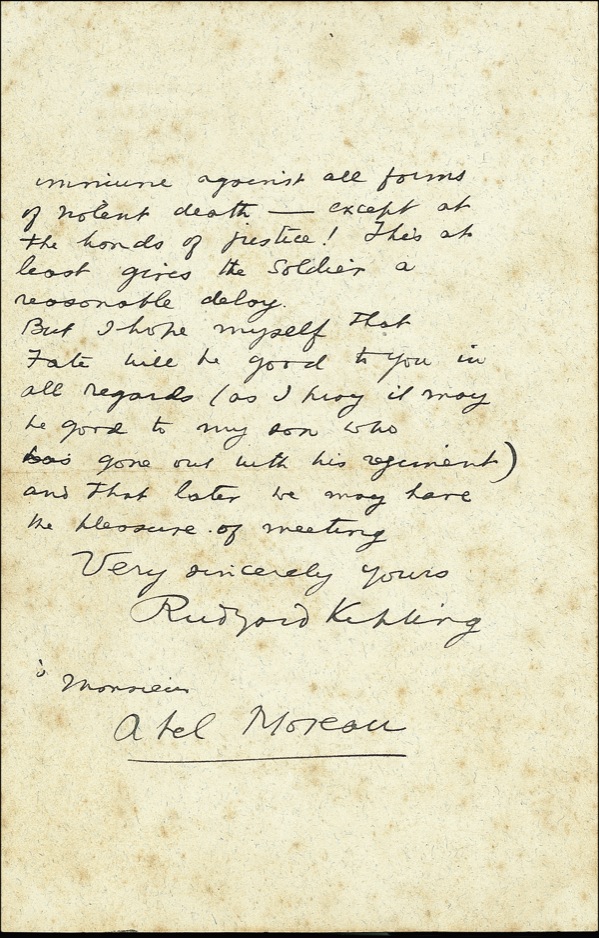
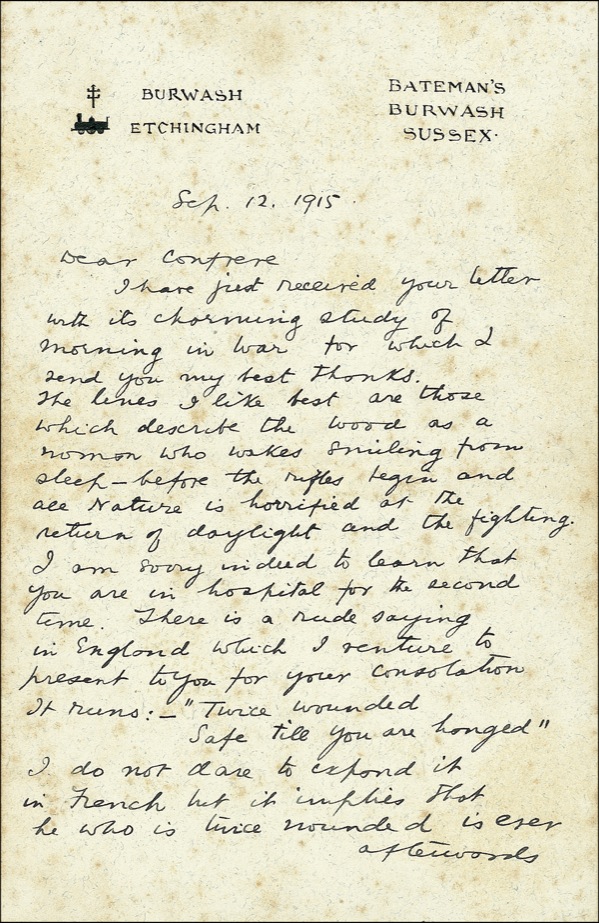
ALS, one page both sides, 4 x 6, Burwash, Etchingham letterhead, March 12, 1915. Letter to Mr. Moreau. In full, “I have just received your letter with its charming study of morning in war for which I send my best thanks. The lines I like best are those which describe the wood as a woman who wakes smiling from sleep - before the rifles begin and all Nature is horrified at the return of daylight and the fighting. I am sorry indeed to learn that you are in hospital for the second time. There is a rude saying in England which I venture to present to you for your consolation. It runs: ‘Twice wounded, Safe till you are hanged.’ I do not dare to expand it in French, but it implies that he who is twice wounded is ever afterwords immune against all forms of violent death - except at the hands of justice! This at least gives a soldier a reasonable delay.” Kipling ends the letter with a poignant reference to his son, who was to be killed in the Battle of Loos, three weeks later, “But I hope myself that Fate will be good to you in all regards (as I pray it may be good to my son who has gone out with his regiment.)” In fine condition, with scattered foxing overall that affects only the appearance; all writing is dark and readable. Kipling’s only son, John, died in 1915 at the Battle of Loos, after which he wrote “If any question why we died/ Tell them, because our fathers lied.” It is speculated that these words may reveal Kipling’s feelings of guilt at his role in getting John a commission in the Irish Guards, despite his initially having been rejected by the army because of his appalling eyesight. Kipling’s text is bold and legible throughout entire letter. LOA John Reznikoff/PSA/DNA and R&R COA.

