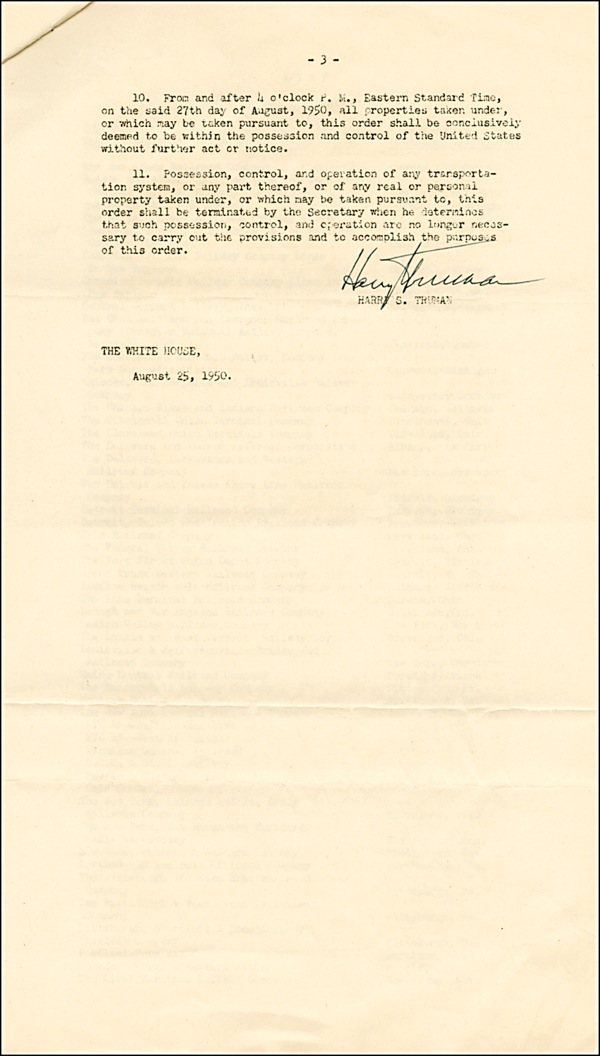
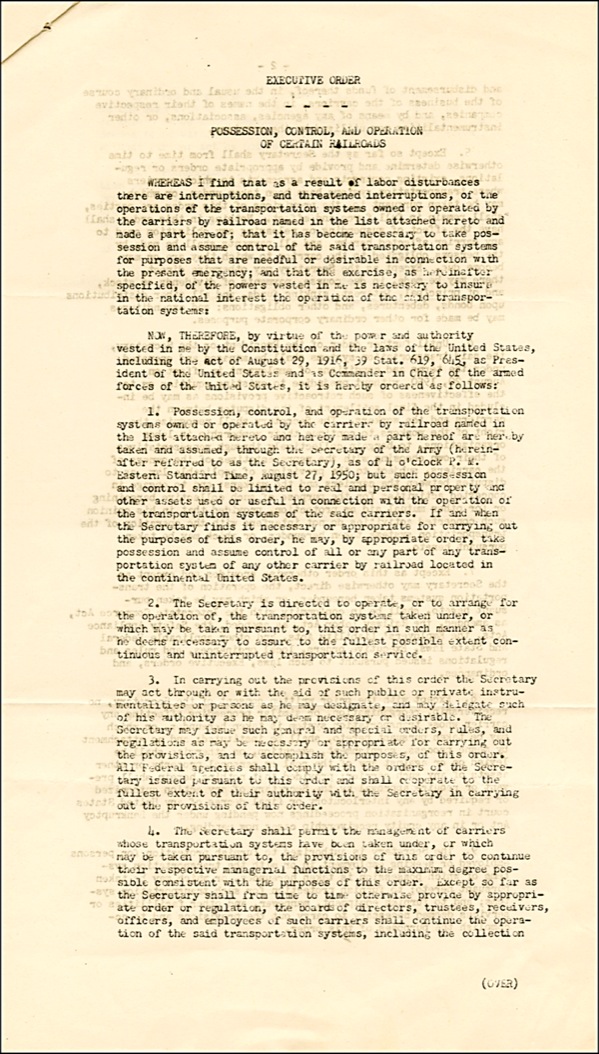
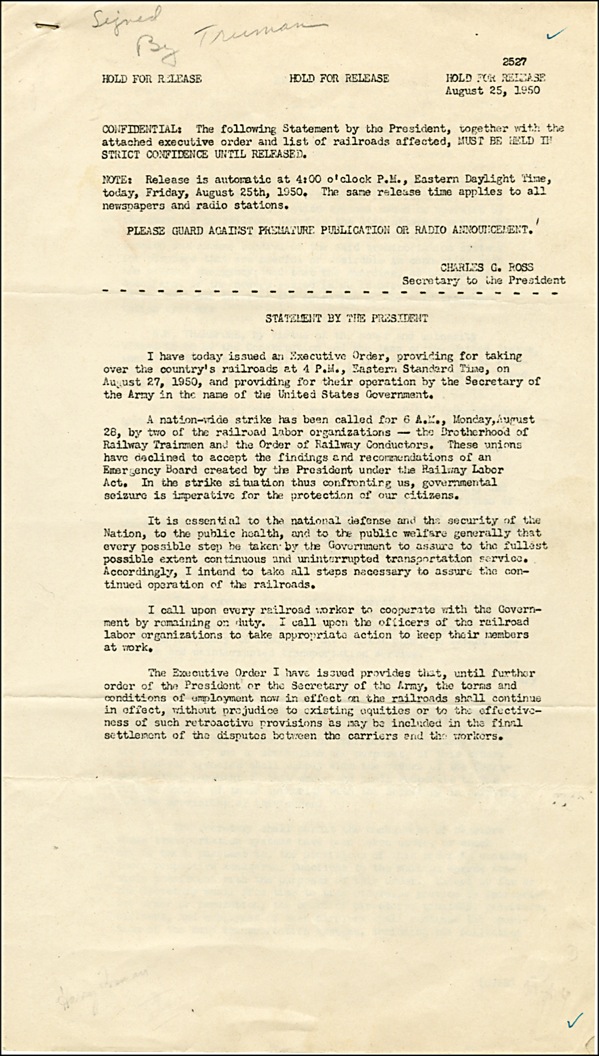
Copy of an Executive Order and press release, three pages, 8 x 14. The statement reads in part, "Confidential: The following statement by the President, together with the attached executive order and list of railroads affected, Must Be Held In Strict Confidence Until released. Release is automatic at 4:00 o'clock P.M. Eastern Daylight Time, today, Friday, August 25th, 1950…Statement By The President: I have today issued an Executive Order, providing for taking over the country’s railroads at 4 P.M., Eastern Standard Time, on August 27, 1950, and providing for their operation by the Secretary of the Army in the name of the United States Government. A nation-wide strike has been called for 6 A.M. Monday, August 28, by two of the railroad labor organizations - the Brotherhood of Railway Trainmen and the Order of the Railway Conductors. These unions have declined to accept the findings and recommendations of an Emergency Board created by the President under the Railway Labor Act. In the strike situation this confronting us, governmental seizure is imperative for the protection of our citizens. It is essential to the national defense and the security of the Nation, to the public health, and to the public welfare generally that every possible step be taken by the Government to assure to the fullest possible extent continuous and uninterrupted transportation service. Accordingly, I intend to take all steps necessary to assure the continued operation of the railroads. I call upon every railroad worker to cooperate with the Government by remaining on duty. I call upon the officers of the railroad labor organizations to take appropriate action to keep their members at work. The Executive Order I have issued provides that, until further order of the President or the Secretary of the Army, the terms and conditions of employment now in effect on the railroads shall continue in effect, without prejudice to existing equities or to the effectiveness of such retroactive provisions as may be included in the final settlement of the disputes between the carriers and the workers.” The document continues to list the Executive Order of Possession, Control, and Operation of certain railroads. The Executive Orders read in part, “The Secretary [of the Army] is directed to operate, or to arrange for the operation of, the transportation systems taken under, or which may be taken pursuant to, this order in such manner as he deems necessary to assure to the fullest possible extent continuous and uninterrupted transportation service…The Secretary shall permit the management of carriers whose transportation systems have been taken under, or which may be taken pursuant to, the provisions of this order to continue their respective managerial functions to the maximum degree possible consistent with the purposes of this order…Except with the prior written consent of the Secretary, no receivership, reorganization, or similar proceeding affecting any carrier whose transportation system is taken hereunder, or which may be taken pursuant hereto, shall be instituted…The Secretary is authorized to furnish protection for persons employed or seeking employment in or with the transportation systems of which possession is taken hereunder.” The Orders are signed by Harry Truman. The following pages consist of a list of Railroad organizations and the location of operating headquarters. The strike ended when Truman threatened to draft strikers into the military. Then, as Commander-in-Chief, he could order them back to work. When the Attorney General warned Truman that such action would be unconstitutional, the President responded, “We'll draft 'em first and think about the law later.” A settlement was reached before Truman had a chance to carry out his threat. Truman's actions during the strike showed his take-charge, no-nonsense style of leadership. The fast pace of wartime decisions such as dropping the atomic bomb, peacetime crises like the railway strike cemented Truman's position as a firm leader. Truman's motto, “The buck stops here” showed he was prepared to make tough decisions. In fine condition, with two horizontal folds, light overall shade of toning, pencil notation to first page and a few slight creases. COA John Reznikoff/PSA/DNA and R&R COA.

