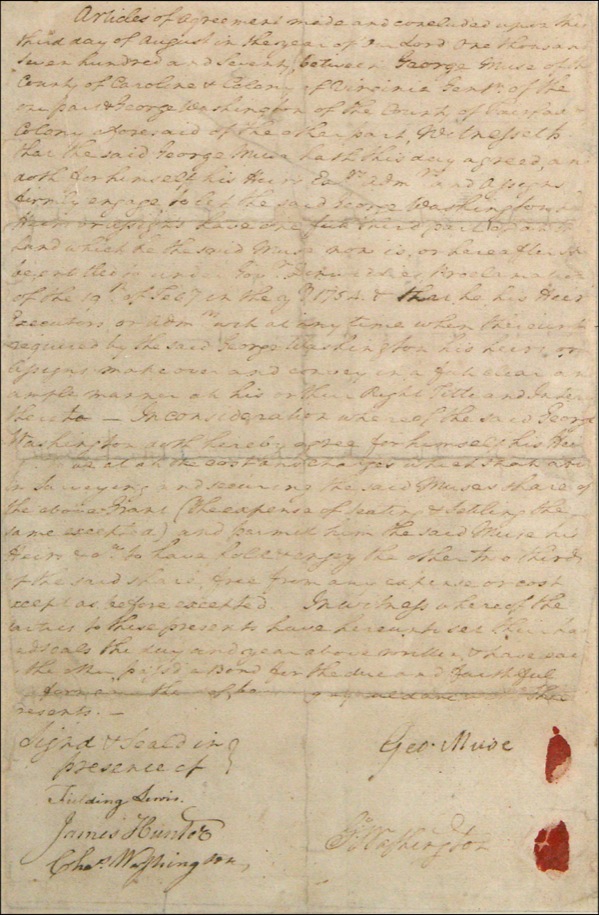
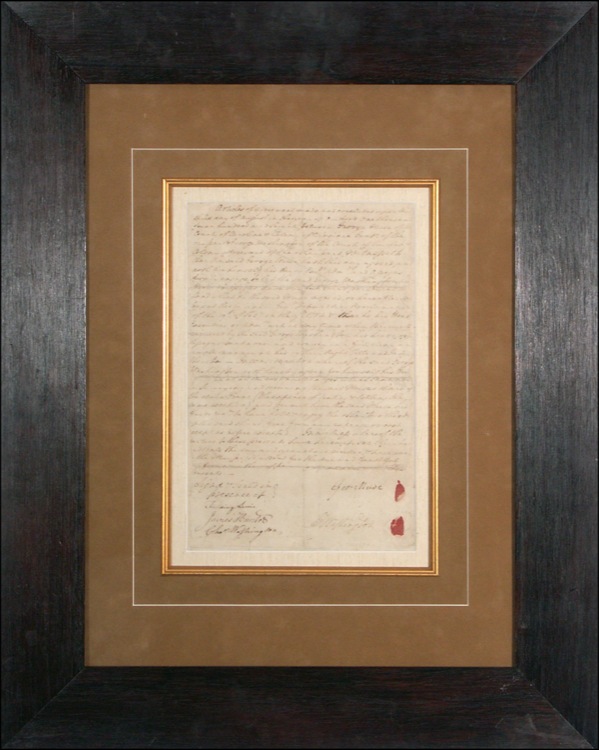
ADS, signed at the conclusion as “Go. Washington,” and containing four additional full signatures within the body of the document, one page, 8 x 12, August 3, 1770. An agreement whereby George Washington is promised one-third of the land due to George Muse for his service during the French and Indian War. This document, entirely in the hand of our first president, reads, in part: “Witnesseth that the said George Muse hath this day agreed, and doth of himself his Heirs Extra. Admris. and assigns firmly engage to let the said George Washington his Heirs or Assigns have one full third part of all the land which he the said Muse now is, or hereafter shall be entitled to under Govr. Dinwiddie’s proclamation of the 19th of Feby. in the year 1754…” This document is also signed by Charles Washington as witness, as well as George Muse, Fielding Lewis and James Hunter. The document bears red seals of both Washington and Muse. Attractively triple-matted in suede and linen and framed to an overall size of 30 x 30. Accompanied by a complete transcript of the document. A highly desirable piece. In very good condition, professionally reinforced and strengthened, with professionally repaired paper loss to edges and repairs to complete horizontal separations along folds, a small portion of first and last name of one in-text signature carefully and professionally restored to even legibility, scattered light soiling and toning. Governor Dinwiddie of Virginia issued a proclamation granting 200,000 acres of land on the Ohio River to be divided among the troops who fought in the French and Indian War. The claims of the officers and soldiers to these lands met with innumerable obstacles for many years, first from England, and then from the authorities in Virginia. On August 3, 1770, George Washington, in his own hand, executed this agreement with George Muse to try his best efforts in securing the land that they might be entitled to under Governor Dinwiddie’s proclamation. Muse was an officer in 1754 under Washington. He was, however, found guilty of cowardice at Fort Necessity and was discharged in disgrace. Knowing he had a questionable claim for land, Muse contracted with Washington to use his influence with the government to obtain the land grant. History books imply that Washington acted on Muse’s behalf with no thought of remuneration, but this original document in Washington’s hand indicates a different story. Washington wanted one-third of the land for his services. Washington would ultimately regret becoming entangled with the disreputable claimant, who he knew even before the French and Indian War. One month after the deed was recorded, he received a galling letter from Muse, apparently written while the latter was drunk, complaining about his share. Disgusted, Washington warned Muse that his claim did not “stand on so solid a basis as you may imagine…as your coming in for any, must less a full share may still be a disputed point…” In any case, Washington added, he regretted assisting “so ungrateful and dirty a fellow as you are.” (John C. Fitzpatrick, editor. The Writings of George Washington from the Original Manuscript Sources, 1745-1799). COA John Reznikoff/PSA/DNA and R&R COA.

